by Pat Lee
(Based on Mark 1:14-20)
We’ve all heard the verses of today’s gospel reading before, so the challenge for me was to find something that was different, but at the same time relevant to both the time for which it was written and for us today. I chose a paraphrase of verse twenty as the ‘sentence’, because it was the one that leapt out at me when I read it. This verse refers to James and John and it says he called them “and they followed.” It is similar to verse 18 which says, after Jesus had called Simon and Andrew to follow him and he would make them fish for people, ”And immediately they left their nets and followed him”. They are words of obedience and trust.
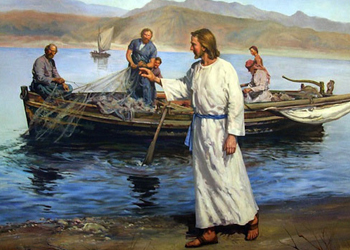
One of the writers I read while researching this suggested that these four men may have already met Jesus before this encounter beside the Sea of Galilee. Jesus had probably been in this area many times as Nazareth was within walking distance, but he had not aroused interest before, because his time ‘had not yet come’ for him to start his ministry. They would have seen him as an insignificant carpenter. A few verses in the middle of the first chapter of John’s gospel support this idea, at least for Andrew and Simon:
Andrew and another person had been listening to John the Baptist speaking when Jesus walked by and John exclaimed, ”Look – the Lamb of God!” They started to follow Jesus who asked them why they were following him. They answered, ”Where are you staying?” “Come and see,” Jesus said. “They saw where he was staying and stayed with him until about the tenth hour (or four o’clock).” Andrew then went off to find his brother Simon to tell him that they had found the Messiah. He took Simon to Jesus who looked at him and said, ”You are Simon son of John. You are to be called Cephas, translated as Peter.”
But this does not detract in any way from the significance of today’s gospel reading. As I said before, the verses in Mark speak of obedience and trust. As far as we know, they did not ask any questions, not a single one like, ”Hang on a minute. Where are we going? What are we going to do? How long will we be gone? What should we take with us?” They don’t ask any of these questions. They just get up and go. Notice that they don’t even bring in their nets. They leave everything, including James’s and John’s father, Zebedee. I wonder what he thought about it? They simply obeyed and trusted.
We all know the story of Jonah and how he ended up in the belly of a whale when he disobeyed God. But God gave him a second chance. Doesn’t God often give us a second chance too? He told Jonah to go to Nineveh and proclaim the message that God gave him. Jonah walked through the city of Nineveh for three days proclaiming that in forty days the city would be thrown over. But the people and the king heard his message and turned from their evil ways. Jonah had obeyed God and saved the city of Nineveh.
I was living in Masterton back in 1977 when Jesus called me. At that time I was a member of the Masterton Amateur Theatrical Society (MATS) and was their Wardrobe Mistress as well as a member of the cast. We had a huge wardrobe which was full of all sorts of costumes and period clothes. I hired out clothes for centenaries, fancy dress balls and other functions all over the country. It kept me pretty busy. I also had a husband and three young children, did relief teaching, as well as doing two papers at Massey extramurally, plus I belonged to various committees including the social committee for our society. But apart from my husband and family, Theatre was my main interest. I lived and breathed it you could say.
A few days after making my commitment to follow Jesus, I had an overpowering conviction to leave MATS. I had been totally devoted to it but I wrote my letter of resignation and gave it to my husband to give to the committee at the next meeting. He could not understand my action then, although he did later, but gave it to them. They were totally surprised as well, but what a relief it was for me. I was filled with that wonderful peace, the kind you feel when you obediently do what God asks you to, even though you may not want to. We don’t know, but I have often wondered if Simon, Andrew, James and John felt a similar peace when they obediently left their boats and followed Jesus. And, for those of you who know that I’m back in amateur theatre now, it is with a very different attitude and with the knowledge that I am, because it is not ruling my life any more and it only happened after praying about it first.
The call to follow Jesus and commit to him requires our obedience. Jesus calls us because we have a quality that he sees in us that helps to further his kingdom here on Earth. We are not called because we have some special gift or talent, although that may also be so, but because he sees what we are really like and can do. He calls ordinary people like you and me. Just look at the bunch of men he called first. They were nothing out of the ordinary either, just a bunch of fishermen, tax collectors and so on. But he saw the qualities that were needed for successful discipleship.
These first four men were fishermen. These are some of the qualities that those fishermen had:
- diligence. Fishermen are always busy doing something. God needs people who are not afraid to work.
- patience. It takes time to find a good school of fish, and it takes time and patience to win others to Christ.
- experience. Fishermen have an instinct for going to the right place and dropping their nets at the right time. Catching souls demands similar skills.
- perseverance. Fishermen have to go from place to place until fish are found. God wants people who won’t give up when things get tough. Fishermen have to work together, and God’s work demands co-operation.
- courage. Fishermen often face danger from storms and other mishaps. It takes courage to reach out of our comfort zone and touch lives in the name of Jesus.
- humility. A good fisherman keeps himself out of sight as much as possible. A good soul fisher keeps himself out of the picture as much as possible as well.
- faith. Fishermen cannot see the fish and are not sure their nets will enclose them. They have to have faith and trust in their fishing gear. Soul-fishing requires faith and alertness too, or we will fail.
Jesus’s call to the fishermen had two parts. The first part was, ”Come, follow me.” It is interesting to note here that Jesus asked them to follow him. The custom in Jesus’s day was that you went to ask a Rabbi if you could be his disciple, and then he either let you or he didn’t. If he let you become his disciple, then you didn’t follow him, but rather studied under him. However, Jesus was not asking them to study under him, but to actually follow him wherever he went and to learn from him. This was not a call to follow a religion or a set of teachings or a way of life, but a call to follow a person. It is still true today. Christianity is primarily about a person – the person of Jesus Christ. If you take Jesus away, you do not have Christianity.
The second part of the call has to do with the reason why Jesus calls us to follow him. He says, ”… and I will make you fish for people.” Jesus not only wants your loyalty and trust, but he wants to change you. He wants to make you into something you were not before. The call to follow Jesus includes the call to bring other people to God. Jesus came to seek and save the lost, and so if you are following him, you will join him in this important task.
If that’s the call, then what is our response to it? It is the same as the fishermen’s, immediate obedience and trust. This is how we should respond to Jesus. But we don’t always do this. More often than not we take a long time to make the decision, and wonder why we hadn’t done it sooner when we finally get there.
Simon and Andrew left their nets behind. James and John left their nets, they left their boat, they left their family business, and they even left their father in order to follow Jesus. Does Jesus always call us away from our possessions, our occupation or our family? No, but he does call us to follow him without reservation or hesitation, which means we must be willing to leave all those things behind should Jesus so require.
This passage of Jesus calling his disciples is a challenging passage to us this morning. It is meant to be. It is meant to challenge us with the message of God’s kingdom, with the call to discipleship, and your appropriate response. That’s the call. If you are not following Jesus, then who are you following?
Jesus said, ”Come, follow me. And I will make you fish for people.” Jesus calls you to follow him, and in following him you are to bring others along. God’s kingdom is meant to be shared. We need to be wise and looking for opportunities to lead people to him. Is Jesus making you a fisher of people; are you being obedient to his call?
Let us pray: Jesus, you call each of us to follow you. Give us the courage to be obedient to your call, and to trust you for all our needs as we travel on this journey. Help us to persevere and to be patient in the tough times, and not to be afraid to speak to others about you and your love for them. Amen


