Fiji Relief

We are accepting donations to assist the relief efforts in Fiji after the recent cyclone. With crops and trees destroyed there’s a long term food need as well as reconstruction of their housing. 

Please give generously, all donations will be sent on to the Anglican Missions Board who are already part of the relief work partnering with the Australian Anglican missions and Tearfund in Vanua Levu and Taveuni .

The best way to make your donation is by Internet banking into the St Francis account 

Tairua Anglican Church       03 1577 0435222 00 

Please put your name and/or your giving number, plus ‘Fiji’ in the Reference box. 

If cash is your best way, please include the same details on an envelope and bring to church or give to Albie Marr.

We give thanks for all who are working to restore the living conditions and bring hope to our sisters and brothers in the Pacific after this destructive weather event.

Christmas Diminished

Christmas spirit!

But when the set time had fully come, God sent his Son, born of a woman … (Gal 4:4).

What can be the Christian stance on Christmas?

The mystery of Christmas and the dead centre focus of the Christmas celebration is that God became human.  Not just human, but a baby human.  God – creator of the universe (and by extension, bigger than the universe) – consented to becoming so small that he fit in a hay trough – a manger.  Let that sink in for a moment …

Not just fancy or fairy tale, this is spelled out in John 1 and explicated conceptually in multiple other Scriptural passages.  Eg, “For surely it is not angels [Jesus] helps, but [humans]. For this reason he had to be made like them, fully human in every way, in order that …” (Heb 2:16, 17)

“In order that …”  There isn’t space here to complete the purpose of why He came, a new-born, but it behoves us all to find out why.

But, grasp the weight of this, and compare it to our western Christmas counterfeit.  Rudolph, Frosty, tinsel and baubles, frenzied spending and eating, and an over-fed, Coca Cola-invented man (only in the 1930s) whose name is an anagram of Satan.  The contrast could not be starker.

Christmas spirit!

Actually, I could embrace most of that if Christ was accommodated at the centre of the Mass.  The celebrations would be worth it, and far more.  But our culture has gutted the feast.  It’s become an illusion, designed, I say, designed, to deceive people who need to per-ceive.  Is it possible to over-state this?  Driven by shameless marketing and media, we strive to capture “the season” with cards and sleigh bells and Santa hats and boxes of liquor.  What can we do?

I say, find small and simple ways both to avoid the offal, and spread the spirit.  Try to find creative ways to share the true love and the peace-and-goodwill, whilst side-stepping the media version of Christmas spirit. 

Bruce is visiting the pub to share on Christmas Eve.  I’m baking today, something to share around the neighbourhood.

Ken F

Mary Hears from God

by Liz Young

(Based on Luke 1:26-56)

Today’s gospel reading is the message from God to Mary, given by the angel Gabriel. Gabriel tells Mary that she will get pregnant and give birth to the Son of God! She wonders, how?, as she is a virgin: and she is troubled: but her next emotional reaction is humility. She is humbled by the honour bestowed on her by God, and then full of joy. Not all unmarried mothers feel joy when they discover they are pregnant, so let us remember Mary, if this situation arises within our own families.

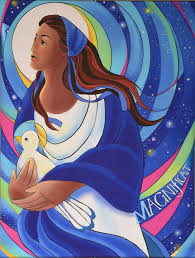
In the Magnificat, Mary’s song of joy, she praises God and describes how great He is, and how bountiful His Grace. She sings of God asking the lowly to fulfil His plans, which reminds us that we too can help him fulfil his ideas for the world.


Mary echoes the words used by Hannah (1 Samuel 1), as she rejoiced when she found she was pregnant with Samuel. In many cultures a woman must prove her fertility before she is acceptable for marriage, a different concept from our own. Today women can control their fertility pharmaceutically when they don’t want to get pregnant; while young men have to worry about their dropping sperm counts, and many couples take more than the expected four months before they get pregnant: use your reflection time to think of, and pray for those childless couples that you know. Some of them have adopted Russian babies and may be unhappy if that child has foetal alcohol syndrome. On the other hand, there are many single mothers who are struggling to look after a child they hadn’t planned to have: conceived when they were disinhibited by alcohol.

So let us enjoy the Advent story of two holy women (Mary and her cousin, Elizabeth) rejoicing in their pregnancies. Times were hard, Mary and Joseph had to make their way to Bethlehem. I tried to imagine riding 100km on a donkey at term, but came across Robert Louis Stevenson’s description of travelling with a donkey in France. You travel behind a donkey with a stick at the donkey’s pace, usually slower than walking. Mary had travelled first 180 km to see her elderly cousin, Elizabeth, who lived in the hill country near Jerusalem and who had had a son, John the Baptist: John’s birth had been foreseen in a vision by his father, Zechariah.
Mary then travelled with Joseph from Nazareth to Bethlehem, this time knowing that her baby was to be called, Jesus, ‘the Son of the Most High God’. Beth-lehem, the House of Bread, is a little town built on a spur of rock with deep valleys to the north-east and south:  this year, Covid year, the people there are suffering from the loss of income from the tourist trade. Nowadays we can get there by train but we can picture Mary coping with the dusty hilly roads as she walked there, then.

We will be reflecting on this story with millions of other Christians all over the world. Some, like us, living in peaceful countries, where we can trust our leaders; others in danger because their beliefs threaten the leaders, or extremists, in their countries. In other places like Fiji, 16,000 people are homeless from a cyclone. Let us pray for them, and respond to their need and, while being grateful that we live in peace and prosperity, there are those who still need some of the basic requirements for living. Perhaps we should search harder for ways we can encourage the growth of social justice in our country. Here in Tairua we could think of encouraging the local building of affordable social housing for the elderly.

To return to Mary’s combination of humility and joy, I have two books that I cherish, one given to my grandfather, The Practice of the Presence of God: the letters and conversations of Brother Lawrence, a 16th century Carmelite kitchen lay-brother, a humble man always prepared to speak of his beliefs with others. The other book describes the visions of Dame Julian of Norwich, an English visionary who was educated by Benedictine nuns. She meditated for 20 years on her visions, while living in a small cell attached to a church in Norwich. Her words still resonate today: “Wouldst thou know the Lord’s meaning in this thing? Know it well. Love was His meaning.”
Both were visited by the powerful and mighty of their time, because of the joy that they radiated and shared. Let us pray that our lives radiate such joy that we offer peace and happiness to those around us at this time: the joy that comes from knowing that Christ was born to redeem us.  Amen    

True Inspiration Requires Right Action

by Bruce Gilberd

(Based on Isaiah 61:1-4, 8-11 and Psalm 126)

“Rejoice in the Lord always, and again I say rejoice.”  Yes to that!
This morning I put it to you that lasting deep joy arises from God’s inspiration, and our resulting action – both!
We are not only to be hearers of the word and the inspiration of God’s Spirit, but doers of his will in the marketplace and the world – and I note that Isaiah emphasises justice – doing as a key outcome of being inspired.
Joan has most helpfully been reminding us of this recently – that whenever God intervenes and inspires, action is required, and happens.  In Israel’s history: Moses leads Israel out of Egypt; Solomon builds the first Temple; Ezekiel predicts the return from Babylon to Jerusalem; and so on …. To John the Baptist’s brief ministry to pave the way for Jesus’s pivotal work for all humanity.
Throughout the first century, covered by the New Testament, time and again inspiration requires and leads to action, and it is so down the centuries and today.
Today, in Isaiah and the psalm readings, we see inspiration leading to restoration – of persons, cities, the nation – and the great joy of that!  I am sure you picked up the meaning and relevance of the first verse of Isaiah 61:

“The Spirit of the Lord is upon me.”

And what follows – action!

  • Good news to the oppressed
  • Binding up the broken hearted
  • Liberty to the captives

and so on.

And, it is this very text Jesus chose to read centuries later to preface his first sermon in his home synagogue in Nazareth (Luke 4:18-19), and what a stir that caused!

True Inspiration leads to Right Action!

When John the Baptist’s disciples come to Jesus to ask if he is the Messiah – what does Jesus say?  There is no theological discussion.  He points out what he is doing.  The inspired Divine Man, Jesus, points to the inspired, life-giving action that was happening.  (Matthew 11:2-6)

Last Saturday and Sunday were God-inspired events – and now a vibrant part of St Francis Church history.  So now we, newly inspired, seek to act, rightly, deeply, convincingly, in our village and wider spheres of influence.  Some of this action will be personal, some with others.  It will involve:

  • Prayer – seeking the Lord’s guidance
  • Giving – self, time, energy – and
  • Action – on one or several fronts

It will not involve a self-centredness – the Holy Spirit is given to disciples – yes, and corporately to the Church, not so we can have an individual high (we may!) but to empower us to act – to do God’s work and will, God’s way, in the marketplace and God’s world.
Some of you will recall the old word “Comforter” was used to describe the work of the Holy Spirit.  Have some of you seen the Bayeux Tapestry portraying Norman William’s conquest of England in 1066?  William is prodding his sword into the buttocks of the soldiers in front, and the caption is “King William comforteth his troops”.

The Holy Spirit comforts us!  That is, prods and stirs us to action!
So, when the Spirit comes upon us, to empower, to disturb, to guide, to require truth and costly love in our living – we then need to get specific … as to how, like King William’s soldiers to put our hearts and minds and bodies on the line … Now what?

Option 1:  We may look to the world wide Anglican Church’s Mission Statement, to see what we are led to do:

  • Share the Good News with a friend?
  • Encourage children and others we know to be baptised?
  • Learn and share more about our faith?
  • Offer accurate listening to someone we know is hurting?
  • Challenge local Councils, or the Government, on issues that need addressing and that address us?  Call for justice?
  • Act responsibly with our household waste, plant trees, be discerning buyers?

Option 2:  Or/And … there are these outstanding Aotearoa issues (so, pray, give act …):

  • Good housing for low income families
  • Putting church investments into housing and social services
  • Reducing child poverty for 300,000 children
  • Enhance gender and ethnic and interfaith respect
  • Speak up when a line is crossed
  • Resist technological takeover of our attention.

The Spirit is given to Jesus’s disciples in order that we may act, joyfully and effectively, in some way or ways towards justice and peace in our village, our world.  If it all seems too much, pick one action today and do remember Michel Quoist’s remark:

So, how might I sum up my message to you today?  With this prayer: Come, Holy Spirit.  Initiate and guide all our actions!