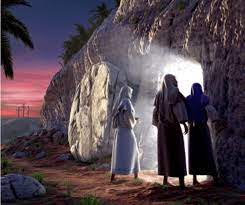
Sunday’s a-Comin’

by Sharon Marr

(Based on Mark 1:9-13, Gen 8:15-22)

Well, my dear family, today is the first Sunday in Lent but you will be forgiven for thinking, “Ground hog day” – You’re right!  This was the reading for the second Sunday in Advent, repeated with a couple of additional  verses in early January and again today we find ourselves, just like in a knitting pattern, dropping a couple of verses and then adding a couple to the same very short passage in Mark.

However, in all good stories it is what happens next that matters. Mark, using one of his favourite words, says immediately the Spirit drove Jesus out into the wilderness.  “He was in the wilderness forty days, tempted by Satan; and he was with the wild beasts; and the angels waited on him …..”

Mark, the man of few words, says little about the temptations of the wilderness themselves, which creates an interesting opportunity for us to reflect on them as we ponder on our own personal wilderness experiences.
Where, during these times, do we find Satan most plausible in our lives?  We do have an extraordinary capacity for rationalizing our decisions as being sensible and unselfish. Godly even.   But are they really?
What can we say about our wild beasts?  The things we fear, both spoken and the ones we suppress and choose not to face: what do these look like when seen in the light of the gospel.

What do your angels look like?  Do you recognize them when they show up in all their sweet and secret guises?  When they minister to you, hold you, brace you, do you hear a new version of God’s voice, calling you “beloved”.  Our much-loved Chris Ison said this of angels: “For myself, I would suggest they are here in this place, in this community of faith.  Angels remind us of the way in which the will of God is done in heaven; by praising him.  It is when we are cast down and feel least able to give thanks that the membership of this faith community carries us, or at least it carried me, forward.”
Wonderfully generous words to us from a man who surely experienced deep wilderness periods. 

At his baptism, Jesus had heard the absolute truth about who he was.  God’s beloved Son.  That was the easy part.  The much harder part now comes in the desert wilderness, when he has to face down every vicious, mocking assault on that truth.  As the memory of God’s voice fades, and the isolation of the wilderness plays tricks on Jesus’s heart and mind, he has to learn that his belovedness will still hold.  That God’s deep and unconditional delight will never depend on external circumstances.

We too don’t choose to enter the wilderness.  We don’t volunteer for pain, loss, danger or terror.  But the wilderness happens anyway.  Whether it comes to us in the form of a devastating pandemic, a frightening hospital stay, a broken relationship, a hurting child, or a loss of faith, the wilderness appears, unbidden and unwelcome, at our doorsteps.  And sometimes it is God’s own Spirit who drives us there. Sometimes, like Jesus, we may need long stints in the wilderness to learn what it really means to be God’s children.  Does this mean that God wills bad things to happen to us?  That God wants us to suffer?  No.  Does it mean that God is ready to teach, shape and redeem us even during the most barren periods of our lives?  Yes.
In the startling economy of God, even a dangerous desert can become holy.  Even our wilderness wanderings can reveal the divine.  This is not because God takes pleasure in our pain, but because we live in a chaotic, fragile and broken world that includes deserts, and because God’s way is to take the things of shadow and death, and wring from them resurrection.  It is only by going through the wilderness of Lent we have the joy of Easter.

In the Old Testament reading we hear the story of Noah and his family also being taken aside by God for a period of time of testing, a time for them in the wilderness, albeit a stormy wet sojourn rather than the desert experience of Jesus.  Like Jesus they return restored, renewed and repurposed to a world that had lost its way because now the family have God’s covenant, His promise of inherent relationship.    

The world remains a scary place, prone to violence and disorder.  It is a world of wild beasts, literal and metaphorical.  The problems haven’t changed but the family has.  They have the promise of God’s enduring relationship; He will never leave them. They are His beloved children.

God did not leave Jesus in the desert, any more than he left Noah in the ark. Just as the Spirit drove Jesus into the wilderness, the Spirit also led him into his ministry in Galilee. Sometimes that same Spirit pushes us into the wilderness where we can learn to depend on God’s provision and we can learn to face our trials by depending on God’s strength, not our own, and then we can perhaps join with Christ in proclaiming to all the good news that the kingdom of God is here.

The amazing African-American preacher S. M. Lockridge  preached these wonderful words and  I think they fit so well as we dwell today on wilderness times.

I know it’s Friday.  But, thanks be to God, Sunday’s coming!

It’s Friday. Jesus is praying. Peter’s a sleeping. Judas is betraying. ……But Sunday’s comin’. 
It’s Friday.  Pilate’s struggling.  The council is conspiring. The crowd is vilifying. They don’t even know ….. That Sunday’s comin’.
It’s Friday. The disciples are running like sheep without a shepherd. Mary’s crying. Peter is denying. But they don’t know …… That Sunday’s a comin’.
It’s Friday.  The Romans beat my Jesus.  They robe him in scarlet.  They crown him with thorns.  But they don’t know …… That Sunday’s comin’.
It’s Friday. See Jesus walking to Calvary.  His blood dripping.  His body stumbling.  And his spirit’s burdened.  But you see, it’s only Friday ….. Sunday’s comin’.
It’s Friday. The world’s winning. People are sinning and evil’s grinning.   

It’s Friday. The soldiers nail my Saviour to the cross. And then they raise him up next to criminals.  It’s Friday.  But let me tell you something … Sunday’s comin’.
It’s Friday.  The disciples are questioning.  What has happened to their King.  And the Pharisees are celebrating that their scheming has been achieved. But they don’t know, it’s only Friday.  …… Sunday’s comin’.
It’s Friday.  He’s hanging on the cross.  Feeling forsaken by his Father.  Left alone and dying. Can nobody save him?  Ooooh … It’s Friday …… But Sunday’s comin’.
It’s Friday. The earth trembles.  The sky grows dark.  My King yields his spirit.  It’s Friday.
Hope is lost.  Death has won. Sin has conquered. And Satan’s just a laughin’.

It’s Friday. Jesus is buried. A soldier stands guard. And a rock is rolled into place.  But it’s Friday. It is only Friday … Sunday is a comin’!

Dear family, regardless of what today brings, regardless of today’s problems, challenges or defeats, may we enter with courage the deserts we can’t choose or avoid.  May our long stints amidst the wild beasts teach us who we really are — the precious and beloved children of God.  And when we strain to hear the angels …. in all their sweet and secret guises …. whisper the name “beloved” into our ears, may we listen, and believe them … because, remember …. it’s only Friday …. but Sunday’s a-coming!  Amen.

Tribalism – the Common Cause?

Read a moving example of reconciliation and unity during the week past.  Stuff (the news outlet) has been telling stories from the Christchurch earthquake, ten years ago.  On that day, two men were rebuilding St Paul’s church, which had collapsed in the earthquake of some months before.  As soon as this second one was over they came out to view the devastation, and immediately ran across the road to the CTV building, which had pancaked, to see how they could help.

Their story from that day is compelling reading, but one incident stands out to me.  At one point one of them, a man called Nosa, was working on top of a pile of rubble, tearing rocks of concrete out and hurling them down the slope.  He remembers being terrified standing on the rubble, as the adjacent lift shaft swayed with every aftershock, “and one was hitting every minute”, says the article.

Mr Nosa found himself working alongside a man with a “Nazi tattoo” on the side of his head. “It was an unlikely alliance that remains memorable for Nosa, who is of Pacific Island descent,” the article relates.
“He was a skinhead, and he was right standing next to me pulling people out.  He shook my hand after, so I felt that we put our differences aside [and] just put human lives first.”

Poignant.  And it triggers in me the ubiquity of tribalism.  My tribe is better than yours!
I’ve noticed this in many contexts over the years.  From the wars in Europe to the killing fields of Cambodia to the genocide in Rwanda, to … many other examples great and small.  I even notice it in sports crowds, where we Kiwis lambaste the Aussies (and they us), or where we Chiefs supporters disparage the Crusaders.  There’s something in us that loves to elevate ourselves at the expense of others; that we are the best there is, come anybody. When there is no hard evidence to that effect at all.  Why would I want to die for the Chiefs, just because I live there, against the Crusaders, who are at least my equal in every sphere?  It’s a strange conceit.

A strange conceit, to be sure, and it leads, I think, to criticism, racism, (all the other “isms”), intolerance, arrogance, judgementalism, injustice, conflict and war.  Historians sift through wars, trying to establish causes, even trying to learn from them.  I say, take any agreed cause, divide it like an avocado, and there in the centre will be the hard stone of tribalism.

Nosa and the skinhead showed that tribal differences can be laid aside in common human cause and, just that easily, tribalism can be rendered meaningless.  My tribe is actually no better than yours at all.  Peace, friend.

Ken F

Not Just a Martian Satellite

Did you notice, the UAE has just set a satellite in orbit around Mars!  The satellite’s name is Hope.

A reasonable name for a deep space explorer, surely; because Hope is so much more, and a deep human driver.

Hope lifts one’s view from hints of despair.  Holocaust survivor Victor Frankl wrote that Jewish inmates of concentration camps who retained hope stood a far better chance of survival than those who didn’t.  Hope drives the student in an important exam; Hope sustains the frail patient going into a risky operation, and the woman undergoing yet another in vitro treatment; Hope attends the sailor making her way in fog; forlorn Hope drove the rebels in Les Miserables, and Hope hoists all other uprisings; Hope makes a man stand up again, who has fallen down many times.

Hope is the subject of a well known painting by GF Watts, in which Hope is shown as a blindfolded woman with a harp, on which all the strings are broken except one, and she is listening intently, longingly for its music.  See https://en.wikipedia.org/wiki/Hope_(painting).  Some critics suggested it showed Despair more than Hope, but Hope is the conqueror of Despair, and Watts explained, “Hope need not mean expectancy. It suggests here rather the music which can come from the remaining chord.”
Others, viewing the painting negatively, thought it showed the futility of Hope without accompanying Faith.  PT Forsyth, a Scottish theologian, wrote that the image illustrated that “a loss of faith places too great a burden on hope alone”.
He may be right.  What do you think?

Hope is more than expectation.  It is an apparently irrational song issuing from the depths of a forlorn heart, and it says, “Keep going”; without succumbing to that which opposes or portends.

Hope is the heart of the Prodigal Father, watching the horizon for signs of his son’s return. (Luke 15:20)

CS Lewis defined Christian Hope as the “continual looking forward to the eternal world”.

The Bible says “we have this hope as an anchor for the soul, firm and secure. It enters the inner sanctuary behind the curtain”, and, “let us hold unswervingly to the hope we profess, for he who promised is faithful.”  (Both from the book of Hebrews.)

What kind of Hope do you have, reader?

Ken F

‘Costly Love’ is his name

by Bruce Gilberd

(Based on Mark 1:29-39, I Cor 9:16-23, and Isa 40:21-31)

I will attempt to address three questions this morning.

  1. What kind of God is God?
  2. What kind of God is my God?
  3. What kind of God is your God?

A student training for the ordained ministry went to see his tutor in theology.
“I can’t go on,” the student said.  “I don’t believe in God any more.”
“Tell me,” said the tutor, “about the God you don’t believe in.”
The student explained his current understanding of God – who he thought God is and what he is like.
“Well,” said his tutor, “I don’t believe in that kind of God either.”

In a moment I will invite you to silently consider what noun, verb, adjective best describes how you experience God at present.  The possibilities are limitless, and can change over a lifetime.  What name or description of God is most meaningful to you today, from your own experience of the Divine, and your reflections, and from your journey of faith?

Who is God to you?

[Silence … 20 secs …]

So, are some of us willing to share our key understandings of the Divine at this time?

[Sharing …]

Today’s readings abound in images, descriptions and names for God:

Isaiah:


Psalm:


Corinthians:
Mark:

the creative
majestic
empowerer
the gracious
healing
Creator
[God is beyond us, yet intimate]
the sender
the compassionate one
healer
and empowerer (through prayer)
purposeful (Jesus ‘must go on to another town’)

All this shows us that whatever our deepest understanding of God is, we can always go still deeper, and go still wider – there is always more of God to experience, receive, name, and share with others …

This raises the question of spiritual growth, of quest, of journey – ever deepening quest into God and into life; and, harvesting meanings from all our day to day experiences, both the seemingly trivial and also the significant experiences and turning points of our lives.

In the twentieth century there was a rather eccentric yet deeply insightful Anglican Bishop of California – James Pike.  He wrote a very important book [Doing the Truth] in which he made these two points.  The first is that thankfulness is the core trigger for all ethical living – and he stresses truth and costly love as essential for personal holiness and community well-being.
The second is even more relevant to our theme this morning:

  1. what we value most,
  2. to whom or what are we most attached,
  3. what we long for most, and
  4. what we would miss most if taken from us …

that is, in fact, our God!  (Whatever else we may say!)
This is quite alarming really!

  • when we are told our health is the most important
  • or even family
  • or things
  • or lifestyle, and so on …
    NO! They are not.  They can, in fact, become idols.
    A dynamic and developing relationship with the living God is to be top loyalty – then, everything else falls into its right place.  Strange that!

So, God is the one we are to love with all our heart, and mind and soul and strength … and our neighbour as ourselves.
Why?  Because he has first loved us.  That is who God is and what God does – today, in this church, and in this village.

For me, Costly love is his name; Costly love is what he does; Costly love is our calling!
Amen.