For every medal celebrated there are dozens who didn’t make the podium. If the medallists were winners, were the others losers? The obvious, if superficial, response is, “Of course not.” Many have overcome great challenges and deterrents just to be there, and are therefore winners in their own right. In fact, before the question is answered, the definition of winning (and losing) needs to be spelled out. What is winning? It’s by no means standard, even at the Olympics: some win by being first across the line or to the end of the pool. For other sports, you need to hammer the other guy, or bullseye the arrow, or dance your horse the best, or be the best kickflipper, or maximise air time and minimise horizontal travel (as in the trampoline)! Et cetera. Golds come in all sorts of packages.
One commentator made a telling comment (although was probably just trying to mitigate disappointment at a poor result) by saying, “You actually learn a lot more from failing than you can by succeeding.” Which is probably true, but no real consolation for the loser.
An aphorism of my dad was influential in my thinking (and so I used it often on my own kids): “It’s far better to have played and lost, than not to have played at all.” Very true. And my old school motto was Per Angusta, ad Augusta. Google Translate it.
Perseverance against the odds surely counts. Emma Twigg deserves a shout. She came ninth in her first Olympics, fourth in the next two, and, deciding she’d reached her Everest, retired. But she reconsidered. Reckoned she had more to give. So started training again in 2018 and, at 34 years of age, has just won gold at Tokyo.
Photo by Outsports
Through the years, much has been written about winning and losing. And persevering against the odds. But here’s a fictional story that has always inspired me. Put it into your own context, and be inspired.
True winning performances are seldom rewarded, or even recognised as such. But you know when you’ve done one. And God knows. Winning is really about overcoming. And you just never know who else might be watching.
(Based on John 6:24-35, 2 Sam 11:26 – 12:13, Ephesians 4:1-16)
Here we have a crowd of people living a simple and hard life in a tiered and harsh society; a crowd who is following this man Jesus – this carpenter from Nazareth. They are so excited because they have seen him make sick people well. They say he walked on water and he calmed a storm. What will he do next? He is worth following!
Let’s look at what has happened in this sequence of events leading up to this reading from the gospel. Jesus had miraculously fed the crowd who had followed him, more than five thousand hungry people on a hillside near the Sea of Galilee, at Bethsaida. They wanted to see more; it was exciting and if he was going to fill their bellies and do great and exciting things for them then why not make the most of this opportunity. There was even talk of making Jesus an earthly king! – the sort of king he would never agree to being.
Meanwhile Jesus had disappeared up into the mountains. Even his disciples couldn’t find him. After waiting by the shore until darkness for Jesus to come back, the disciples eventually got into their boat without him to go across the Sea of Galilee, to Capernaum. Then a terrible storm blew up and they were fearful for their lives. Jesus came to them walking over the water and calmed the storm, and they were immediately there at Capernaum.
The next morning the crowd set out to find Jesus, who had disappeared, and went across to Capernaum to look for him. When they found him they said in wonder, “How did he get here?”
All through this time, the crowd’s preoccupation with the benefits of immediate, short lived solutions has diverted them from seeing what really matters. We can understand this. It mirrors what happens here in our world today: – so much endless pursuit for the reward that immediate satisfaction gives, – but a reward which has no ultimate lasting significance.
At the same time it completely overlooks the life being offered by the ‘Son of Man’.
When the crowd picks up on this, they ask, “What must we do to perform the works of God?”
They have understood enough to ask for more information.
So, how to get beyond the temporal solutions to open the way to the eternal offer? The answer comes, “that they must believe in the one God has sent”. They must have faith in what he says and in what he shows himself to be. That is the work God wants of them – Belief. Jesus says, “The truth of the matter is you want me because I fed you, not because you believe in me!” He is telling them they are making a profound mistake, and he is bringing to them a new way of thinking and of being: to realise that life is more than eating!
And it is here we come close to the heart of the message of John’s gospel. This chapter is to be understood on two levels. Jesus’s miracles are extraordinary deeds that rectify the situations of needy people – the sick, the hungry, the dying. But the results are not lasting unless the miracles are seen as signs pointing to the eternal gift of God in his son, Jesus Christ. People in the crowd ask, “What do we need to do? And the answer is, “Belief is what matters, not works!” Trust in the one God has sent. Have faith in what he says and what he shows himself to be.
[Examples of this imperative: John 3:14-18, 36; 4:39-42; 5:24, 38, 44-47]
Of course, this is not as simple as it sounds. Even the disciples find it difficult. [6:60-69] But Jesus speaks of it as the “work of God”, meaning not only what God desires but also what God gives. The miracle that really matters is the miracle of faith, when God breaks through the misconceptions we have held about life, our pursuit of unsatisfying answers, our self-centred worlds, to reveal the radical new age embodied in and taught by Jesus.
A third question comes. The crowds compare ‘the feeding’ to the manna their ancestors ate in the wilderness, which came daily, quoting, “Moses gave them bread from heaven to eat.” Jesus replied that the giver is not Moses but “my Father”. And we note the present tense of the verb: God gives freely, now and forever, and without limit. The crowds are still confused until Jesus reveals that he is the “Bread of Life”. The true bread is not manna from heaven but Jesus himself.
This statement of course upsets the Jews. And this underlines the difficulties of ‘faith’: the intellectual, cultural and religious barriers that stand in the way of believing, both then, and through to and including our day here and now. And it is here we do well to remember that these difficulties are overcome by God’s grace – gifted to us by the Work of God, which makes our faith possible (v29).
When we look at today’s world we see that so much remains the same, has done throughout the ages. David, in the today’s Samuel reading, makes huge ghastly mistakes as he lives life selfishly. Then in Psalm 51 he repents, asks for and receives mercy and turns to live under God’s guidance.
In the Ephesians reading Paul gives guidelines to the church on how to live in unity; guidelines which apply as well to the church of today, being the fellowship of believers, ideally a family of one body with different gifts, working together for the good of all.
And for us, here today, in this time and place? I would say we work together with a belief and trust in Jesus Christ, the Bread of Life, whom God has sent us. We step out in his name, within the community, to give help and comfort and service to others. However I would say, too, that we who live in our little bubble of life here in Tairua are not stretched, we never go without, we are never deprived of the necessities of life in our giving. I wonder how people outside of our church see us?
Look around you, you who are here today. Take a deeper look. I wonder how you who are part of our church see us? Do you feel supported within our church family? If not, I think we need to know.
To finish, let me re-iterate. The true bread is not manna from heaven but Jesus himself, who said “I am the Bread of Life”.
I invite you to cast your mind back to your childhood, or adolescence, even your early adult years. Were there hints of what you would do for a living? What you would aim for? Your vocation? And, were there the beginnings of the path of faith? James and John – who feature in today’s Gospel reading – faced both these questions. Perhaps it was a foregone conclusion they would join their father Zebedee’s fishing business. And they seem to have been young men of Jewish faith.
Then, while they are working, along comes Jesus … as he still does! “Follow me,” is the call, and that is what we are to do, to follow, even before we believe, and come to know how significant Jesus is. We are to hear and to follow! And all of us are called. Further, there is an art in being an increasingly committed disciple as we fulfil our daily work and societal obligations.
Some of you will be aware of Maslow’s ‘hierarchy of needs’ – how we move up from the need for food and a roof over our heads, to social relations, to meaningful work and living … right up to “self-actualisation” – fulfilling all of our potential … But Maslow stopped too soon. What about a further step up, to a spiritual maturity that leads to living for others? Placing all our lives at God’s disposal (as Jesus did).
When Jesus called the fishermen brothers James and John while they were in their boat, perhaps mending their nets, they followed him. What a tumultuous three years they had! James and John, along with fellow fisherman Peter, formed an inner threesome – often with Jesus at pivotal moments. They were there for
the raising of Jairus’s daughter;
the transfiguration;
in the Garden of Gethsemane (asleep!); and
beside the lake, post-resurrection.
Yet James and John – later in the early church significant leaders – still, in those three years with Jesus, often missed the main point: you are called to serve and live for others (Maslow’s omitted top step). Not status; but humility.
They wanted to call down fire on the Samaritan village that declined to receive them (status ignored?);
and, notably in today’s Gospel episode, status sought!
Here we have, in Matthew 20, James and John’s mother, as the dark clouds of the last days and the cross gather, asking for privileged positions for her two sons in Jesus’s kingdom. She – and they – want power, prestige and position. I know mothers can have great hopes for their sons, but what was she thinking? [Mark records the same incident, but has John and James themselves asking for this privilege.]
Hadn’t they been listening the last three years?
What about laying down your life for others?
What about becoming as a child?
What about taking lower seats at dinner?
What about serving others and going the third mile?
What about humility?
What about really listening and really seeing what Jesus was really on about?
What about the sermon on the Mount?
No. Personal and misplaced ambition triggered this self-serving request to be beside Jesus at the top table.
Our call – still – is to follow, believe, and live for others – love is the test of our obedience. We may be retired from a working life, but we don’t retire from discipleship as we engage in the life of the village here, and life beyond it – and amongst family, friends and acquaintances.
And we continue to offer our lives, not for what we might get out of it (top table) but in glad obedience to Christ’s call
to follow
to believe
to love – live for others
Growing into fully alive Christ-centred human beings. Not misplaced ambition, but the greatness of humble living for others: costly discipleship.
(Based on Mark 6:30-34 and 53-56, Ps 23, Eph 2:11-22)
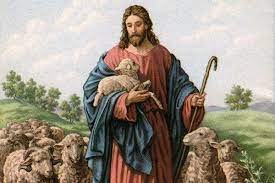
I’ll be reflecting on these verses from Mark, which seem at first to be all about healing and miracles … which is daunting! But looking at the supporting Scriptures – the psalm and the Epistle readings – and at the Mark passage again, it’s also about shepherding – especially Jesus accepting his role as a shepherd.
Let’s consider the Psalm first – Psalm 23 … so well known to us, and sometimes known as the Shepherd’s Psalm. “The Lord is my shepherd”! Is he your shepherd? Probably most of us can claim and own the opening line: “The Lord is my shepherd”!
I started preparing this at the same time as I was putting together that PowerPoint for Bruce’s seminar on Bonhoeffer last week, and I was looking at footage of Adolf Hitler’s speeches at the same time as I was thinking of the Lord being my shepherd, and it struck me, you couldn’t get a greater contrast between Hitler as a leader and Jesus. Hitler, in all his frenzy and mania and bankrupt views, and … “The Lord is my shepherd. I shall not want. He maketh me to lie down in green pastures: he leadeth me beside the still waters. He restoreth my soul: he leadeth me in the paths of righteousness. ….” Until we read, “My cup runneth over. Surely goodness and mercy shall follow me …”
Thank you, Jesus, for being our shepherd, and all that goes with that.Amen?
So, then we read in Mark about Jesus being a shepherd to his people. (“He had compassion on them, because they were like sheep without a shepherd.”) But not quite an enthusiastic one, it seems! He was hounded by demanding crowds, with barely time to recover, regain his strength, regain that power that left him when he healed.
When I was given this Gospel reading as my text I thought I was going to have to commentate on the feeding of the five thousand. But, no, did you notice? The reading skips that event. And focusses on the before and after, which is really cool. The entrée and the after dinner mints. Earlier in the Gospel – in Chapter 5, actually – we’ve seen Jesus heal a woman who touched his hem, raise Jairus’s daughter from death. And he was turning people’s laughter and scorn to astonishment and awe. And celebrity. Now, in Chapter 6 the crowds are pursuing him. [Except in Nazareth! Where he was “without honour”.] The twelve have been sent out, and “they … drove out many demons and anointed many sick people with oil and healed them.” Jesus has been sharing out his power with them, the disciples, as perhaps a good shepherd and leader should do.
Incidentally, I’m not going to say much about the Ephesians reading, but its thrust is that we Gentiles have also become part of the shepherd’s flock – part of his household, it says, in which he is the cornerstone.
But let me focus on the Markian piece. The disciples gather around Jesus, their shepherd, from their field trip, no doubt excited and flushed with their recent successes. Jesus is delighted for them and says, let’s slip away, and debrief. But they can’t get away from the crowds, who … Jesus and the disciples slipped away by boat, but the crowd raced around the shore and were waiting for them when they landed. I’m trying to imagine what the clamour must have been like. The Pied Piper of Hamlin comes to mind – the crowds are scampering after Jesus, the celebrity – in fact, like children after Mr Whippy. Or like those huge crowds that gathered when the Beatles came to Wellington in 1964!
The NZ History’s website says, “Seven thousand screaming fans waited as the band touched down … [on the Gallilean shore?] A team of 30 police officers, some in plain clothes, was on hand. One officer later said that: ‘We underestimated the whole thing badly. The crowd was so big we had to … keep all the people behind a wire fence. At one stage it looked like the fence would collapse.’ As the band stepped out of the boat [ok, I’m using a bit of preacher licence here!], the shrieks of fans drowned out the noise of the turbo prop engines. The Beatles waved to fans who lined the roads from the airport to town. The crowds outside their hotel were so large that the Beatles had to be taken in secretly through the bottle shop entrance of the hotel. It was mayhem.
Well, you get the idea. And this was the sort of scene Jesus and his band were experiencing wherever they went.
And on this particular occasion they had to feed them all!
Afterwards they tried to escape again – that’s when we get the incident where Jesus came to them in the middle of the lake – in the night – walking on the water!
But as soon as they landed, the crowd was there again. And throughout the days that followed. “They ran throughout that whole region, carrying the sick on mats to wherever they heard he was. And wherever he went, they brought the sick … They begged him to let them touch even the edge of his cloak …”
All this healing and miracle-working. How great would it be to experience it today. But I can’t help noticing that Jesus was mostly a reluctant healer. Why do I say that? Not because he didn’t care – on the contrary. But, how often we read the lines – and we last had them in Chap 5:43 – “He gave strict orders not to let anyone know about this”. Why was that – I’ve often wondered … and there are various theories. Practically speaking, it might have been simply that, as a man, he realised he couldn’t cope with demand, if word got out. Plus, perhaps the demand for signs and wonders threatened to hijack the higher purposes of his mission.
But we get a more substantial answer from God’s treatment of Job. Have you read the story of Job? You may recall that, once Job pours his heart out before God and very reasonably asks for why he is suffering so, God kind of blasts him! He says, in essence, “Who do you think you are, Job? Do you know who I am? I’m the one who …” and he lists multiple aspects of his creation. What God doesn’t do is answer Job’s plaintive question, and it’s clear He wants Job to love and honour and serve him because of who he is – not for what he does for Job! And I think Jesus thought similarly. He wanted people to follow him for who he was and what he came to do – to save men and women from their sins – not just for the spectacle. He knew these crowds mostly wanted to see the spectacle, to clamour after the Piper … and ‘get their healings’ however they came. He knew these people would not endure once the healings stopped. And once he was gone. He felt these signs and wonders were the side show – not the main event. That, I think, is why he tried to play them down, and that is why I think, to a certain extent, he was a reluctant healer.
A reluctant healer? Probably more a reluctant celebrity healer. But a very willing and determined and gracious shepherd, who wants us to put our trust in him, and to follow him – love him – just simply for who he is: the saviour of our souls. So, in conclusion – and here’s today’s takeaway – I suggest we don’t clamour for the spectacular – or be disillusioned if we don’t see the healings, five thousand people being fed, or anyone walking on water. Rather, let’s enjoy being part of his flock. Embrace the fact, the wonderful truth, that “The Lord is my shepherd”! All of us – the Lord is our shepherd. Hallelujah.
Let’s take this notion with us into the coming week.