The Lord is Our Shepherd

by Ken Francis

(Based on Mark 6:30-34 and 53-56, Ps 23, Eph 2:11-22)

I’ll be reflecting on these verses from Mark, which seem at first to be all about healing and miracles … which is daunting!  But looking at the supporting Scriptures – the psalm and the Epistle readings – and at the Mark passage again, it’s also about shepherding – especially Jesus accepting his role as a shepherd.

Let’s consider the Psalm first – Psalm 23 … so well known to us, and sometimes known as the Shepherd’s Psalm.  “The Lord is my shepherd”Is he your shepherd?  Probably most of us can claim and own the opening line:
“The Lord is my shepherd”! 

I started preparing this at the same time as I was putting together that PowerPoint for Bruce’s seminar on Bonhoeffer last week, and I was looking at footage of Adolf Hitler’s speeches at the same time as I was thinking of the Lord being my shepherd, and it struck me, you couldn’t get a greater contrast between Hitler as a leader and Jesus.  Hitler, in all his frenzy and mania and bankrupt views, and … “The Lord is my shepherd.  I shall not want.  He maketh me to lie down in green pastures: he leadeth me beside the still waters. He restoreth my soul: he leadeth me in the paths of righteousness.  ….”  Until we read, “My cup runneth over.  Surely goodness and mercy shall follow me …”

Thank you, Jesus, for being our shepherd, and all that goes with that.  Amen?

So, then we read in Mark about Jesus being a shepherd to his people.  (“He had compassion on them, because they were like sheep without a shepherd.”)  But not quite an enthusiastic one, it seems!  He was hounded by demanding crowds, with barely time to recover, regain his strength, regain that power that left him when he healed.

When I was given this Gospel reading as my text I thought I was going to have to commentate on the feeding of the five thousand.  But, no, did you notice?  The reading skips that event.  And focusses on the before and after, which is really cool.  The entrée and the after dinner mints.  Earlier in the Gospel – in Chapter 5, actually – we’ve seen Jesus heal a woman who touched his hem, raise Jairus’s daughter from death.  And he was turning people’s laughter and scorn to astonishment and awe.  And celebrity.
Now, in Chapter 6 the crowds are pursuing him.  [Except in Nazareth!  Where he was “without honour”.]
The twelve have been sent out, and “they … drove out many demons and anointed many sick people with oil and healed them.”  Jesus has been sharing out his power with them, the disciples, as perhaps a good shepherd and leader should do.

Incidentally, I’m not going to say much about the Ephesians reading, but its thrust is that we Gentiles have also become part of the shepherd’s flock – part of his household, it says, in which he is the cornerstone.

But let me focus on the Markian piece.  The disciples gather around Jesus, their shepherd, from their field trip, no doubt excited and flushed with their recent successes.  Jesus is delighted for them and says, let’s slip away, and debrief.  But they can’t get away from the crowds, who … Jesus and the disciples slipped away by boat, but the crowd raced around the shore and were waiting for them when they landed.  I’m trying to imagine what the clamour must have been like.  The Pied Piper of Hamlin comes to mind – the crowds are scampering after Jesus, the celebrity – in fact, like children after Mr Whippy.  Or like those huge crowds that gathered when the Beatles came to Wellington in 1964! 

The NZ History’s website says, “Seven thousand screaming fans waited as the band touched down … [on the Gallilean shore?] A team of 30 police officers, some in plain clothes, was on hand. One officer later said that: ‘We underestimated the whole thing badly. The crowd was so big we had to … keep all the people behind a wire fence. At one stage it looked like the fence would collapse.’  As the band stepped out of the boat [ok, I’m using a bit of preacher licence here!], the shrieks of fans drowned out the noise of the turbo prop engines.
The Beatles waved to fans who lined the roads from the airport to town. The crowds outside their hotel were so large that the Beatles had to be taken in secretly through the bottle shop entrance of the hotel. It was mayhem.

Well, you get the idea.  And this was the sort of scene Jesus and his band were experiencing wherever they went.

And on this particular occasion they had to feed them all!

Afterwards they tried to escape again – that’s when we get the incident where Jesus came to them in the middle of the lake – in the night – walking on the water! 

But as soon as they landed, the crowd was there again.  And throughout the days that followed.  “They ran throughout that whole region, carrying the sick on mats to wherever they heard he was.  And wherever he went, they brought the sick … They begged him to let them touch even the edge of his cloak …”

All this healing and miracle-working.  How great would it be to experience it today.  But I can’t help noticing that Jesus was mostly a reluctant healer.  Why do I say that?  Not because he didn’t care – on the contrary.  But, how often we read the lines – and we last had them in Chap 5:43 – “He gave strict orders not to let anyone know about this”.  Why was that – I’ve often wondered … and there are various theories.  Practically speaking, it might have been simply that, as a man, he realised he couldn’t cope with demand, if word got out.  Plus, perhaps the demand for signs and wonders threatened to hijack the higher purposes of his mission.

But we get a more substantial answer from God’s treatment of Job.  Have you read the story of Job?  You may recall that, once Job pours his heart out before God and very reasonably asks for why he is suffering so, God kind of blasts him!  He says, in essence, “Who do you think you are, Job?  Do you know who I am? I’m the one who …” and he lists multiple aspects of his creation.  What God doesn’t do is answer Job’s plaintive question, and it’s clear He wants Job to love and honour and serve him because of who he is – not for what he does for Job!  And I think Jesus thought similarly.  He wanted people to follow him for who he was and what he came to do – to save men and women from their sins – not just for the spectacle.  He knew these crowds mostly wanted to see the spectacle, to clamour after the Piper … and ‘get their healings’ however they came.  He knew these people would not endure once the healings stopped.  And once he was gone.  He felt these signs and wonders were the side show – not the main event.  That, I think, is why he tried to play them down, and that is why I think, to a certain extent, he was a reluctant healer.
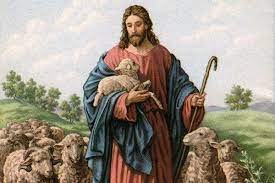
A reluctant healer?  Probably more a reluctant celebrity healer.  But a very willing and determined and gracious shepherd, who wants us to put our trust in him, and to follow him – love him – just simply for who he is: the saviour of our souls.  So, in conclusion – and here’s today’s takeaway – I suggest we don’t clamour for the spectacular – or be disillusioned if we don’t see the healings, five thousand people being fed, or anyone walking on water.  Rather, let’s enjoy being part of his flock.  Embrace the fact, the wonderful truth, that “The Lord is my shepherd”!  All of us – the Lord is our shepherd.  Hallelujah.

Let’s take this notion with us into the coming week.

On the Other Hand …

I recently heard a news commentator say, “We’ve lost the ability to disagree.”

The perceptive 1964 musical Fiddler on the Roof examines issues like tradition and the mixing of competing values; the place of love in long term marriages, and the repression of Jews.  Characters are forced to examine the views of outsiders, and how their own views need to change and accommodate – often to compromise long held beliefs.

“On the one hand,” reflects Reb-Tevye, in several monologues, “[This is how I see it …]  But on the other hand, …”  On the last occasion, his “other hand” comparison was (and shouted in despair), “There is no other hand!” It was just too much to ask.  He can’t bring himself to accommodate, and he banishes his daughter from his house forever, at heart-breaking cost.

What would you do if your (Jewish?) daughter wanted to marry a gentile communist activist, or a repressive Russian soldier?  On the one hand, you wish for nothing more than your daughter’s happiness.  On the other hand, you might find yourself totally opposed to what her suitor stands for, and his lifestyle, and doubt the young couple’s ability to live together successfully.

Is there ever a third hand?

Questions without answers!  Such is rhetoric.  But such competing values occur all over our world, especially in the online universe.  [Not so much in the public media, because the public media line seems to coalesce into an agreed, politically correct stream – that sells newspapers.  They no longer seem to debate all sides.]

But we, the middle people, need to learn to discern ‘other hands’, choose accommodations or compromises, and disagree gracefully and graciously.  In public.  Unseduced by conspiracy theories. And without fear of being banished forever.

Proposition:  Let’s say I believe strongly in Alpha.  You believe as strongly in Beta
You and I disagree, obviously, even to the point of row.  We argue, debate …  You begin to realise (perhaps through the strident case I make, or perhaps through wider reading and listening) that most of the world believes Alpha!  Your Beta is unpopular, in some quarters despised and vilified.  Maybe even you alone hold the Beta view.  What are you going to do?

More importantly, what am I going to do?  I smugly hold the higher – interpret, more populist – ground.  I can rubbish Beta.  I can rubbish you.  I can humiliate you publicly.  Will I?

I might hope that you come round to Alpha.  I might try to forcefully persuade you.
But the imperative is that I don’t scorn you, or, worse, banish you forever.  I might actually consider your Beta.  The majority is not always right.  (Arguably, it is seldom right.)  Or maybe there’s a ‘third hand’!  A common ground, and point we can agree on.  And points we can agree to disagree on.  With respect.
The love principle guiding us is more important than the (often trivial) black-white-grey principle we disagree on.

Give us public debate without rancour or mutual destruction.  Give us respectful, if heated, discourse – online, in the media, and with our friends and neighbours – even in our families.  Give us unresentful and reasoned peace, above all difference.

Let us get better at disagreeing.

Ken F

God’s grace is sufficient

by Joan Fanshawe

(Based on Mark 6:1-13, Ezekiel 2:1-5, 2 Cor 12:2-10)

“Hear O Mortal” — if I heard God’s voice like Ezekiel did way back then I would certainly know there were going to be some directions to follow.

A few days ago the blog on hearing God’s voice, posted on our St Francis webpage, was a good intro into the scriptures set down for this week. Also we have had a little discussion this week about how the readings might relate to each other. This week it’s easier to find links than some. First we have the prophet Ezekiel’s dramatic recounting of hearing God’s voice and being sent to the Israelites, in the fiftieth year of their Babylonian exile – a nation of rebels who have rebelled; they and their ancestors have transgressed. The descendants are impudent and stubborn. Ezekiel hears the instructions, “You shall speak my words to them, whether they hear or refuse to hear; for they are a rebellious house. You shall say to them, “Thus says the Lord.”
Things were not going to be at all easy with these people but “they shall know that there has been a prophet among them.”
Strong stuff!

Six hundred years later we have Paul recounting his experiences with the church in Corinth, also dealing with an uncooperative group of people that he feels have ‘gone off the tracks’ since he left them – perhaps much closer to a scenario that we can understand – a world that rates success and celebrity. Corinth is a very cosmopolitan city and it seems the church has been infiltrated by ‘super-apostles’. There has been much academic debate about this but it might be easiest to think of these as sort of first century ‘tele-evangelists’. Certainly they set high store on the quality of their ‘spiritual experiences’ to justify their authority, and had an admiring following in the new Corinthian Church.

Paul, who has a poor opinion of his own speaking ability, responds almost angrily and using a rhetorical technique recounts the vision experienced by a person – commonly held to be Paul himself – who “was caught up to the third heaven … into Paradise and heard things that are not to be told, that no mortal is permitted to repeat.” An astonishing experience, as we know from the account of Paul’s conversion on the road, but Paul goes on to say he is not going to brag about this, “so that no one will think him better than what they have heard or seen of him already.”
He’s not taking the ‘super apostles’ on head to head on ecstatic experiences; it isn’t the basis of his authority. In fact, he claims that, to keep him from being too elated, he was given a “thorn in the flesh” to torment him.  His message revolves around what he heard from God when imploring that this impediment be removed. Three times he begged God – but heard this:

My grace is enough; it’s all you need. It is sufficient for you. My strength comes into its own in your weakness.”

Paul makes it clear that he does not rely on his eloquence (he knows he isn’t eloquent) or his experience of ecstatic visions for his authority.  His power and authority are totally different from that claimed by the ‘super-apostles’.  In fact his power does not come from himself at all, but from the gospel he proclaims; and his authority does not rest on what he has experienced in an inward private way, but in the manner in which he is living the gospel in their midst.
And despite so many hardships ahead – what a mission Paul is committed to. Together with his helpers – moving around to early Christian communities, and letters going to Rome, to Corinth, Galatia and Ephesus, to Philippi, Colossae and Thessalonica.
These epistles, which are collected in the New Testament, written to the earliest Christian churches, have provided unimagined inspiration through the history of our Christian faith. Did Paul envisage this? Almost certainly not. 

But what he did know was, “My grace is sufficient for you, for power is made perfect in weakness.

So there we have Paul and Ezekiel, Apostle and Prophet, both hearing God’s voice and being sent out to proclaim a message to people who don’t particularly want to hear what they have to say.

Which provides a good segue to our Gospel story of Jesus who meets opposition in his own home town when opening the scriptures and teaching at the local synagogue.  Their rejection gives rise to the well-known quote from the passage:

“Prophets are not without honour, …. except in their home-town, and among their own kin, and in their own house.”

There’s a wealth of sermon material in this aspect but we will move on a little because we know that Jesus has heard God speaking to him (at the time of his baptism) and we know that he has already been teaching and healing; he has stilled a storm and raised a small girl from apparent death. Now he is moving about, teaching in the villages, and we hear that he’s called his disciples to go out as well. Sending them in pairs but with the clear instruction that they’re to take very little with them. Many may not have had much anyway as these were just ordinary men, as we know, fishermen and artisans. But it wasn’t going to be easy. They had instructions to move on when not received well – shaking the dust from their feet.

Maybe some were also known and hassled in their own home-towns.

As with Ezekiel and Paul there was resilience required to go out with the Good News about the coming reign of God, and living it, Mark tells us, with healings and exorcisms and setting free the oppressed. They were sent by Jesus to be bearers of good news in word and deed.

You’ll have to wait two weeks to hear how they got on because Mark interrupts his narrative at this point with a shocking story.

For us, in our own time, we need to talk about how we too hear God calling us, to be, and to share the Good News that Jesus made clear and makes clear. That blog on discerning ‘God’s voice’ on the website offers a very good opportunity to reflect more on that.

Mark’s Gospel of Jesus is very much about ‘the Way’: the way of the Lord, the way of Jesus and what it means to follow that way. We know that many desire to be on that way with Jesus. That we are each here today to worship God as part of a community is a sign of hope and faith in being on the Way. Here we can support each other in learning and encouragement. And to be equipped to carry on in spite of history showing us it’s not an easy path. We won’t be perfect and we won’t succeed in all we attempt. But when we hear that call we must step out in faith and trust in God’s grace.

Recently I came across a resource that’s being promoted in the Episcopal Church of the United States – that’s the Anglican Church there. It’s a seven step process that endlessly repeats – creating a rhythm and template for the Way of love!

It begins at 10 o’clock.

TURN   Pause, listen, and choose (to follow Jesus).
LEARN Reflect each day on Scripture, especially Jesus’s teaching.
PRAY Dwell intentionally with God each day.
WORSHIP Gather in community regularly to thank, praise, and dwell with God.
BLESS Share faith and unselfishly give and serve.
GO Cross boundaries, listen deeply and live like Jesus.
REST Receive the gift of God’s grace, peace, and restoration.

To conclude let’s recall what Paul reminds us: it‘s not about him, and it’s not about us, it’s about God; it’s about forgiveness and love and fullness of life. For Paul, God’s grace is as much a ‘given’ as the air we breathe – it’s a grace that prevails over weakness, hardship and apparent failure.

 May God call us with the same message.

“My grace is sufficient for you, for power is made perfect in weakness.”

Amen

God’s voice?

How to hear the voice of God?  That’s the question stirring today.  Uncharacteristically.  These blogs are usually of a general (and random) nature, seldom addressing ‘religious’ topics.  But discerning the voice of God surely enters everyone’s thinking, even the non-religious.  If we’re honest, most of us are often listening out for guidance on big decisions, etc, from somewhere in the cosmos!  Some seek it from tea leaves or crystal balls, but the more discerning would seek the voice of ‘God’. 

Easier said than done.  And worthy of more words than this piece can offer.

But signposts are posted for the discerning and focussed traveller, and I offer the following three helpful quotes.

John Wesley (learn of him here) proposed: “When a person is ‘born of God’ … their whole soul becomes aware of God … The Spirit of God breathes life into the new-born soul … Their ears are now opened and the voice of God no longer calls in vain.  They hear and obey the heavenly calling.  They know [his] voice … All their spiritual senses are now awakened, they have a clear course of communication with the invisible world … they know more and more of things which before their hearts could not begin to understand.”

Frederick Buechner (see here) posited: “… the word that God speaks to us is an ‘incarnate’ word – a word spelled out not alphabetically, but enigmatically, in events, even in the books we read and the movies we see … [but] we are so used to hearing what we want to hear and remaining deaf to what it would be well for us to hear that it is hard to break the habit.  But if we keep our hearts and minds open as well as our ears, if we listen with patience and hope, … deeply and honestly, … we come to recognise that, however faintly we may hear him, he is indeed speaking to us, and … his word to each of us is both recoverable and precious beyond telling.”

And King David (in the music of Psalm 19) said: “The heavens declare the glory of God … day after day they pour forth speech; night after night they display knowledge.  They have no speech, they use no words; no sound is heard from them.  Yet their voice goes out into all the earth, their words to the end of the world.”

‘Incarnate’ is an interesting concept.  It means (according to Merriam-Webster) “made manifest or comprehensible”; as if to say, we need to be looking for signposts or impressions less than obvious or not part of our normal noise, but listening sensitively and with God-ward focus to something unobvious, but somehow made manifest or comprehensible.

Easy.  (Not.)

But practise.  Look for those signposts, and discern what God’s voice would say to you in your current circumstances.  Write and tell me about it.

Ken F