Everything is Possible

by Barry Pollard

(Based on Mark 10:17-31; Heb 4:12-16)

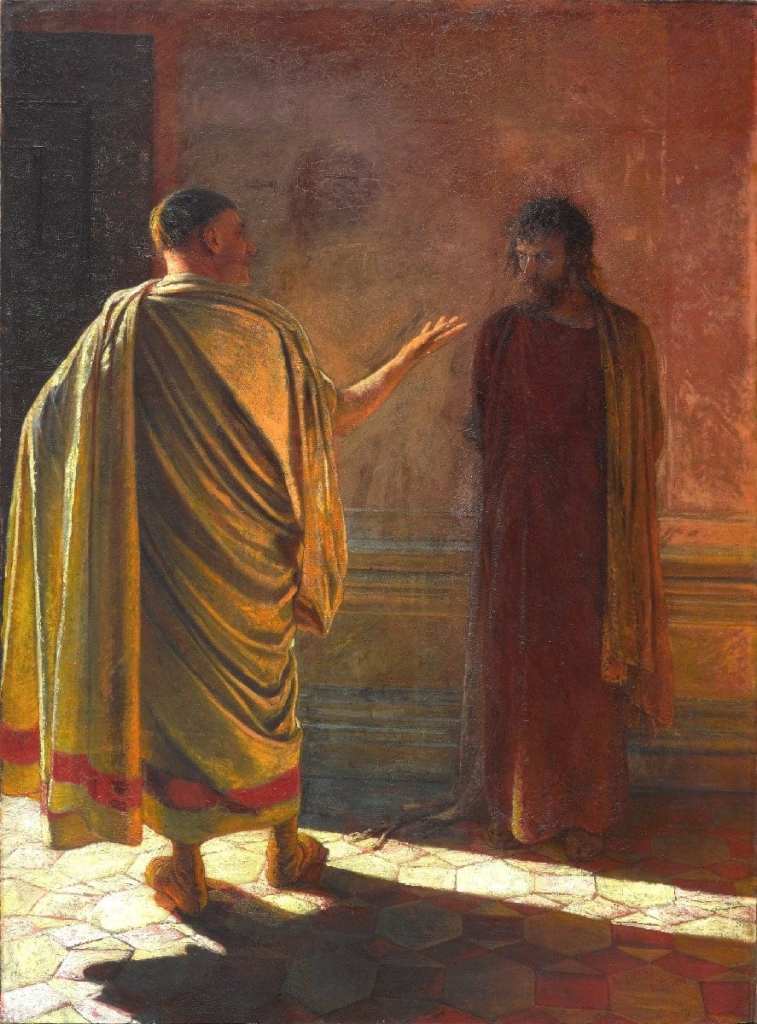
So many times in the gospels we hear Jesus questioned by people who are trying to trick him into giving himself away. In today’s reading I’m pretty sure the man asking the question of Jesus is sincere – he genuinely wants to know what he must do to have eternal life, to book his seat in heaven.
His approach is respectful and he is attentive to the answers Jesus gives him. On the surface it appears to be an honest exchange. But when Jesus looked at him he knew that there was something that the man was not acknowledging in his quest for eternal life. And, as we hear, the man did not get the answers he wanted.

You know, this man could be any one of us! I imagine that we all come before the Lord reverently, keen to hear His words for us and, if you’re like me, expecting to have our wishes and will confirmed. But do we admit all that we should when we are in the presence of the Lord? Do we hold back in our confessions? Are there issues we’d rather not talk about? And how many times have we been disappointed, walking away from the encounter in the same way as the man in today’s gospel reading.

The man in question is recognised as a rich man, a man with many possessions. Jesus saw that the man did not acknowledge where his heart really lay, and His instruction to him to go and sell the possessions and give the money to the poor turns out to be too big of an ask. He simply couldn’t do it, and left in sadness.
We don’t hear any more about him but I suspect he probably continues to live his life in the same manner he had been, prior to the encounter with Jesus. The disciples looking on and hearing the explanation offered by Jesus, that it is very hard indeed to enter heaven, are ”astounded”, and ask “Who then can be saved?”

I’ve often thought that really rich folk must have things pretty easy, able to indulge every whim and fancy. Their wealth is often the passport to getting things done, and done their way. I suppose that the rich man in the gospel story was like that. But this week I am changing my mind about wealth and easy lives.

I had been praying about how I would approach this reflection and was having trouble getting past the idea that the solution for the rich man, and us if we are to take something away from our reading today, is simply to give generously to those in need.
But a local young man came to mind, a man who came into a fortune, courtesy of a major Lotto win. As I pondered what he did with it, the people who tried to guide and help him, and the endless parade of new toys that were seen around town, I realised that his life was anything but easy. Okay, it was probably fun for the first few years as he indulged himself, but at the same time a procession of loose acquaintances accosted him for attention and a share of the action. Relationships disintegrated all around.

Then, at work in the past week, I dealt with a customer who was outwardly a very successful businessman. He seemed to have all the trappings. A successful business man who was privately dealing with a marriage break-up, a separation of business and marriage assets and liabilities, all the while looking after his children for the school holidays away from their usual family home.
The man was so preoccupied with sorting out his affairs he appeared to have little time for the children, who kept up a barrage of requests for treats and food as they vied for his attention.
Was the marriage break-up caused by business issues? Could the focus on accumulating wealth have been a major factor in the break-up? Whatever the whats and wherefores were, it didn’t look like life was very easy for him and his children. I was left wondering how it will all turn out.

Anyway, after pondering all this I understand that having wealth comes with issues. To be wealthy, in all likelihood, makes life far from easy.

The gospel rich man couldn’t bring himself to give away his money and possessions. But more importantly than that, he couldn’t really engage with Jesus. The encounter for him was really based on his terms. He had already assessed himself and presented as somewhat self-righteous. All of the commandments that Jesus raised, as measures of how to judge a life lived for eternity, the man said he followed. These commandments were, and are, rules to be followed. And for most of us, most of them are pretty easy not to break. The hard part for the rich man was when the focus changed from rule breaking to positive action. At that point the man had no response other than to walk away.

As a youngster I grew up with lots of rules, as I imagine most of you did. In those days compliance with rules was reinforced with punishments and penalties whenever we broke them. We probably learned through avoidance to modify our behaviour to suit the expectations of those monitoring us: parents, teachers, the clergy and so on. Essentially we complied. That compliance probably led us to eventually absorbing those rules into our daily lives and thinking.

Personally, in all honesty, I didn’t really start to consider the effect of my behaviour on others until I reached my teens, late teens at that, I suspect. I generally went along with the crowd, wanting to be in the group rather than outside it, in good and bad. Peer pressure was a reality!
I think it wasn’t until I became a father that my thinking about, and behaviour towards, others really started to change for the better. I started to do things to build up, rather than knock down. I did things to help my children avoid the things that I had struggled with. The focus gradually moved from me, and my wants and needs, to them and theirs.

My behaviour wasn’t controlled by avoiding penalties any more, but more motivated by positively getting on with others. Don’t get me wrong: I was not great at it! But I was trying. And this is about when I realised that I was doing everything in my own strength.
When Jesus reflected, “How hard it is for the rich to enter the Kingdom of God!”, to me he was saying that anyone trying in their own strength to enter the Kingdom of God was going to fail. Eternity isn’t about our efforts. It is about our hearts.

When Jesus responded to the disciples’ question, “Then who in the world can be saved?” by pointing out that, without the divine, the earthly have no show, he was providing the answer for everything that we ponder and have to face.
It is not really possible for us, in our own strength, to do very much at all. When it comes to the most important of things: saving ourselves and getting eternal life, it is impossible. We can’t earn it or buy it and we don’t deserve it. But with the grace of God, things are very different. Everything is possible.

With the grace of God, everything is possible!

God’s love for us is so far beyond what we can imagine that he has given us an assured pathway to eternity. It is as simple as a belief that Jesus is Lord of our lives and an acknowledgement and repentance of our sinful ways. To help us grasp what that means we have his Word. Attending to it will help to keep the pathway open as we journey towards eternity.
Ponder again the words of our Hebrews reading: “For the word of God is alive and powerful. It is sharper than the sharpest two-edged sword, cutting between soul and spirit, between joint and marrow. It exposes our innermost thoughts and desires. Nothing in all creation is hidden from God. Everything is naked and exposed before his eyes, and he is the one to whom we are accountable.”

Whether it is our riches or something else that stands in the way of our relationship with the Lord, we can’t hide it. We need to acknowledge it. We need to know that to Him we are naked and exposed!

And … if you’ve had any difficulty following my reflection today, one solution could be to give generously to those in need from what you have, whether it is your riches or your time or your labour.

Amen

Geniuses 4

In my early teens my family visited rellies in New Plymouth.  My cousin was a year older than me, and was (I thought) already well acquainted with the ways of the world, and would therefore no doubt have plenty to teach me.  She proved to be surly and a bit dismissive with me, her fourteen-year-old baby cousin, but she did invite me to listen to her latest groove.  I expected something from the hit parade, but to my bemusement she played a piece from a classical LP.  Even then, uncultured as I was, the piece struck me as exquisite.  Or maybe I just liked it because she did. 

The piece she played was the Emperor Concerto, from some musical wunderkind called Ludwig von Beethoven.

When musical geniuses are tossed around (figuratively), Mozart and Bach are usually the ones put forward most insistently.  But, not to disparage them (for fear of inflaming the readership), they are the lightweights to Beethoven’s gravitas, the toast and marmite to Beethoven’s full lamb roast.  Granted, this is just opinion, but once you begin to infuse Beethoven’s nine symphonies, his five piano concertos, and legions of other works, you’ll never find the bottom of them.  Not as prolific as Mozart or the Bachs, but charged with a richness that I’ve never found anywhere else. 

Beethoven was an eighteenth century man (from Bonn, then Vienna), and not that likeable by all accounts; but his irascible personality might well account for his soaring opuses, as well as his exquisite quieter pieces.  Born fourteen years after Mozart, the two did meet on one occasion (in 1787), and they seemed to respect each other.  Even then (as a teenager) he was a strong pianist, an inspired improviser/composer, a violinist and, a little later, a conductor, and was famous before he was thirty.

But, genius?
I reckon so.
So do others. (See links below, for example.)
Glenn Gould, twentieth century Canadian writer, broadcaster, composer and conductor, said of him, “[Beethoven’s] senses of structure, fantasy, variety, thematic continuity, harmonic propulsion and contrapuntal discipline were absolutely — miraculously — in alignment.”
He captivated.  Some of his music was shocking, apparently, to contemporary music lovers, so ‘revolutionary’ was it considered to be1.  He was said to ‘spurn the rules of classical romantic music’.  But he captivated, nevertheless, through his compelling music and his ADHD persona.

Ludwig’s music is best breathed in, experienced as an experience.  You can wallow in it, like Scrooge McDuck in his millions, or like immersion with 360 degree VR goggles.
Anyone wanting to start experiencing his work … [I’m thinking] … start with Fur Elise, a lighter piece, then on to the Emperor (his Fifth Piano Concerto), still my favourite piece of all music of all time, even though I am now some decades older than fourteen; then perhaps one of his sonatas (try the 8th, 14th or 23rd); then: the incomparable Choral Symphony (the Ninth) is essential.  After that you’ll migrate to numerous other piano and violin concertos and sonatas and seven other awesome symphonies.  But listen to the Choral and overlay its splendour with the realisation that he composed it when he was almost completely deaf2 and only three years before his death, and you won’t doubt his genius.

[He actually died (of cirrhosis of the liver) at 56 in a thunderstorm, which seems appropriate, given his stormy mien, life, and creative output.]

My third genius.

Ken F

https://www.washingtonpost.com/outlook/beethoven-the-genius-who-broke-all-the-rules/2019/08/16/399b54b2-a71e-11e9-9214-246e594de5d5_story.html

https://www.jacobinmag.com/2020/12/ludwig-van-beethoven-250-birthday

A Broader View

by Bruce Gilberd

(Based on Mark 9:30-37)

This telling incident (the disciples have been arguing among themselves about who was the greatest) reveals to us how, when we become obsessed with self-interest, we miss truths of global significance that are right in front of us.

Jesus needs to find a quiet place, hidden from the crowds, to teach his disciples and prepare them for what is going to happen.  But they did not understand – because their minds were focussed on competing for importance, the lust for significance and greatness, for power.
Jesus knew this and addressed it directly: humble authentic servanthood is the key, he told and showed them.

Interestingly, this episode speaks into the state of our beloved planet, our home; and the motivation of those persons, corporates and nations who would be great, important and wealthy at the expense of future generations, who could inherit a wounded and declining planet.

The truly greatest amongst us are not those obsessed with power, status, wealth and profits, but those who personally and in coalitions of shared vision take action to sustain the planet’s life, well-being and inter-connectedness.  These people, rather than the self-absorbed, that don’t see, or choose not to see, the great issue of our time, visible before their eyes, are the greatest amongst us.  They don’t seek reward or fame.  They fearlessly keep the issue before us, and invite action.  Only so will sustainability become a reality for our planet.

[For a video on sustainability, go to https://www.youtube.com/watch?app=desktop&v=rmQby7adocM&feature=youtu.be.]

Geniuses 3

It would be a mistake to think all geniuses are to be found in the sciences; or as engineers or inventors.  That would straight away exclude all sorts of alternative and motley geniuses and limit our survey.  My definition of genius, if you need reminding, is “an extraordinary intellectual power especially as manifested in creative activity”, and (goes without saying), “has captivated me”.

But – and here’s my dilemma for this specimen – this fortnight’s genius offering is a writer whom I can barely understand.  Can that really count?  This guy wrote 37 plays and 154 poems; invented thousands of his own words; has been translated into 180 languages; and is as oft-quoted as the Bible.  Have you guessed who he is?  Yes, it’s the Bard of Avon, William Shakespeare.  And although I’ve tried, I can only half understand his stuff.  Because not only is his intellect on another plain, but he was writing for a people whose English barely resembled ours.  Even in his own time (late sixteenth century, early seventeenth) he was writing not for the contemporary sophisticates, but for the rank and file – the ordinary people.

Shakespeare was first forced on me in the fifth form, when we had to study Julius Caesar, and the teacher reckoned that all those clever speeches and couplets and phrasings were intentional, not just flukes, as I suggested.  In the sixth form it was Henry IV Part Two.  By the seventh, I’d had enough.  But in later decades he lured me back.  I’ve been to several of his plays, but, knowing how difficult it is for a Kiwi rank-and-file to follow his work, I’ve tried to read a play before viewing, presuming that would give a leg-up to better understanding.  And it has helped – for Romeo and Juliet, Midsomer Night’s Dream (which is hilarious in places), King Lear, Macbeth and Much Ado About Nothing (these two in Stratford-Upon-Avon itself), and Hamlet and Julius Caesar (again) (both of these at the seasonal Pop-Up Globe theatre in Auckland).

You see, I’ve tried, and his writing really is clever if you can break into it – genius level, perforce [another word he invented]. How could anyone write that stuff, even today, with all our learning and sophistication, let alone four and a half centuries ago?

But, given all the a-foregoing, and in just over five hundred words, how can one describe his genius, let alone explain or analyse it?  Fortunately, dozens of other sophisticates have already.  Some of the shorter ones are listed at the bottom of this blog – check ‘em out. The uncredited Daily News article says, “More than any other writer, he had the capacity to think himself into the minds of other human beings, and to summarise the great range of our emotions in words that are simple and supremely eloquent.”  Harold Bloom, in a best-selling Shakespeare: The Invention of the Human (1998), says, “… supreme literary talent is the necessary precondition for the composition of [Shakespeare’s great works] that have shaped our language, embedded themselves in our individual and collective imaginations, and inspired so much work by other artists.”

Because I had to concentrate, and climb the mountain to even begin to enjoy the view, I’ve been captivated by the genius of William Shakespeare.  If you’re tempted, Julius Caesar is as good a place as any to start climbing.

Ken F

1. https://www.britannica.com/topic/Shakespeares-Genius-1733556https://www.theguardian.com/artanddesign/jonathanjonesblog/2011/oct/27/anonymous-william-shakespeare-genius
2. https://www.dailynews.lk/2017/03/27/features/111556/what-made-shakespeare-genius
3. https:// www.dailymail.co.uk/news/article-3554782/What-Shakespeare-genius-grammar-school-boy-died-400-years-ago-today-snobs-sneer-humble-origins-completely-missing-point.html
4. https://www.theguardian.com/artanddesign/jonathanjonesblog/2011/oct/27/anonymous-william-shakespeare-genius
5. https://www.bbc.co.uk/programmes/articles/5SYcPN38ZVbsBWZqJhShxzW/was-shakespeare-a-genius
6. https://www.goodreads.com/book/show/1075391.The_Genius_of_Shakespeare