The Pharisee and the Publican

by Ken Francis

(Based on Luke 18:9-14; Ro 5:1-11)

Can you see it?  This scene?  This delightful short drama, painted very economically by Jesus …

I doubt he meant it as comedy, but to me it seems so comical!  Like a cartoon.  We could almost do it as a little drama … a bit of street theatre:
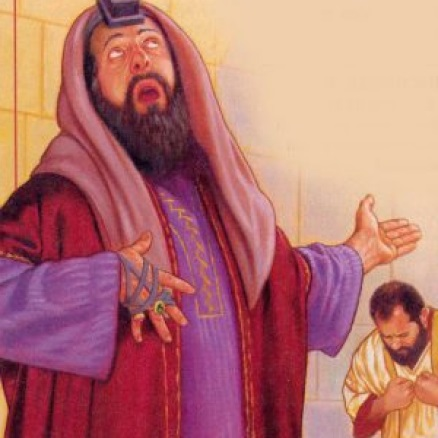
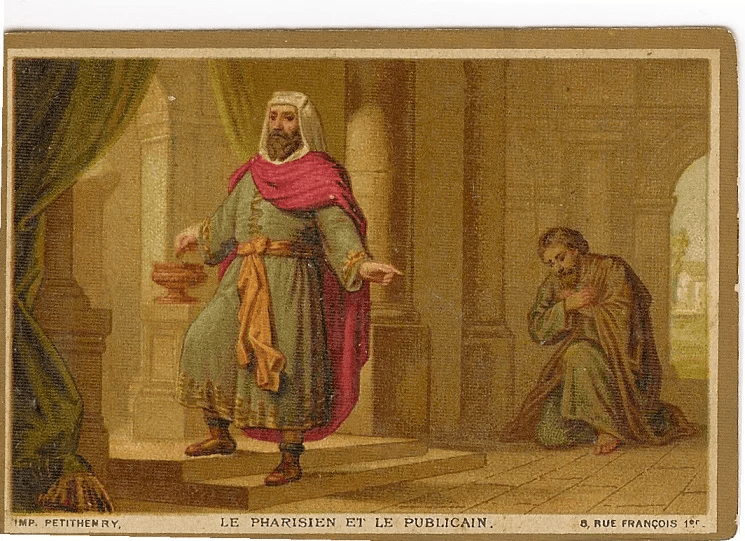
There on your left stands a proud, dignified looking man, pompous and cartoonish, head held high and sneering sideways, telling God how righteous he is!  Not like that sinner over there.
On your right, a bowed, cowed man, kneeling, too ashamed to come near the altar, even to look up, but deeply contrite.  All but sweeping handfuls of ashes over himself.

This second guy – the King James Version calls him a ‘publican’ (which, according to Encyclopaedia Britannica, was the label given to an “ancient Roman public contractor”), and seems to be, in Jesus’s telling, a tax collector – is hardly a cartoon though.  That wouldn’t do him justice, poor man.  But the question is, as we look at these two guys, which one is you?

Which one do you identify with?

Or, let’s say … if he is at one end of the continuum and he’s at the other, and you were asked to position yourself somewhere between the two, to indicate your disposition, where would you stand?

I’m ashamed to say that I’d be much closer to the Pharisee than the publican.
Because the inclination of my heart is to think I’m pretty good.  I pay my tithe – I pay my taxes – I try to think of others, I … I’ve never murdered anyone – honest!  I never – well, hardly ever – tell lies … or miss church on Sunday.  Yes, God I’m pretty good.  Thank you that I’m so righteous!  Not like all those sinners … out there!  Actually, I’m so pleased with myself, it’s hard to be humble.  I’m proud of my humility!  Like the old saying, I used to be conceited, but now I’m perfect!

But, where would you stand?

And … which of these two guys is the greatest sinner, do you think?

I suggest that they’re both equal sinners.  Because, is any one sin greater or worse than another?  Was Adolph Hitler any worse than … Queen Elizabeth?  We humans – we’re the ones who rank sin.  We’re the ones who say genocide is worse than … lying; or murder is worse than … theft.  But in God’s eyes, sin is sin.  It’s not ranked.
And, don’t forget, there is good in the worst of sinners, just as there’s sin in the best of us … so, let no one cast stones at anyone else, right?

In fact, what is sin?

Judaism regards the violation of any of the 613 commandments as a sin!  (We’re left to guess which of the 613 the publican had breached. He was loathed, of course, as a tax collector.)

Well, we’re not Jews, so …

Here are three slightly different views of sin:
In one sense it’s things we do.  Our sinful acts, our sinful behaviour.  Breaking the rules!  The Ten Commandments list some of them.  Murder, theft, adultery, coveting.  Things we actually commit.
A second way of understanding sin is this:  Sin is turning away from God’s purposes, from his call on our lives.  (Like sheep, we have all gone astray, wrote Isaiah.)  So, when we abuse someone, when we deny someone mercy or justice, when we watch or read something we shouldn’t, when we assassinate someone’s character, when we fail in some way to love our neighbour … we are turning away from God’s purposes.  That’s sin.  There are sins of omission, of course, just as there are sins of commission.
In another, perhaps even more telling sense, sin is who we are.  It is embedded in our very nature.  The human condition.  We were born sinful, it says in Psalm 51; Jeremiah says the hearts of people are desperately wicked. [Jer 17:9: “The heart is deceitful above all things, and desperately wicked: who can know it?”]  Many think humanity is inherently good, but … can we honestly say that?

St. Augustine said sin is “a word, deed, or desire in opposition to the eternal law of God.”  And therefore, needs to be redeemed (that’s a metaphor for paying for someone’s release or deliverance): the death of Jesus is the price that is paid to release the faithful from the bondage of sin.

So, I put it to you that these two men are equally sinful, but … it’s their attitudes that truly distinguish them.  One of them (the Pharisee), like me, says, how good I am, that I am not like other men.  But the other, the publican – also like me – says, woe is me for I am a sinner.  God, forgive me.  God, save me.  For if he doesn’t, I am lost.

Commentator Matthew Henry writes, “God sees with what disposition and design people come to him.  The Pharisee seemed to be a good man, in some respects.  But he was boastful, in apparent expectation that God would affirm him, admire him, be in his debt!  Moreover, he thought meanly of others, particularly of the publican.  The Pharisee claims merit; the publican mercy.”  That is the difference that Jesus was emphasising.  The difference between the self-righteous and the mercy-seeker.  The publican’s disposition is, “Justice condemns me; nothing but mercy will save me.”

We all need to acknowledge this same truth.  No matter how good we try to be, it is only through God’s grace, through what Jesus did for us on the cross, that we can have eternal hope.  It’s important to recognise this, acknowledge it consciously, confess our sinful nature to him, and cast ourselves on his mercy, like our brother there (the penitent).  It’s kind of taking responsibility for who we are in our hearts.

This reminds me of how, as a school teacher, I sometimes found myself having to get to the bottom of teenage conflicts of various kinds, and meting out disciplinary consequences. I might ask some antagonist what happened, and they’d start saying something like, “Well, he tripped me” or “she stole my homework”, or …
Typically, I’d interrupt with, “Ok, but what did you do?” They might say, “Well, I wouldn’t have … if they hadn’t …” And again I’d say, “But what did you do?”
It was commonly difficult to get an adolescent to own his or her own actions – to take some responsibility for what had happened!

The publican was accepting responsibility for his sinful behaviour or nature.

Yes, we are all equally guilty.  But it would be a mistake to hold all of this in a solely negative light.  At the end of this brief street theatre, Jesus sums up with God’s view of all this.  Both of these men are sinners, but only one is “justified”, he concludes.  That’s the word he uses, not me.  We cannot shed our sinful nature, but we can be confident of being justified if our attitude is right.  The Romans reading talked about justification.  Martin Luther joyously latched onto the idea of justification at the outset of the Reformation.  He described the concept of justification as “just as if I’d never sinned”, which is cute, but actually a very helpful way of thinking of it.  “Just as if I’d never sinned.”

All our own righteousness “is as filthy rags” (the prophet Isaiah says), but if we turn to God, we can be ‘counted’ righteous, it says in Romans.  We take upon ourselves His righteousness – Jesus’s righteousness.  Yeah?

The words righteous and righteousness – we don’t use them much in modern parlance – we use the word ‘sin’ even less – actually occur 72 times in Romans!  Ro 4:5 says: “to the one who … trusts God who justifies the ungodly, their faith is credited as righteousness.”
We can’t tell God about how righteous we are!  Like this guy.  How arrogant.  God laughs.  But He credits us as righteous, if we come to him as the publican did.

A delightful little parable.  Spoken, it says in verse 9, to some who were “confident of their own righteousness and looked down on everyone else”.  Actually, it’s not a parable at all – a parable is a superficial story with a deeper meaning.  This is a straight out narrative of what’s what around approaching God.  A contrast between how to be and how not to be.

Friends, let’s get closer to the publican’s end of the spectrum …

Concluding prayer:
Father, help us to see merit in the publican’s approach to your throne.  Help us to find humility as we approach, and true regret for our sinful inclinations.  Then to receive, by faith your credit of righteousness, based on what you have done, not on our own efforts.  Then to find true gratitude, that you have taken the initiative to rescue us from whatever sin has made us.  We are enormously grateful even this morning as we reflect on these things.

Help us to walk our walk this week, with intent and integrity, and may our walk of faith please you. Amen

Wrestling with God

by Sharon Marr, channelling a Debie Thomas essay

(Based on Luke 18:1-8; Gen 32:22-31; 2 Tim 3:14–4:5)

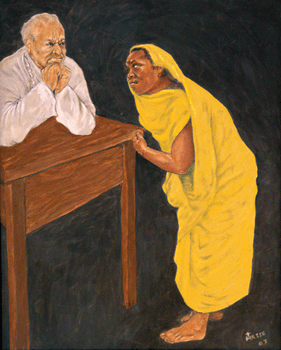
In this week’s Gospel reading, Debie Thomas (of Journey with Jesus) recounts how Jesus tells a parable about a bothersome widow who seeks justice against her oppressor.   Day after day, the judge refuses to help her.  But she persists, tirelessly bothering the judge until he’s sick of her very presence: “I will grant her justice,” he says to himself, “so that she may not wear me out.  (In the Greek, “so that she won’t give me a black eye”! Don’t you love that? These are the gems you get when you dig a little deeper sometimes.)

“At the outset,” writes Debie, “the Gospel writer tells us that Jesus’s parable is about ‘the need to pray always and not lose heart.’  But this is troubling.  Are we really supposed to harass God until we wear him down?  Is that what prayer is — bothering a hard-hearted God until he gives in?  When I receive an answer to prayer, is it only because God is sick to death of hearing my voice, and wants me to shut up?

“In case we’re inclined to think of God as the unjust judge, Jesus explains that the parable works by way of contrast: Unlike the heartless judge in the story, God ‘will quickly grant justice’ to those who cry out to him. 

“But this explanation raises troubling questions, too, because our lived experiences contradict it.  Too often, God does delay, and our most fervent prayers — for healing, for justice, for protection, for peace — go unanswered.  Too often, our struggles with prayer lead us to experience God very much as the judge, turned away from the urgency of our requests for reasons we can’t begin to fathom.

“So what are we to make of this parable?  Well, for starters, I wonder if the story is less about God, and more about us.  I wonder if it’s about the state of our hearts, and about the motivations behind our prayers. Maybe what’s at stake is not who God is and how God operates in the world but who we are, and why we need so desperately to be people of persistent prayer.

“The parable begins with an exhortation not to lose heart.  What does this mean?  What does it look like to ‘lose heart’ in our spiritual lives?  The words that come to mind are weariness, resignation, numbness, and despair.  When I lose heart, I lose my sense of focus and direction.  I lose clarity, and begin to doubt God’s intentions.  I get irritable and cynical very quickly.  My spiritual GPS goes haywire, and all roads lead to nowhere.

“In contrast, the widow in Jesus’s parable is the very picture of purposefulness, precision, aliveness, and clarity.  She knows her need, she knows its urgency, and she knows exactly where to go and whom to ask in order to get her need met.  If anything, the daily business of getting up, getting dressed, heading over to the judge’s house or workplace, banging on his door, and talking his ear off until he listens fortifies her own sense of who she is and what she’s about.”

She is persistent.  I remember a story my grandmother Bebe told.  As a child she was one of seven, and food was not under any circumstances to be wasted.  One breakfast, her younger brother said to his mother, “Do I have to eat this egg?” Their mother quickly retorted, “That’s enough of that. Eat it up” … and then probably mentioned the starving millions in the world. 
“But Mum,” he said … and she responded sharply, “Eat it up and eat it now”.
“But …”
And an angry glare was given. … Silence …
Then his small voice said, “But do I have to eat the feathers?”

Persistence on his part paid off, and the egg was removed.

“What happens when we pray like the widow?” Debie asks.
Then answers, “I can only speak from experience, but I know that when I persist in prayer — really persist, with a full heart, over a long period of time — something happens … to me.  My sense of who I am, to whom I belong and what really matters in this life.  My heart grows stronger.  It becomes less fragile and flighty.  And sometimes — here’s the biggest surprise — these good things happen even when I don’t receive the answer I’m praying for.”

And maybe I am learning what it is to live in ‘your will be done’, and trust Him.

Debie continues.
“I don’t mean for a moment to suggest that unanswered prayer doesn’t take a toll.  It does.  It hurts and it baffles.  Sometimes it breaks my heart.  But maybe that’s the point of the parable, too: the work of prayer is hard.  The widow’s predicament is not straightforward; she has to make a costly choice every single day.  Will I keep asking?   Can I be patient?  Am I still capable of trusting in the possibility of justice?

“Prayer is, finally, a great mystery.  We can’t know — it’s not given to us to know — why some prayers are answered quickly and many others are not.  We can’t understand why our earnest pleas for justice (or healing, or peace) hit the wall of God’s silence and sometimes remain there for weeks, months, years, or lifetimes. And yet, from the heart of this bewildering mystery, Jesus asks, ‘Will I find faith on the earth?’  Which is to say, will I find men and women like the bothersome widow?  Will I find such ferocity?  Such tenacity?  Such fortitude?

“The widow’s only power in this story is the power of showing up.  The power of sheer grit.  But the story suggests that this power is not to be taken lightly.  Which is to say, prayer is not to be taken lightly.  We can’t always know what gets shaken, transformed, upended, or vindicated simply because we show up again and again in prayer. 

“Not coincidentally, all of our lectionary readings this week are about persistence.  The widow persists in her belief that good things will come to her, even when the odds look wretched.  Jacob, wrestling the angel in total darkness, persists until the blessing of a new name and a new future are granted to him. The writer of 2 Timothy encourages persistence again and again, “whether the time is favourable or unfavourable.”  And the psalmist reminds himself — and us — that the reason we can be persistent is … because God is. Our persistence can never be in vain, because it is rooted in God’s.  

“What all of these readings suggest to me is that God delights in those who dare to strive with him.  To contend with him.  To wrestle with him.  Wrestling, as it turns out, is not a bad or even a scary thing, because it’s the opposite of apathy, the opposite of resignation.  It’s even the opposite of loneliness.  To fight with God — to show up day after day in prayer, to wrestle with our resistance in the darkest hours of the night — is to stay close, to keep our arms wrapped tight around the one who alone can bless us.  Fighting means we haven’t walked away. 

“When the Son of Man comes, Jesus asks at the end of the parable, will he find faith on the earth?  Faith that persists, faith that contends, faith that wrestles?  This is the question that matters. Will he find such faith in us?”

Seven Deadly Sins?

Sin is on my mind this fortnight.  It’s hard to even remember what the word means, it’s so seldom said or heard these days.  Why is that, I wonder?  It seems to have gone the way of thee and thou and Sunday roast and the national anthem before a movie.  It’s a word, a concept, for which we have no further need in this post-modern age of moral relativism.

There was a time when sin was front and centre in the minds of both perps and moral watchdogs.  Evagrius Ponticus, also known as Evagrius the Solitary, which perhaps spikes his authority somewhat, a so-called ‘Desert Father’ from the fourth century AD, first proposed a list of seven deadly sins: pride, greed, wrath, envy, lust, gluttony and sloth.  Interesting list …  Why “deadly”, is not recorded. But, is it the list you would have come up with?
What about murder and robbery?  Paedophilia and human trafficking?  Maybe they didn’t have those in the fourth century.

Personifications of the Seven Deadly Sins in a fourteenth-century manuscript

What about spite … character assassination … deception, fraud and white collar crime?  Notwithstanding collar colour. 
Trade Me rip-offs?  Emotional abuse?  Family spats or parental neglect.
[Stop me here: I could go on all day.]

Anyway, Thomas Aquinas and Pope Gregory, Chaucer and Dante, several renaissance artists, must have tautoko’d1 the seven, because they burnished them and gave them further dignity and impetus in their various treatises and paintings, and we have movies made about them today, because they’re such delicious founts of sensation and scandal.  And money-making.

I wonder if, in answering my own earlier question, Aquinas would have argued that all the other sins stem from the basic seven.  Paedophilia from lust, perhaps?  Fraud and theft, etc, from greed?  Gossip and slander from pride or envy …

Sloth!  That’s a good one.  Guilty here.
And gluttony … why is that even in the list?  Deadly? [Actually, as Wikipedia attests, it’s not just about food, but any unhealthy or excessive appetites.  So, fair enough, yeah?]

Actually, in further answering my previous answer to my own earlier question [… trying to push up my word count …], in arguing that the magnificent seven are foundational to all other sins, pride would seem to be the grand-daddy of them all.  The antecedent, if you will.  All of us are guilty of the wrong sort of pride, wouldn’t you say?  Pride is the opposite of humility, and can open the way to arrogance, hubris, narcissism and unwarranted superiority. One can even become proud of one’s humility! 

Dante’s definition of pride was “love of self perverted to hatred and contempt for one’s neighbour”.  C.S. Lewis writes in Mere Christianity that pride is the position in which the ego and the self are directly opposed to God: “Unchastity, anger, greed, drunkenness and all that, are mere fleabites in comparison: it was through Pride that the devil became the devil: Pride leads to every other vice: it is the complete anti-God state of mind.”

Am I guilty of some of the downstream progeny of the seven? Or of pride, the progenitor itself?  You bet.

Perhaps the answer is to be monkeys in denial.  (See no evil, hear no evil, smell no evil – something like that.)
Or, more responsibly, consider what the book of Romans2 has to say, that “all have sinned, and come short of the glory of God”, and that “the wages of sin is death, but the gift of God is eternal life in Christ Jesus …”.  Weigh that against the seven and form your own conclusions about the deadliness of sin.

Ken F

1to support, prop up, agree, advocate, accept
2Romans 3:23 and Romans 6:23

Unpacking ‘Faith’

by Barry Pollard

(Based on Luke 17:5-10; Hab 1:1-4, 2:1-4; Ps 37:1-9)

It has been a busy few weeks for Keri and me. We had a social calendar, something we don’t often have, and it was pretty full. We have travelled away to celebrate a son’s 40th birthday and then our wedding anniversary, we have farewelled and welcomed monarchs, and in the last few days farewelled a dear member of the church family, Ruth Lee. Quite frankly it has been a tiring and, occasionally, an anxious time.

You know, often our anxiety and tiredness can become our focus, spoiling our appreciation of the experiences we have just had. But when I take the time to think about it I usually find that, in nearly all those circumstances, the good things actually outweigh the bad (not-so-good) things. And this is the case in the time period I have just described.

So what could be a good thing that came out of the loss of dear Ruth, you may ask?

Consider the wide view. Verily I tell you: we will all die. Despite the most amazing medical interventions these days, the best we can do is delay the inevitable a little. But in the end we are all destined to depart this world. Knowing and accepting that, Ruth had a pretty good innings (if you’ll allow a cliché or two). 93 beside your name is an impressive entry in anyone’s scorebook. If we think about the woman we all knew, the stories told about her at her memorial service were indeed testimony to her true character and faith! If you had seen the church and St Francis House filled with her ‘visual ministry’ contributions (as Joan called them) you would have been amazed. It made us all appreciate the huge impact a very small person can have on a church and community. Ruth was a quiet little lady who just got on and did things, often great things, and often for others. We have cause to be very grateful to have shared Ruth’s life here in Tairua.

So that is a good thing! And there is more, which I’ll come to shortly.

Now, the point of this chat is to reflect on the Scriptures we have heard today, try to make sense of them, and work out how to apply them in our lives.

Our Gospel reading brought a measure of relief when I first read it as I started my prep. Only five verses. Sweet! But I read the verses, re-read the verses, pondered each one, re-read them, read before and after them, then realized that actually I didn’t have a lot of leeway here. In the end, not only the brevity of the reading but the tone of the verses gave cause for concern.

You have heard them! Jesus was speaking directly and bluntly.
The apostles said to the Lord, “Show us how to increase our faith.” A good question!
The Lord answered, “If you had faith even as small as a mustard seed, you could say to this mulberry tree, ‘May you be uprooted and be planted in the sea,’ and it would obey you!

In Matthew’s Gospel it’s a mountain that can be moved.

To have faith, Jesus says, is awesome!

But I hear his response to their question as a criticism. It is as if Jesus is saying, “You have good cause to ask me that because actually you don’t seem to have a lot!”

If we stopped there I imagine it would be cause for even greater concern for us. It was the apostles who were asking the question. They had been in the very midst of Jesus’s ministry, had prayed with him, had witnessed his miraculous healing power, and seen the effects of that ministry. Surely they of all people should have developed their faith.

But is faith a ‘thing’? Is it a commodity of some kind that we can possess? Is it something we either have or not have?
The Oxford Dictionary defines faith, in the context of theology, in this way:

  • Belief in religious doctrines, especially such as affects character and conduct
  • Spiritual apprehension of divine truth apart from proof (Hebrews 11:1)
  • System of religious belief (like the Christian or Jewish faith).

These definitions certainly apply. But do terms like “faith-walk” and “faith-journey” better describe what faith might be. Walks and journeys assume going to a destination. Does a faith-walk ever actually end in the achievement of faith? Or is it more like the way or method of walking and journeying that is the important bit? That sticking to the task. That turning of our attention and effort to the Lord.

But according to Luke’s version of this exchange, Jesus doesn’t explain further. He then tells the apostles:
“When a servant comes in from ploughing or taking care of sheep, does his master say, ‘Come in and eat with me’? No, he says, ‘Prepare my meal, put on your apron, and serve me while I eat. Then you can eat later.’ And does the master thank the servant for doing what he was told to do? Of course not.” 

These verses I interpret as a description of a good servant, one who has multiple roles within the household, who is expected to ‘get on with it’ until all those jobs are done. Can you see that it is like saying faith is something that comes with application to task and getting on with it? This is amplified in verse 10: Jesus says, “In the same way, (as the servant he was describing) when you obey me you should say, ‘We are unworthy servants who have simply done our duty.’”

This is also a pretty good guide to our faith. If Jesus is our Lord and Master, surely, then we are the unworthy servants. I think it means we are to acknowledge our place in his plan. We are not on an even plane with God, he is above, we are below. And as to our behaviour and responses: we are to do our duty, whatever that is, just getting on with it.

So let’s go a little wider.
I have often heard Keri say to me that nothing is random. Everything has a purpose and is connected. I know that when the lectionary was compiled the readings listed for each day are supposed to have a connection. I can hear the preaching team groan! I know, sometimes it is beyond all reason to see those connections but the Holy Spirit is here to help us, and I give thanks that today’s readings do fit a theme.
The reading from Habakkuk came in two parts. In the first, Habakkuk is complaining to the Lord that his world is violent and corrupt, that people love to fight and argue, and that good is outweighed by bad. In the second, the Lord responds. The key point the Lord makes is that to avoid falling into the ways of the world, the disharmony and fighting, we need to live by faithfulness to him.

The circumstances Habakkuk found himself in are not dissimilar to those we find in our world today: Russia and Ukraine in Europe, the US and China in the Pacific, the youthful ram-raiders across the country, and so on. God’s answer to Habakkuk is the same one to us, hence the instruction to write God’s response on stone tablets so we wouldn’t forget it. God even told Habakkuk it wouldn’t happen immediately, adding to the need to make sure the correct message was sent out and remembered.

Faithfulness to God! This is how we are to live.
What does that look like? How do we do it?

A thought came to my mind not long after coming back to the Lord a decade or so ago. I was pondering the 180 degree turn I had just made and I couldn’t account for it. I had been in the wilderness for more than forty years, had opposed the church and church-goers with the same zeal that Saul the Pharisee had, had studied and believed in an evolutionary ascent of man, and was really as far from faith, the type of faith that Jesus talks about, as one could be. Yet, something inside me had broken. I was deeply uncertain about my past, but pretty hopeful about my future. I realised I was disposed to change. I needed help!

Disposition describes a mindset that meshes with the concept of belief and faith. Positively, it is willingness or openness to accept new inputs. So I knew I was disposed to change for good. I was open and ready. But I also knew I couldn’t manage it on my own.
Shortly thereafter, I was blessed to be part of a home group that met weekly, and through thoughtful and intimate teaching and discussion, and inclusive open prayer, I began a journey that has had a huge impact on my life and the relationship I now have with the Lord.
I am not saying I have no difficulties or doubts, or that I have a perfect prayer-life, or any of that. I’m just saying my head and heart are turned towards God these days. I am always weighing up the situations I am in and looking for better ways to deal with them. And I hope you are too. So to that end, let’s continue.

Our other reading, Psalm 37, holds some of the keys to what Jesus is saying in the Gospel. Think about it. This is what I hear the psalmist saying:

Don’t be like the wicked
Trust in the Lord
Do good
Take delight in the Lord
Commit everything you do to the Lord
Be still in the presence of the Lord
Stop being angry!

There are overlaps but each point could act as a guide to how we build faith in the Lord. It isn’t one thing, it is many things. But we all have to start somewhere. Each could be a focus for intentional behaviour. Each could be a reinforcement to how we build faith.
Think back to dear Ruth. She lived by these guides. She was certainly remembered by many at her memorial service as having done so.

It is timely, too, that we weigh the life Queen Elizabeth.
At the outset I mentioned the change of monarchs. I am surprised to admit that this has had quite an effect on me. The late Queen had indeed been a constant in my life. She was the only monarch to reign in my lifetime. In the latter years I have come to understand and appreciate her life of dedicated service and her motivation to act so. From the moment of her father’s death and her accession to the throne, she acted selflessly, guided by prayer, committing her actions and the people she was responsible for to the Lord. Let’s hope and pray her son will model his behaviour and monarchy on similar principles.
Elizabeth openly confessed that she was a prayerful person. She encouraged others to pray for her. This admission that in her own strength she couldn’t rule her realms and dominions is pretty humbling. She needed help, just as we all need help.

In Luke’s Gospel, when Jesus used the example of the hard-working servant, the idea that we are just to get on with things, expecting little or no acknowledgement for our efforts, seems harsh these days. In our time and country we are not slaves. We can choose our life paths. We have been brought up to expect words of praise and reward for any and all of our efforts. Nearly everything we do is transactional. If I do this, I get that. But Jesus is saying that we are to operate in a different way, a way that focuses on duty.

Our duties are spelled out in various forms and places in the Bible, but could be summarized by loving God and loving each other.

Just as the Queen responded to duty in her life, we should respond to duty in ours. Just as the Queen turned towards the Lord to be effective in carrying out her duties, so we should. Queen or commoner, we have been assured that Jesus will never forsake us nor leave us. We can all rely on him, in all things. He is the strength we all need to ‘get on with it’.

So as I conclude, let us take heart again in the words of the Collect for the day: God our shield and our rampart, it is your strength, not the size of our faith, that supports us in all life’s difficulties; may we be content to simply serve, and, when our labours are done, all gather as equals around your table …