I feel there’s more to be said about dying, but I’m unsure what (following my previous blog here). There are many views, and so many have no views at all, and it’s a sensitive subject. It’s something so many dare not think about. Yet, it’s the most important question anyone can ask: “What happens when I die? What happened to Grandpa when he died? What happens to anyone after they die?” Such important questions, but questions, really, without answers. So, what is there to be added here?
At the risk of getting it wrong, here’s a stream of thought: Humanity has always had an expectation of life after death. Many – most – First Nations and indigenous people buried their dead with tools, weapons, utensils … things they presumed they’d need in their next life. Where does this expectation come from? Whence comes that oft expressed hope and comfort that a loved one is now ‘one of those stars up there, looking down on us’, or ‘Mother is still with me – I feel her presence all around’? Or other fanciful notions, fashioned to explain the unthinkable – that Grandpa has really gone forever.
There’s something in the heart of men and women which rejects the notion that death is a full stop. Like, there must be something more, right? Something after death.
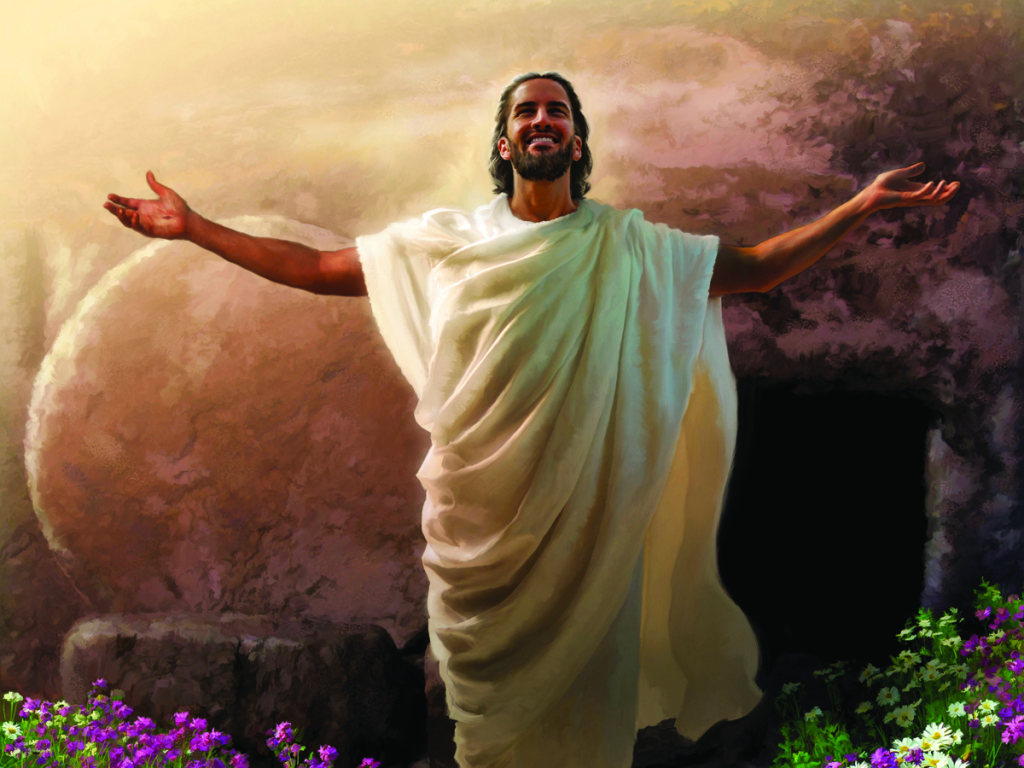
Trouble is, no one has ever returned to tell us, confirm it, that there is something more. Except Jesus Christ, if you subscribe to that hope.
Actually, if we dare to face the issue in a measured way, the claims of Jesus have to be confronted. We ignore them at our peril. We can’t afford to unthinkingly take on the common but uninformed opinions and fancies of people who deny any life hereafter. What do they know? They know nothing, have no evidence, no authority. Yet that’s the opinion we mostly go with, because what else can be true? Surely this is all there is, here and now, because the alternative conclusion carries profound implications, which we don’t dare buy into.
It’s not for me to say. I have no authority either. But Jesus’s claims need to be assessed. He was undoubtedly a historical figure. (There is more documented evidence for his existence in history than for most other historical figures whose existence we never question.) And this Jesus claimed to be the portal to eternal life. A wild claim! Scorned and spurned by an increasing majority in our world. But he claimed it and, if you accept the truth of it, he rose to life again after his execution, asserting and evidencing an after-life.
Truth or fiction?
There’s a simple test: that historical Jesus was either mad (yet, read his teachings – surely not the wisdom of a madman), or he deliberately lied (yet it was a lie he willingly and without recanting or trying to escape it, went to the Roman cross for), or he spoke the truth. Mad, lie or truth?
Dying is a bewildering, scary mystery for we on this side of it, but one for which there are clues if we have the wit and courage to soberly evaluate them.
(Based on Matt 5:38-48; Leviticus 19:1-2, 9-18; 1 Corinthians 3:10-11,16-23)
The past week has kind of seen our world turned upside-down, hasn’t it? Cyclone Gabrielle has swept across our country with impacts that many of us haven’t seen or experienced before. On the Coromandel we have seen our road networks fail, our power network fail, our communication systems fail, our water supply compromised and sewerage systems overrun, trees blown over, land slipping, boats run aground and flood waters rise to threaten our houses and businesses. All that nature at its most destructive can bring.
But, in all of that, we have also seen members of our community shine out the best that humanity has to offer. They have willingly stepped in to assist others in whatever capacity they could. From offering neighbourhood help, to providing accommodation for the displaced, to sharing scarce resources, to those big roles of managing the community response to the event, maintaining order and calm, ensuring community safety, and so on.
But as we analyse how we coped and the lessons we may have learned, or need to learn, we as a region realise that we actually got off lightly compared to our countrymen and women in the Hawkes Bay. As we are learning, there have been a number of fatalities already and there are still hundreds of people unaccounted for. Estimates put the tally of homeless in the region so far at around 10,000! You can’t help but re-set your perspective of our experience of the cyclone against theirs. Most of the things we faced are now inconveniences when compared to the wholesale loss of houses and catastrophic damage to infrastructure they have suffered. So, what can we do about it?
As a church, we can pray! Pray for those who have been made homeless, pray for those who have lost family and friends, pray for those working to rescue those still in danger and resurrect infrastructure, pray for the generosity of the country, pray for the wisdom of leaders. We can pray for anything.
The church Council is gearing up for an appeal, to send our contributions to the relief effort in the Hawkes Bay region. Treasurer Albie has already sent out the details via email and will surely talk about it in the notices.
Now, today’s reflection has been impacted by the cyclone too! Let me explain. It started life a couple of weeks ago and I thought it was starting to look pretty scholarly and deeply meaningful. Then we had Strahan’s book launch last Sunday and the idea of a prolonged period of silent contemplation emerged as a cunning alternative to what I had been doing. No sooner had that idea popped up than we were looking into the eye of Cyclone Gabrielle, with all that she brought, and took away. No power, no computer, no driving compulsion to think or write. Especially on the topic I thought I should be reflecting on!
As I considered the way forward, the Holy Spirit put on my heart that what I had been thinking about was trite after all we have just experienced. So I felt encouraged to try to glean some understanding from the experience and relate it to what I had already started.
I started this talk referring to our world being turned upside-down in the past week. This dovetails nicely into what the Gospel reading today, from the Sermon on the Mount, reveals. It is one of the great examples of the way Jesus was turning His world upside-down. Last week, Norm read verses from Chapter 5 of Matthew’s Gospel. The topics Jesus dealt with in those verses were anger, adultery, divorce and making vows. They were all couched in terms of how we initiate things. The locus of control is in our hands. This week we have heard His teaching on revenge and love for enemies. These two topics are couched in terms of our reactions to circumstances and situations. The locus of control is out of our hands.
“Locus of control” is the degree to which people believe that they, as opposed to external forces (others, God), have control over the outcome of events in their lives.
This past week we have lived through a period when we didn’t get to initiate very much at all; instead we were reacting to the conditions we found ourselves in. The locus of control was definitely out of our hands.
The nature of that upside-down world Jesus brought is plainly stated in his words from the Gospel, “You have heard the law that says . . .” followed by, “But I say . . .” Essentially Jesus is saying, you know the old, but I offer the new. This new way, His new way, requires us to examine the motivations for our behaviour. Why do we do what we do?
I’m pretty sure we were all brought up on rules, the ‘law’ as it applied in our childhood homes. We knew them, and we knew what happened when we broke them. However, if your home was anything like mine, there was a good measure of mixed messaging going on. The rule about fighting was straightforward, you would think. We weren’t to fight, particularly among ourselves. But when it came to bullies, we were encouraged to stand up to them. Kind of, be as good as you can be, but “don’t let others do you down”, a favoured saying of my father. And in our humanness, most of us actually survived growing up and didn’t turn out too bad.
The Leviticus reading outlines the list of rules and laws God gave us to follow so that our lives would be easier, and easier for everyone around us. They are rich in equity and fairness. They make pretty good sense. They were recorded as sanctifying our lives. The passage says we should follow them because they will make us holy, as I read it, and we are called to be holy, because God is holy. That is how much value he places on us.
Jesus said many things that are hard to swallow. Take today’s examples; they go against human nature. But 1 Corinthians reinforces the upside-down nature of the New Testament world. We should take great heart from the fact that the wisdom of the world is “foolishness to God”. In fact, the world has spent centuries thinking about the very nature of God. Some very wise philosophers have tried to prove his existence (or non-existence) by reason, and have failed. Soren Kierkegaard, a 19th century Danish philosopher, concluded, among other things, that since God could not be found by reason he could only be found by taking a leap of faith! If human reason couldn’t find God, then the upside-down approach of Jesus must be the answer. And that deserves some philosophical unpicking!
A few weeks back we met for a service themed around us being the clay in the hands of God the potter. It was about how we are being transformed, transformed to be more like Jesus. To be moulded into perfection, the perfection of our Heavenly Father. In this moulding, the mixed messages of childhood are tossed out. Our focus becomes loving God and loving others. Not just those we get on with, but all others. As the locus of control in our lives moves about, we have been equipped to deal with it. We have been given the Jesus-focus.
In simple terms, in all of our circumstances all we need do is ask ourselves, “What would Jesus do?” A practical example from the last week could be how we reacted to the things happening around us. How did that compare to what Jesus would have done? Where was our major focus? Was it spouses and family first, then property? Over time, did that change? I know for me it did. Once I had experienced the full blast of the wind and rain and knew our house hadn’t rattled off its foundations and the windows hadn’t blown in, I was pretty much settled. The family had been kept informed of the progress of the storm and our welfare via the “Fam Bam” (a Messenger App group the children set up) while we had power and internet. But when things started to fail my focus turned a little more outwards. How were the neighbours doing? What could we do to help? Who did we need to check on?
I have to admit that I still have a bit of that moulding to go. I could have happily stayed lying in my recliner chair doing word puzzles despite knowing I should be out answering some of those questions. I did get resentful of those better prepared than me, with generators keeping their households running. How could they expose anyone to the annoying constant thrum of their generator for eight hours a day? You know how we humanly rationalise things. But once I acknowledged how selfish I was being, I realised that I needed to actively submit myself to the welfare of others. Thereafter it was easy to start addressing the neighbours and their concerns.
It was in submitting myself that I got release. This is the upside-down world I need. I want to be more like Jesus. I want to know what he would do my circumstances. I am a person who needs to be regularly reminded of what God is doing in my life. To that end I look for his affirmations. I take great heart from 1 Corinthians today:
Don’t you realise that all of you together are the temple of God and that the Spirit of God lives in you? God will destroy anyone who destroys this temple. For God’s temple is holy, and you are that temple!
Together we are the temple of God, with the Holy Spirit living in us. We are holy and have God’s protection. Take heart!
As we navigate the aftermath of Cyclone Gabrielle and take stock of the things we cherish and hold on to, let’s do it with our Jesus-focus. Let’s do it with thanksgiving, and let’s honour those who went out of their way to practically show the love of Christ to their neighbours in this community!
The biggest ‘disaster’ at our home during the cyclone was the blowing over of a fig tree, so this reading from Habakkuk 3: 17-19 is a great note to end my reflection on this morning:
Even though the fig trees have no blossoms, and there are no grapes on the vines; even though the olive crop fails, and the fields lie empty and barren; even though the flocks die in the fields, and the cattle barns are empty,
yet I will rejoice in the Lord! I will be joyful in the God of my salvation! The Sovereign Lord is my strength! He makes me as sure-footed as a deer, able to tread upon the heights.
Do you give death and dying much thought? In a healthy way, I mean? Is dying a notion we reflect on at all? Or avoid? Or perhaps obsess on? [Don’t.] No doubt there are various approaches.
I’m prompted by two stories, one recent, one historical. One fictional, one emphatically not.
I’ve just read a thought-provoking book, Tuck Everlasting. Written for teenagers (by Natalie Babbitt), its premise builds around a family who find a spring in a forest, drink of it, and find themselves immortal. The story explores the implications, especially the Tuck family’s misery in living forever in precisely their present form and age, while all around them others (spouses, children, friends, etc) grow old and die. At the time of the story – although one of them is still only seventeen – they have already existed like this for 87 years; and their daughter, who didn’t sup of the spring, died three years ago, aged 91. Imagine …
You’d think we would welcome immortality. But, wait … Could that possibly be worse than death? What if some could (live forever) and others couldn’t, so decisions had to be made? Or … what if we could all have it – immortality? Then we wouldn’t face the torment of seeing our loved ones age and pass on … Yeah, but … the planet couldn’t hold or support us if that was the case … And what about the bad guys?
So sobering imagining all this and cause for reflection – at a number of levels. Think about it.
I have a dying story.
I was on exercise in Central Queensland. I was part of the Orange forces, arrayed against the Blue forces. It was evening – a beautiful tropical evening. Flying was done for the day, our aircraft secured and camouflaged, and a group of us were sitting in a circle outside our dusty tents, shooting the breeze, as aircrew do, well fed and, if I recall correctly, drinking beer. Two soldiers, appropriately dressed in desert cam, so arousing no suspicion, bearing familiar weapons, sauntered up to our group and one of them handed a slip of paper to one of our circle. Unbelievably, they then took a step back, raised their automatic rifles and blasted us – full circle – rat-tat-tat-tat-tat! We dived for the ground, folding chairs clattering and tumbling, bodies tangling – all in the intense shock of the first half second. By the time we recovered and crawled uncomprehending to our knees, the two had vanished and we looked around at each other sheepishly. What the hell?! Our member with the note, still in his hand, unfolded it and read, “Bang. You’re all dead,” and it dawned on us. Two Blue Force soldiers had somehow got into our camp and brazenly wiped out (albeit it with blank rounds) three Huey helicopter crews.
It was a memorable experience for me. The closest you can come to experiencing death without actually being deaded. So sobering and cause, would you not agree, for reflection – at a number of levels. Think about it.
How we strive to avoid death. Wired to survive, at all costs. Difficult for most to even to contemplate it – dying. It is the worst thing that can happen to a living person, nē rā? A person without a faith, anyway.
But imagine dying wasn’t on the table …
There’s a lot more to the matter than we usually give weight to, and … well, go on: think about it some more, and see if you can’t come to a more balanced view (and acceptance) of it. I’m not sure how my own death experience has helped. It was a rich adventure, at least. Maybe that’s the thing … dying could be imagined a last great adventure.