by Barry Pollard
(Based on Mark 5:21-43, Psalm 130, 2 Cor 8:7-15)
Mark’s gospel reading today gives us two stories in one. The first is the story of Jairus’s daughter, who is dying, the second is the story of the woman afflicted with non-stop bleeding. Each is a story about faith.
As I pondered them, and what they could mean in my life, I ended up with more questions than answers.
Jairus was a leader of the synagogue, presumably steeped in Jewish ways and faith, yet he appeals to Jesus, who was preaching to a crowd of disciples and the curious. This tells us a couple of things: knowledge of Jesus was spreading and having impact, people starting to believe that he had the power of healing, probably as they learned of his other acts of healing and miracles. And people with no close relationship with Jesus were seeking him out.
This was a feature in the second story of the woman. In various accounts she is referred to as a “zaba”, literally meaning “oozer”. She must have had knowledge of, and faith in, the one she sought. She had experienced “remedies” and treatments from many doctors over a long period of time and no healing had been effected, no relief given. Yet she had enough faith in what she had heard about this man Jesus that she sought him out, believing that even to touch his robe would be enough to be healed. Something to remember is, desperation can lead to deep faith.
The touch was enough but it drew a response from Jesus that gives us a clue about healing power, for the healer and the healed! For Jesus there was an awareness that healing power had gone out of him. He hadn’t initiated it. The woman had. I assume that there must have been a sudden drain in energy that he sensed; and for the woman, she had a physical awareness that her bleeding had stopped and her body was put right.
This type of sensing I can identify with, having dislocated a shoulder. After visiting the A&E department for it to be put back, I suffered through two weeks of physio trying to get it to do what it should. A follow-up visit to the hospital led to the job being done properly and the relief I felt was instant! It was back where it should have been and functioning pretty much as normal.
But Jesus called the woman out. He wanted to identify who had been healed. His disciples didn’t give much encouragement in the search, but he kept looking and eventually the woman came forward and fell at his feet, admitting that it was she who had touched him and been healed. Jesus’s response publicly identified what had brought about her healing – faith!
Remember that the story of the bleeding woman is told within the story of Jairus. Jairus has asked for Jesus’s help in the first instance and they were en route to his house when the woman intervened. The healing of the woman and his follow-up teaching had brought the procession of the crowd to a halt. Jesus was not to be hurried and took the time to explain what had happened for the benefit of not just the woman but the crowd watching on.
But as the healing of the woman was concluded the attention turns back to Jairus and the daughter in need.
As Jesus was sending the healed woman off, messengers from Jairus’s house arrived to announce the passing of the child. Jesus heard this news and turned to Jairus to encourage him. “Don’t be afraid. Just have faith.” Remember, like the woman, Jairus has sought out Jesus to heal his daughter.
The crowd was stopped, and Jesus proceeded to the house of Jairus in the company of disciples Peter, John and James. As you would expect, the scene on arrival at the house was one of weeping and deep sorrow at the passing of a loved child. Something else to remember is, desperation can lead to deep despair.
Not put off, Jesus announced to everyone gathered there that the girl was not dead, simply asleep. Disbelief was rampant and he was mocked openly. But, undeterred, Jesus proceeded into the house with Jairus, his wife and the three disciples to raise the daughter back to life. Holding her hand and saying, “Little girl, get up” was enough!
You can imagine the depth of amazement in the room, as a child that had been declared dead was suddenly up and walking around. Jesus, ever practical, tells those in attendance to refrain from telling others what they had experienced, and to get the child something to eat!
At this point I admit that I have more questions than insights about Jesus and what he was doing in these accounts. Perhaps you’ll ponder these along with me:
- He was alerted to the presence and actions of the bleeding woman by sensing that power had left his body. If healing had that effect on him, how much more might he have felt bringing Jairus’s daughter back to life?
- And, why did he order those who witnessed the resurrection of the girl to say nothing about it, yet he publicly identified and spoke with the suffering woman?
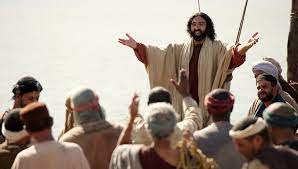
Has anyone heard of the television series on the life of Jesus and the disciples called The Chosen? It is a crowd-sourced television production depicting the life and impact of Jesus on those he called to follow him, the disciples. Watching it, I have come to see and understand another side of Jesus. He is wonderfully portrayed as a smiling, engaging man who exudes love, compassion and goodness to all others. If you have ever struggled to come to terms with who Jesus really is – man and God – this show might give you a better appreciation, as it has me. I would have loved to have been in his company! He was funny, intelligent, friendly, and purpose-driven, and, yes, he appears to have enjoyed feasts and the odd wine!
Anyway, the idea of healing power leaving his body was a theme used in one of the shows. In the episode Jesus was leading the disciples through the wilderness, and the crowds who have heard of his healing power turn up en masse to be healed. The show focuses on the disciples going about their work, preparing food, erecting shelters and so on, but all were concerned for the welfare of Jesus who is engaged throughout the day, without breaks, healing those who keep turning up before him. The day ends with the evening meal being served and Jesus staggering into the encampment and heading straight for his bed roll, saying he was too tired to eat and talk. He was drained. The power had been going out of him all day long! [You can view the various episodes here.]
This provided further insight into the life of Jesus for me – selfless and serving – and explaining the draining effect of healing others.
The leading characters in our two Gospel stories, Jairus and the bleeding woman, both demonstrated deep faith. And in each story Jesus acknowledges the depth of their faith – by miraculously raising a loved daughter to life for Jairus, and healing the body of the woman who had carried her affliction for more than a decade. Their faith was rewarded.
And for those who have ‘read ahead’ and researched the accounts in Mark’s Gospel, you might be thinking about the taboos Jesus was breaking down: it was forbidden for rabbis to touch the dead (in the case of Jairus’s daughter) and it was forbidden to have contact with a menstruating woman (in the case of the zaba). These were significant steps that Jesus was taking, to break down the strictures of the law, providing instead his grace alternative.
In today’s Psalm, the message I heard was that the despairing can have every hope in the Lord, because he is faithful. The psalmist acknowledges that God is upon high, and petitions for a hearing. He confesses that he is a sinner but knows that God forgives. He counts on the Lord, longs for the Lord, hopes in the Lord. He sees God as unfailing, redemptive love!
The psalmist definitely has faith in a faithful God!
The reading from Paul’s second letter to the church in Corinth builds on the idea of faith. The message I heard is, if you have faith (and Paul acknowledges that the church of Corinth was a faithful community), you need to demonstrate it in practical terms. Imagine a church where the faithful sat around and did nothing. Would that have appeal, would it draw others in? Is it sharing the Good News? It is not exactly how God envisaged us ‘living out our faith’.
The Corinthians were grappling with the issue of supporting other churches, particularly those in need. Paul’s letter was to encourage them to continue to be generous in their giving, according to what they had. His point was that while they were in a position to help, they should, because there may be a time in the future when they might need the help of others. Paul uses the Jesus-comparative in verse 9 to emphasise his point: “You know the generous grace of our Lord Jesus Christ. Though he was rich, yet for your sakes he became poor, so that by his poverty he could make you rich.”
By heeding Paul’s advice, the church of Corinth would further the theme of faith and generosity.
This brings up my next set of questions: What about us?
- As in the case of the psalmist, do we see God as faithful? Does he ever change? Do we believe he is the same today as he was yesterday and will be tomorrow?
- Are we faithful? Is our faith as unshakeable as that of God? Do we seek him out only when we face crisis? Or do we turn our backs on Him in our time of desperation?
- Do we live out our faith? Do we take thought to action? Do we act in equitable ways?
For each of us the answers will be different. And will be according to situation, according to experience, and according to belief. As we mull these things over we may face a reality check or two. I know I did, and do.
A worry I have is that we may see faith simply as a transactional thing – I desire this outcome, so to bring it about I’ll believe more, live out my faith more, and so on. If we take the face-value message of ‘faith equals a great reward’, we are likely to fall way short.
If faith isn’t transactional, what is it? Faith is moral and spiritual, and it is relational. In fact, the very heart of faith is about relationship to God through Jesus Christ and, through that, relationship to others.
Jesus was always pointing us to faith in him. If our faith is anywhere else, we have missed his point.
Our challenge this week, and I hope you’ll take it up, is to spend time examining our faith in relational terms. Set aside time and make it a ‘waiting on the Lord’ time. Be honest in your assessments and commend them to God. Expect to hear his response!
Hear from you next week?
Let us pray: Healing God, you are indeed life and wholeness. Transform our brokenness by the power of your life-giving love, and deepen our faith.
We ask this through your faithful Son, Jesus, who lives and reigns with you, in the unity of the Holy Spirit, one God, now and for ever. Amen





 stfrancischurchtairuanz