Some Thoughts on Acts 11

by Liz Young

(Based on Acts 11:1-18)

My thoughts and those of the Online Bible organization on Acts chapter 11. May they enlighten and enthuse you.

Jesus’s teachings and his redemption are for us all: Jews and Gentiles alike.

I was reminded last week of all the Jewish friends I’ve had, as many Jews go into medicine; in particular, David Baum a neonatologist at Bristol who organized a multi religious service for paediatricians in the UK, at York Minster, and for whom as a student I enlisted the help of a Jewish flatmate, so I could offer him a kosher dinner.

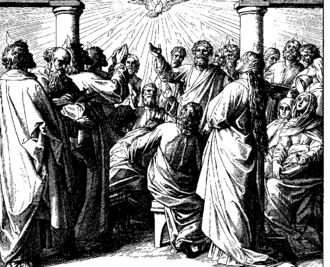
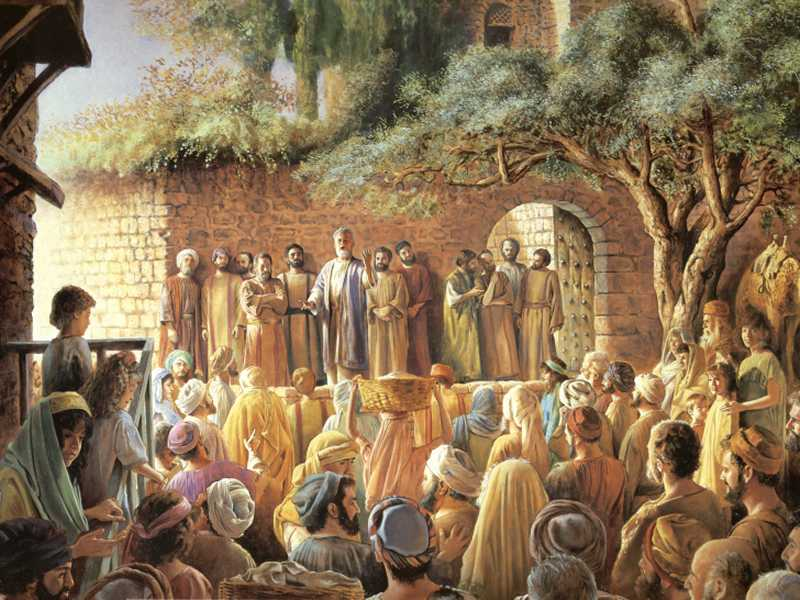
In this chapter in Acts we hear of Peter’s dream of a feast, a feast of non-kosher food. This was God’s preparation of Peter’s mindset, to expand his expectation of sharing Christ’s teachings to the Jews, with going on to share it with all people regardless of the culture they had been born into. Peter took six Jews with him to witness how the Holy Spirit was working through him, to share the Gospel, the Good News, with Gentiles who had not had a life time of following Jewish rituals.
Israel had been God’s chosen people for centuries, keeping God’s teaching safe from infiltration by other local religions. But Jesus taught that everyone, anyone of any nation, who turns to him in repentance will benefit from his love: and Paul also wrote, “Gentiles who turn to Christ have become fellow heirs, fellow sharers in the promise of Christ through the Gospel.”

We have to understand that although it is God’s purpose to provide our salvation, he would like each of us, in person, to participate in passing on his message. He sent his message to Peter in a dream, the dream of a feast of forbidden bounty, but Peter had to interpret that message and preach it, to pass it on to the Gentiles. We can preach by thought and word and deed: altering our mindsets, preaching encouraging words, acting on our thoughts, and loving others every moment of the day: helping people witnessing our actions to understand Christ’s message: Salvation comes from God.
But we, weak and feeble humans, social animals, have to carefully choose our moments to offer help, consolation and encouragement when the time is right. Not to be too pushy, but to be emotionally intelligent in our encouraging, in our offers of help and actions.

The On-line preacher I looked up states that if you are not involved in getting the Gospel to different nations, you are not involved in God’s purpose. On reading this, I excused myself by thinking of the Christian charities I support: the Leprosy Mission, because although leprosy can be cured now, the cure may not get to isolated, rural, poor people; IHC because they and their families get isolated within their own group with little time to share with others; and the Auckland City Mission, because we live in a comfortable and caring community here in Tairua, and they are constantly working with needy people.
We also have to overcome our shyness at mentioning our belief, when chatting with friends and neighbours.

We also have to be open to sharing our belief with those at the end of their lives, or dying, at our local resthome, Matapaia. So often we are tempted to hold back at this time, but it’s an opportunity for very close conversations, and can bring relief for those who need to get something off their chests.

And the On-line preacher recommended that our local church should be as racially diverse as possible. For historical reasons we have few local Maori living here, but the restaurant and local stores have owners, their families and workers who are not NZ Europeans, and I’m always pleased to see us welcoming them here; and plan to share my custom more widely.

I’ve been reading two books this week, which relate to this reflection’s message of ‘loving one another’. One, The Twins of Auschwitz, who, on entering Auschwitz camp, were separated from their sister and parents, who were then killed immediately. The twins were taken to Dr Mengele who studied identical twins, and one wrote their story later, which included the daily little stories of prisoners caring for each other, that kept them alive.
The other book deals with the spontaneous caring for one another shared by communities in war zones.

Love others every moment of the day! A tall task. It’s easy to get irritated by some habits of others, especially when we’re tense or worried about something else; when we’re interrupted while doing something we want to concentrate on (for me it’s while I’m reading a book); or when we’re asked to volunteer and we feel overloaded. But I think that’s something we can prepare for while we’re in our quiet space of self-reflection, prayer/prayer time. Even as I write this I’m making a mental note to do that more often. We need to be alert to others at those times, and we need times when we enjoy ourselves. For me that’s while I’m gardening, or on a walk through a forest,  or on the beach: a time when we can restore our souls, even as Jesus did by the shores of Galilee.

So I share my thoughts and love with you, in the name of Jesus.

It’s hard to be humble

The rottenest thing about humility is that, if I might put it thus, in achieving it you lose it!  Like, in striving to achieve it, and you think you’ve achieved it, and rising in your mind is the thought, I’m there. I’m so humble.  I’m just so satisfied I’m at last so humble!
(Like the old line, I used to be conceited but now I’m perfect!)

There’s a great song that begins, “Oh, Lord, it’s hard to be humble, when you’re perfect in every way …”!  Do you know it?  You can read all the words here.
It’s so self-mocking, yet true to life.  I recognise my own instincts in it, and it reminds me once again to get over myself.  To not take myself seriously!

Humility is something we recognise in others, but struggle to emulate, and even to define.  (And I’m not satisfied with the dictionary definitions I’ve uncovered.  One dictionary, Merriam-Webster, gives examples: “Being a parent can be a humble job, wiping noses, changing diapers, and meeting a child’s every need for years. Letting someone ahead of you in line when you see they are in a hurry is an act of humility. Cleaning the toilets of your office, even though you own the company, is an example of humility.”  No, even these don’t suffice.)

Watchman Nee wrote, “Genuine humility is unconscious … God’s workers must be so emptied of self that they are unconsciously humble.”
I knew a Pastor once who seemed to have quite a big ego. But one day I learned of something amazing that he’d done with his own time and money, and never mentioned it, never sought applause, never had it known by anyone except the recipient of his service.  My previous suspicions dissolved and I realised I’d misread the ego thing.  Boy, was I humbled.

A famous conductor (a story goes) was once asked what instrument he considered the most difficult to play.  His reply:  “Second fiddle.”

Abraham Lincoln wore tall ‘stovepipe’ hats. The man he defeated for the presidency in 1860, Stephen Douglas, is reported to have held Lincoln’s hat at his inauguration.  As he stood up to speak, Lincoln (himself a man known for a certain humility), looked for somewhere to put his hat.  Douglas rose and took it, sat, and whispered to a cousin of Lincoln’s wife, “If I can’t be President, I can at least hold his hat.”

Getting the idea?

Last anecdote.
No, second to last.
Author Elisabeth Elliot wrote, in musing over Isaiah 59 about the Potter and his clay, “I believe the word humble comes from the Latin word humus, meaning earth, clay …”

And Merriam-Webster concurs. That helps. Think about it.

Last one:  Gladys Aylward was a much admired twentieth century missionary.  Her story contains some breath-taking, credibility-defying chapters. (Read about her here.)  But she started out a poor, uneducated (due to learning difficulties) parlour maid to a wealthy British family.  She became a missionary (an inspiring story in itself), and near the end of her decades in China she travelled the world speaking to large crowds; dined with Queen Elizabeth and Prince Philip, and was the subject of a This Is Your Life TV programme.  But the most striking thing about Gladys was her unconscious humility, saying on one occasion, “I wasn’t God’s first choice for what I did in China.  There was someone else … I don’t know who it was … I don’t know what happened.  Perhaps he died.  Perhaps he wasn’t willing.  And God looked down and saw Gladys Aylward …”

Ah, yes.

To know me is to love me
I must be a hell of a man.
O Lord it’s hard to be humble
But I’m doing the best that I can.
(Mac Davis, 1980
)

Ken F

Resurrection Evidence

by Bruce Gilberd

(Based on John 20:19-31)
Feature art work is The Incredulity of Saint Thomas by Caravaggio

Have you ever missed a meeting when a crucial decision was taken, or a surprising/astounding event happened?
I have!
So did Thomas – on Easter morning – when all the apostles were gathered, except for him!  So he missed encountering the risen Jesus.

Pragmatic and, yes, doubting Thomas didn’t miss next week’s meeting, that’s for sure, and so we have John’s description of the Jesus-Thomas encounter and its astounding outcome: “My Lord and my God!”

The risen Jesus appeared several times to believers and apostles after the resurrection, for about six weeks.  This is one of three main evidences that lie behind our belief that Jesus was raised, and that this is an historical fact.
So, we gather, as today, around a risen, wounded Lord of all humanity.

The second more pragmatic piece of evidence is the empty tomb and the head and body cloths lying undisturbed, but not enclosing a body – as seen by Peter and John, after Mary Magdalene had been greeted by Jesus.


How the politicians and religious leaders of Israel would have delighted in finding Jesus’s body …
… but they didn’t.

The risen Jesus came to those who believed, in a new bodily form – Bishop Tom Wright describes this as “incorruptible physicality”.  Worth pondering …
It is wise to note here that Christians and the church, from its first days, rejected the Greek belief in ‘the immortality of souls’, but kept embracing the truth of the resurrection of the body, so sustaining true personhood – of body, mind and spirit.

So, evidence of resurrection:

  • Encounters with the risen Jesus,
  • the empty tomb,
  • and, thirdly, the birth, life and expansion of the early church, empowered and guided by the Spirit of Jesus, the Holy Spirit, given to the apostles by Jesus, and so to the personal and corporate life of believers ever since.

Since then the church has had a somewhat dodgy history, over the twenty centuries, to our own day.  There have been

  • splits and rows and conflicts over beliefs and practices;
  • crusades;
  • capitulation to wealth and secular powers;
  • and avoidance of her prophetic role (which must be worrying Russian Orthodox church members right now …)

Nevertheless, God, down the centuries, has raised up men and women to be beacons of faith, and movements of renewal.  And so the church, called and re-called by God’s Spirit, has housed and brought the Gospel to every land, and to us here and now in Tairua.

The church in many places today is a persecuted church – as the Barnabas Fund informs us, and asks us to pray for, and give to.

The flawed church, because there are people like us in it, is constantly called to be a wounded church, living out costly discipleship, in the power of our risen Lord.  All our hurts, as real as they are, are resurrections unborn.
A comfortable church is a worry …
We are to be Easter people living in a Good Friday world.  Yet a world in which critical triumph has been achieved – on Good Friday and Easter Day – but its effects await completion.

So, the evidences of the resurrection:

  • The empty tomb
  • The appearances to many
  • The birth of the church

In the resurrection event history, science and faith all coalesce.  So our heads and our hearts can joyously receive in the present the One who comes to us from the past and from the future!

Wounded, risen Lord Jesus … may our hurts, doubts and questions lead us all to you. Amen

Remembering Paskhas

Easters are not generally remembered like birthdays or Christmases.  Who really remembers stand-out Easters?  Well, thank you for asking.  I do.

My first (of three – chronologically, not in rank order) was in Queenstown.  Camping out of my Morris 1100 in off-road laybys, hooning with mates in various acts of late teen larrikin-hood.  The abiding memory, standing atop a snowless Coronet Peak in weak sunshine, intoxicated by the remarkable 360 degree scenery.  It was good to be alive.

Second one saw me (and I saw it) in Moscow with my wife.  Except that there it was called Moskva (Москва), not Moscow, and Paskha (Пасха), not Easter; and there was no off-road camping or larrikinism or one could be shot. Russian Orthodoxy. No sun either (just a whitish, suffuse light, and dirty slush all around).  But, what atmosphere; what a memory.  It was good to be alive.

Cue time ticking by and there we were: wife and me and now three kids – two larrikin sons and a haughty daughter.   Camping, but not really off-road: under willows down by the river on Uncle Mansel’s farm.  “Don’t let Mansel take you through his bull paddock,” my Mum had warned me, as she had on possibly twenty three previous visits (from the time I was five years old).  “He’s too casual.  Those bulls are dangerous.”
Well, we kept clear of the bulls.  I was scareder of Mum than the bulls.
We swam in the river when we arrived, although as soon as the larrikins reckoned eels had nibbled their feet the haughty daughter could barely be persuaded to leave the car, and the river was definitely a no-go zone for her.  I dug a magnificent long drop with a lovely rural view.  But people refused to use it, preferring the considerable distance up the hill to the farmhouse WC.

The car, by the way, an Austin Princess, was parked down the slope in the long grass.  Which became problematic during the night when black skies opened and floods came.  We huddled unsleeping until the waters began to flow through the tent – until it came time to evacuate.  We bundled what we could into the car and … but, no, the loaded Princess wouldn’t handle the drenched grassy slope.  Everybody out, unpack, take only what you can carry …  I managed to nurse the Princess up the slope in low gear while wife, larrikins and haughty daughter pushed, and we spent the rest of the night, and the next one, in sleeping bags on the floor of Uncle Mansel’s house.  But, when all was said and done, a great memory, and it was good to be alive!

Coronet Peak, Москва, Uncle Mansel’s farm in the storm … ah, yes.

There was another Paskha apparently – I wasn’t there but I’ve heard told – when a man was executed on a hill.  But, fair play, that’s one Пасха few of us care to remember.  Too raw.  Uncomfortable to contemplate and, it’s only a myth anyway, isn’t it?  That old rugged cross … nothing to do with me, is it?
It’s cosier to centre our rememberings nowadays on bunnies!  And chocolate and eggs.  None of which relates to His memory, hijacked as we have become to commercial interests.  Oblivious to the greatest story ever told.

Ah, yes, good times.  Great memories.  But give me bunnies, not crosses, eh.

Ken F