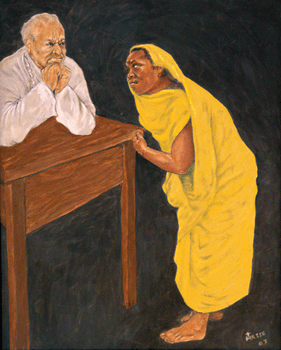
Place of Honour?

by Joan Fanshawe

(Based on Luke 14.1-14; Prov 25:6-7)

It has been said that if Jesus came and walked the streets today, people in Christian churches might not recognise him or want to hear what he had to say.

Jesus wasn’t known for his politeness around the dinner table; or … Jesus wasn’t known for his politeness. The Gospels record him bluntly challenging the social order of the day many times.

Although it might be surprising to hear today that Jesus has been asked to a Sabbath meal by a leader of the Pharisees, Jesus was actually an acceptable guest – that is, he was very well versed in the Scriptures and Torah rules.

Bill Loader, Emeritus Professor in New Testament studies at Murdoch University, Perth, points out in his commentary on this passage that Jesus’s greatest conflicts were with those closest to him: the Pharisees.
Why?
Probably because they felt betrayed by his behaviour. He was observant of Torah but in a radically different way – more about setting priorities perhaps. They had no answer when he challenged them about his healing on the Sabbath, but they were watching him closely.

In this passage, what Jesus challenges is a customary rule of favour and status that was the social norm in that all important arena of gathering to eat together.

These days, meals are too easily obtained by most of us, for us to really appreciate their major role in the ancient world. Group meals, including wedding banquets or communal meals, were important community events, some being of such significance that they became the life and identity of a group. We know this was so in the earliest Christian communities where the Eucharist had its setting in a group meal.

Among the ‘rules’ for meals of this kind, there will be a correct order of seating. There is a place for the most important and the least important and everyone in between.
In first century Palestine, reclining on one elbow beside a very low table, or on low couches, had become the established fashion and is reflected in most meals mentioned in the gospels. (Disciples reclining beside Jesus on other occasions would probably also have had places. In John’s gospel we read that the ‘disciple whom Jesus loved’ was seated in intimate proximity to him.)

So in the ancient world, place was guarded most jealously. Society was strongly hierarchical. There was a place on the ladder. For many it was a matter of economic survival to make sure they either stayed where they were, or climbed higher. Position was not just a matter of individual achievement, it was in some sense given by the group. Your value was inseparable from what others thought about you. Most to be feared was to lose your place, to be embarrassed, to be publicly humiliated by having to take a lower place.

This is the setting for what appears at first as a bit of practical advice. Like many sages of the day, and like today’s Proverbs reading, Jesus instructs the would-be go-getters to avoid putting themselves in the position where a demotion might occur. Indeed some commentators leave it at that, so that Jesus is simply giving advice to go-getters. Perhaps Luke read it that way and connected the sentiment, ‘If you want to be exalted, humble yourself!’

But Loader points this out as a contradiction in terms, because such strategies very often result in a false humility driven by self-interest and personal advancement, thus defeating the purpose.

Because after offering this free advice on how to climb the social ladder, Jesus then dismantles it by exposing the underlying social structures which maintain these ladders of power and privilege.
“Next time you’re planning a lunch or dinner,” he says to his host, “don’t invite those who are within your circle, don’t invite those who can influence your advancement. Instead, send invitations to those who cannot return the favour in any way. Invite the unclean, the poor, the marginalised, especially those who have no access to the parties that matter. Then you will be blessed and rewarded at the resurrection of the righteous.”

Does Jesus really mean that we should put people in our social debt who cannot repay us because we will be repaid by God when we get to the pearly gates? Are we to help the poor and needy in order to build up points for our own future salvation?

Loader calls that spiritual capitalism at its worst, and he isn’t alone: others have similar reservations and we know it does happen.

Sometimes we are tempted to confuse privilege with blessing. This is especially dangerous if we name our privilege as a blessing from God. One way of understanding the Gospel is to see it as a call to transform our privilege into blessing for others – who ordinarily are denied either privilege or blessing.
The whole Gospel of Christ invites us to acknowledge God’s love for all people and to act in a whole-hearted belief in that love. Acceptance of being beloved of God oneself and then sharing love fully in all directions. Taking up this invitation to love is an invitation to life which, when lived generously, is its own reward.

The lines of love – for God, for others and, yes, for our own self, need to be closely entwined; the connection becomes frail if one element fails. Being aware of our actions, some might call it self-examination, leading to confession – can keep us from getting caught up in thoughts and actions that can deny the fullness of life to others in the pursuit of our own interests.
Always accepting and gratefully affirming that the strand of God’s love for us never falters and we need not be afraid.

How then does this passage have any connection with what happens at the banquet of life today? I found it very timely to see recently a story about New Zealanders sharing a banquet. Called The Table, this was done comic book style and as I can’t show you the cartoons I’ll read the captions in order:
Imagine you’re invited to a dinner.
There are ten guests, ten seats at the table and ten plates of food.
But when you sit down to eat, one person is served nearly six meals (5.8 to be precise). Four people get a meal each. Then five people have to share one fifth of a meal between them.
And that’s dinner in New Zealand!
That is the distribution of wealth in NZ, based on Statistics NZ’s 2020-21 Household Economic survey.
This showed the richest 10% of adults hold 58% of NZ’s wealth. That means money in the bank as well as assets like property or cars, minus debts.
At the other end of the table, the poorer half of the country holds just 2%!
Of course, in reality it didn’t get served up like this out of the blue – it’s happened over generations.
And while individual effort does matter, it’s also true that wealth leads to more wealth and poverty leads to more poverty.
Uncomfortable words jar into our consciousness: colonisation, dawn raids, child abuse, and discriminatory wage gaps are some such words.
But being conflict averse we don’t say anything about it, do we?
Max Rashbrooke, author of Too much money and inequality; a New Zealand Crisis,
features in the comic strip, saying this should be a source of great embarrassment to us, because we think we’re very egalitarian, and it’s awkward to acknowledge.

Here is the link to the whole piece:
https://thespinoff.co.nz/society/16-08-2022/the-side-eyes-two-new-zealands-the-table

Rashbrooke has further comments – not wanting to make it an ‘us versus them’ argument, but suggesting that a fairer distribution of wealth could mean a world (or a table) that’s better for 50% of New Zealanders.
I don’t know what the answer is – but I am sure that this Jesus-inspired life of love for others that we are called to must include facing this situation openly, to find a better and fairer solution that doesn’t rely on ‘feel good’ charity.

Last week our church children were introduced to some new words: ‘Hypocrite’ (which Michal remembered meant not practising what you preach). And ‘the Pharisees’ (whom we’ve met today again today). Jesus called these religious ones out for failing to follow the important matters of the law – justice, mercy and faithfulness.

Can we think boldly about ways to ‘share what we have’? Or, better, think boldly about ways the dominant economic system needs to change, so that wealth, resources, and opportunities to enjoy them are more fairly accessible to everyone.

I add these quotes in closing:

“When I feed the poor they call me a saint. When I ask why so many people are poor they call me a communist.” (The late Archbishop Dom Helder Câmara, of Brazil)
“Jesus did not die suggesting a more caring and sharing society. He was executed for demanding a radically transformed society in which ALL of God’s children are fed adequately and with dignity. Capitalism would have him executed today as well.” (Anonymous blogger on davidlose.net)

Dear God, draw us ever nearer in your love so that we might always have the confidence to be that love for others, as Jesus teaches us. Amen

Pollyanna Part Two

Continuing … (refer to Part One, here) …

Bob Newhart

If pessimism can and should be challenged, is optimism the antidote?  Yes … and no.  Stating the obvious, it’s a high bar to expect someone of pessimistic disposition just to change up.  (Although, Bob Newhart had a comic take on this, worth the viewing: see here.)  And, perversely, a pessimist is likely to feel pretty pessimistic about his/her chances of attaining optimism!
Naïve optimism – pollyannarism – is unrealistic too, and can be damaging.

Optimism, though, let it be said, is an admirable and therefore desirable state to realise. If you can.

Why?

Well, if you always see the brighter side of things, there’s a chance that you’ll experience more positive events in your life than others, find yourself coping better, with lower stress levels, better physical health, and higher persistence when pursuing goals. You’ll see challenges or obstacles as opportunities to learn.  You’ll feel gratitude for the good things in your life.

A passage on the Psychology Today website says that an optimistic disposition “helps protect against doubt and despair, which can make people feel like whatever they try is futile, and a negative outcome is already predetermined. Optimism gives them hope that they have some free will and that they have some power to change their circumstances for the better.”  Even shaky optimism, poorly founded, can increase chances of success or happiness.
People who are more optimistic “tend to have better pain management, improved immune and cardiovascular function, and greater physical functioning … Optimists tend to look for meaning in adversity, which can make them more resilient.  They are likely to see the causes of failure or negative experiences as temporary rather than permanent, specific rather than global, and external rather than internal.”

Such a perspective fosters hope, even in unhopeful circumstances.

Fair play, I’m labouring the benefits because it’s a thing worth doing, if I can only persuade so.  It’s not an easy choice for everyone: there can be genetic and chemical and situational blockades to overcome.
But it can be, nevertheless, a choice.

So, if I’m going to labour this thing, I’d better set the table with some practics … some how-tos.  Anyone can search for these online, but here’s some suggestions from the verywellmind website:

“Research suggests that genetics determine about 25% of your optimism levels, and environmental variables out of your control—such as your socioeconomic status—also play an important role.  But this doesn’t mean that you can’t actively improve your attitude. There are things that you can do.”
These include:

  • Become more mindful: Mindfulness is a focus on being engaged, attentive, and present in the here and now. It can be a useful technique to help you focus on what matters in the present and avoid worrying about future events and things that are outside of your control. If you’re living fully in the moment, you’re much less likely to ruminate over negative past experiences or worry about upcoming events. This allows you to feel more appreciative of what you have now and less consumed with regrets and anxieties.
  • Practice gratitude: Gratitude is an appreciation for what is important in life. One study found that participants who were assigned to write a gratitude journal showed increased optimism and resilience.  If you are trying to develop a more optimistic attitude, set aside a few minutes each day to jot down some of the things for which you are grateful.
  • Write down your positive emotions: Research has shown that something as simple as writing down positive thoughts can help improve your optimism. One study found that expressive writing focused on positive emotions was linked to decreased mental distress and improved mental well-being.
  • Cognitive restructuring: It is possible to develop ‘learned optimism’. Pessimists can essentially learn to be optimists by thinking about their reactions to adversity in a new way and consciously challenge negative self-talk.  Using a practice called cognitive restructuring, you can help yourself become more optimistic by consciously challenging negative, self-limiting thinking and replacing it with more optimistic thought patterns. Here’s a summary:
    1. Identify the situations that are triggering negative thoughts or moods.
    2. Identify the actual negative thoughts that you are having in response to the situation.
    3. Consider the evidence that either supports or refutes your negative thoughts.
    4. Focus on the objective facts, and replace automatic negative thoughts with more positive, realistic ones.

Oh-oh.
This blog is already too long, and I haven’t even begun to unpack the Pollyanna Effect yet!  Better hold off for the next exciting Part … Part Three.  Unpacking Pollyanna!

Ken F

Division? Really?

by Strahan Coleman

(Based on Luke 12:49-56; Isa 5:1-7)

One of the earliest documents we have from the early church, dating from the first or second century, is called the Didache, commonly known as The Teaching of The Twelve Apostles To The Nations.
In fact, before the New Testament canon was formalised in 692 a number of biblical collections included it. It gives us some profound insight into the emphasis and values of the early church.

I want to start this morning by reading from it …
(The Way of Life)
There are two ways, one of life and one of death, and there is a great difference between the two ways. The way of life is this. First of all, you shall love the God who made you. Second, love your neighbour as yourself. And all things you would not want done to you, do not do to another person.

Now the teaching of these words is this. Bless those who curse you, and pray for your enemies, and fast for those who persecute you. For what credit is it to you, if you love those who love you? Do the people of the nations not do the same? But you should love those who hate you, and you will not have an enemy.

Abstain from the desires of the flesh and of the body.

If anyone strikes you on your right cheek, turn the other cheek to him also, and you will be perfect. If anyone compels you to go one mile, go with him for two miles …..

 It goes on, summarising much of Jesus’s gospel teaching.
There are two ways, the apostles tell us, not two belief systems but two ways of living our lives. This way, they tell us, is the way of life.

… it goes on then, after more exposition on the ‘way of life’, to explain the other way, the way of death …

(The Way of Death)
[It proceeds to list a number of sins that characterise the ‘way of death’ – an interesting list!]

Then a few characteristics of such people … Persecutors of good men, hating truth, loving a lie, not knowing the reward of righteousness, not adhering to the good nor to good judgment, alert to evil rather than to good; neither gentle nor patient; loving worthless things, pursuing a reward, not having mercy on the poor, not working for the downtrodden, not recognizing the God who made them, murderers of children, corrupters of God’s creation, turning away from the needy, oppressing the afflicted, advocates of the rich, unjust judges of the poor—sinful in every way!

May you be delivered, my children, from all these things.

So, according to this document, the Didache, there are two ways.
Two kingdoms.
We might even say, two vineyards.

Vineyards crop up a few times in both the Old and New testament. Jesus uses it as a metaphor for Israel and her leaders a number of times. But in the Old Testament they’re used both positively and negatively to describe what it’s like living in God’s world.

In the case of this morning’s Isaiah passage, the vineyard is a place mishandled. A place God comes to make aright. But at other times vineyards are symbols of joy, feasting, blessing and promise. The land isn’t the focus in this image, it’s how the people use it that is. It’s as if God is saying, “I have given you something beautiful. All I ask is that you use it for the goodness it was made for.”

And then we have this harsh and uncomfortable Gospel passage. Jesus telling us he’s come not for peace but for division. It would be easy to read it as if Jesus loves dividing people – friends, families, communities – but that seems far out of kilter with the rest of the Gospel story. Didn’t he come to give life rather than condemn? Wishing that “all people would be saved”?

How do we make sense of this radical statement by Jesus then?
Well, what we do see Jesus doing continually throughout his ministry is refusing to allow the status quo when it comes to injustice, and in those circumstances Jesus is quite happy to create a clear line between him and the people causing injustice. Jesus made no apologies for making people feel bad when he called out the mistreatment of the poor, the hypocrisy of the hyper-religious, the mad extremes of the lawyers or the callousness of those who walked past the sick and needy. He wanted to make it clear that injustice and idolatry didn’t belong in his kingdom. To love God meant to love others and the world too. There was no middle ground.

Jesus did in fact divide the world in to two. But division wasn’t the point, a healthy vineyard was.

          Two Ways, as the apostles taught.
          Two kingdoms.
          Two vineyards.

Jesus openly and shamelessly invited every person on earth into the vineyard of his love, joy, peace and presence. But that invitation came with a hard caveat – ‘do what I do, love whom I love, care as I care. If you want to keep your greed, malice, condescension and self-oriented religious piety, you’ll have to find another vineyard. And there is only one other, a place full of darkness and death.’

~

As someone who has been experiencing the beauty of the contemplative tradition for over eight years now, this can feel shocking to me. Because it’s easy to assume that love wouldn’t want anyone to feel discomfort, to feel put out or put off by my marking the difference between these two ways.
But Jesus does make people uncomfortable. He’s not afraid to challenge us and draw a line in the sand. We have only two choices: the way of life, or the way of death, and Jesus came to make the difference vitally clear.

The gravity of this decision even having the power to divide families and friends.

~

I love my boys deeply, more than anything else in the world. And one of the things we’re teaching them at the moment is that to be part of our household they need to give as well as take. That they can’t expect us to be patient all the time and then turn and punch each other at a whim. That it’s not ok to take their little brother’s toys just because they’re big enough to do so. That they can’t enjoy our respect and security then disrespect each other’s dignity through teasing and degrading one another.

If they do those things, the natural consequences are often their losing a piece of our family vineyard; be it being sent outside to play, losing a hang out until they can be physically respectful, or going to bed early.
Because as much as I love them, in our family vineyard we want to love, respect and appreciate each other.

I never condemn or judge them, but by their own decisions they can choose where they want to be for a moment. Their behaviour divides them from us. As their father it’s my job to help them see that. To them, I’m sure at times it seems as if it’s me that’s causing the conflict. But as they grow up they see that it’s their behaviour, not my judgement that causes the divide.

I believe it’s much the same with Jesus. His bringing division is the consequence of our rejecting wholeness, goodness and life. Not from his desire to reject, cause harm or be unnecessarily provocative.

~

There are only Two Ways. Not three. Life and death. No middle ground. There is the way of Jesus, which includes all the things I shared from the Didache and all the gospels. Or there is a way that is not his – the way of death.
We can’t say ‘yes’ to Jesus’s way with our lips and not our bodies, finances, ears and schedules.

But here’s the thing.
There is another vineyard Isaiah talks about. We find it in 27:2-5;

In that day,
          A pleasant vineyard, sing of it!
          I, the Lord, am its keeper;
          Every moment I water it.
          Lest anyone punish it,
          I keep it night and day;
          I have no wrath.
          Would I had thorns and briers to battle!
          I would march out against them,
          I would burn them up together.
          Or let them lay hold of my protection,
          Let them make peace with me,
          Let them make peace with me.

This kingdom, with the king, and with all he is in us, is a place of beauty, magnificence, joy, wine and godly pleasure. It’s kept by God, and those who live there are satisfied by his calm. It rains when it should and keeps dry when it should, always budding, always fruitful, always with the sound of singing and dancing. This vineyard is open, no fences, anyone can come, especially the hungry. Its vines reach out through every street and community, across every continent and sea. It nourishes the forgotten and wraps around the naked, clothing and sustaining them.

This vineyard smells sweet and draws to itself anyone willing to give up on the bitterness of the world’s frosts and the violence of the greedy. This vineyard is God’s. It’s his kingdom. Established in Christ and planted permanently in the world. And one day, not a tear of grief or illness will be found in it. It will be perfected.

That’s where I want to be.
That’s where Jesus wants us all to be.
The rest is up to us, to what we choose, to whom we cling.

Jesus’s call to division in today’s passage is a potent invitation for us to take stock of our lives. To celebrate the places Christ’s Way flourishes in our lives and to seek his strength to overcome any places of death.

Where are you this morning in these two ways?
In which vineyard are you living?

Of course, none of us walk this road perfectly, that’s not what this is about. The goal is the struggle, not the instant success of following the way of life; and the New Testament is full of our stories of struggling to walk this way well. It’s the choice to keep giving a little more each day to Jesus and his way that matters, rather than slip into settling for the usual sins or living over-indulgently. It’s the direction we’re facing.
Jesus’s grace floods in to meet us in this struggle and loves us along the way. Remember, he didn’t come to condemn, but to invite, empower and walk with us in this journey toward building his vineyard with him.

Every time we choose to give rather than receive,
To forgive rather than harbour anger and violence in our hearts,
When we choose softness and patience rather than condescension and arrogance,
Every time we seek out those in need, and cover their wounds, and let them not be forgotten,
we are building our life in The Way.
We’re sowing in the eternal vineyard.
We’re making sure our home.

Yes, Jesus came to divide. He was clear about what does and doesn’t belong in his vineyard. His kingdom. But that division is also a call to live in a just and whole world, a right-living place where love is tangible and all are cared for.

May we find ourselves in the pleasure of that calling today.

Faith and Trust

by Pat Lee

(Based on Luke 12:32-40; Gen 15:1-6; Heb 11:1-3, 8-16)

Last week Bruce told us a personal story of running in a steeplechase at school when his friend passed him saying aloud, “Keep on going,” as he ran by. Bruce used this to encourage us to never give up. God is always with us, no matter what is happening.

We know Abram, or Abraham as he became known, was persistent in his asking, even pleading, with God. We also know, God had promised him a son.
In Chapter 15, God spoke to Abram in a vision telling him that he would have great blessings, so Abram asks God how come, because he had no son, and that another member of his household would inherit all his wealth.  God tells him to go and look up into the night sky and see the countless stars, and that he will likewise have descendants too many to count.
And Abram believes God.

What a great statement that is!  “Abram believed God.” He trusted God to do what he said he would do.

Last Sunday I asked Ruth what had brought her to Tairua. Her answer was, “Because that was where God told me to come.” And here she and her family are, with us. What a great answer. Just like Abram, she had to step out in faith and trust God to bring her to the place he had told her to come. She has a great testimony, well worth listening to.

This reminded me of a time in my life. Michael and I, along with our daughter, were living in Timaru in 1988. Michael was a Supervising Technician in the transmission section of Telecom and was in charge of quite a large number of staff. He came home from work one day early in that year to say that Telecom was going to restructure the whole company. And he had been tasked by his boss to find out how the transmission section could be more efficient, which levels could be run better … but with fewer staff.
After a few weeks of working at this project, he said to me one night that it looked most likely that his job was one of those that would disappear. So, he started applying for positions around the country in similar types of work but nothing came from it. We had no idea what was going to happen to us, as Michael, at the age of 47, was going to find it very hard to get a job even with his experience. He would have to retrain for something different.
But God had a different path for him in mind.

Unbeknown to each other, we committed our situation to God in prayer. I can’t remember who spoke about it first, but we both sensed that God was calling him into ordained ministry. Wonderfully, it was confirmed to us several times over by some of our friends; also by people we had only just met and knew nothing about us. We were totally blown away by this.
We had no idea how it would happen, but we had the faith to believe, and trusted God to bring it about.
It would take much too long to tell the rest of this story, but just to say that before Michael’s redundancy took place in October that year, he had secured a place at St John’s College through the Bishop of Waikato, Roger Herft. The rest is history.

Hebrews 11:1-3, this time from the Good News version: “To have faith is to be sure of the things we hope for, to be certain of the things we cannot see. It was by their faith that people of ancient times won God’s approval. It is by faith that we understand that the universe was created by God’s Word, so that what can be seen was made out of what cannot be seen.”
And that Hebrews reading goes on to say more of the faith of Abraham!

God, the Holy Spirit, ‘speaks’ to us in many different ways – through the Bible, other resources, books, music, other people, sometimes even animals, believe it or not. Some of us may even hear God’s voice.
But he’s not always telling us to go out and do something or go somewhere like he did to Abram and Ruth. But when God does call us to do or go, it is more than likely that we will find ourselves right out of our comfort zones. Virtually forcing from us the faith to believe and trust him.

God is telling us in the Luke reading not to be afraid, because it is his good pleasure to “give us the kingdom”. We heard last week about the man who built bigger and better barns. He lost his life because he was building up his treasure here on earth and not in heaven. He was not trusting God. (But how many of us would actually be prepared to go out and sell everything and give the money to the poor. Most of us would feel very uncomfortable about that.) It’s unlikely God will ask us to do that, but he may call us to do something else or give up something that we really treasure.
The joy of obedience, of course, is worth sacrifice.

Then Luke takes us in quite a different direction. He relates what Jesus says about slaves waiting for their master’s return from a wedding, and to be ready. Jesus follows this story with one about a thief breaking into a house and, once again, to be ready, because we “do not know what hour” it will happen. “You must be ready,” he says, “for the Son of Man is coming at an unexpected hour.”

I think this suggests a reversal: We need to have faith and trust in God, which gives us security, but God also seems to have faith and trust in us when he asks us to do things, expecting us to be ready when Jesus returns. So, when the Holy Spirit speaks to us, we need to take heed. It shows that God has faith and is trusting us to do what he asks.

Reflect on the words of this old hymn, in finishing:

Go at the call of God,
The call to follow on.
To leave security behind, and go where Christ has gone.
Go in the strength of God,
in weakness prove God true.
The strength that dares to love and serve, God will pour out on you.
O God, to you we come,
Your love alone to know.
Your name to own, your strength to prove,
And at your call to go.