By Barry Pollard
(Based on Gen 18:1-10; Ps 15; Luke 10:38-42 )
Today’s reflection today, like the Gospel itself, is couched in hospitality. At St Francis Church we pride ourselves on being hospitable. We even see it as a core element in our church’s mission statement.
Let me read it to you: “We are a community of faith who are inspired in worship to encounter a sense of the sacred and spiritual, as we journey in life together. We believe we each have a part to play in the Church and value our team approach to ministry. We are a hospitable, loving and supportive community who care for one another and the wider community to which we belong.”
Hospitality is something we understand. Or do we?
In the Genesis reading this morning Abraham takes note of three strangers approaching. Without hesitation he rushes out to them and invites them to sit in the shade of his oak trees and partake of a feast which Abraham would organise for them. In keeping with hospitality protocols of the day, this offer came complete with foot washing!
Also in keeping with hospitality protocols of the day, Abraham immediately turns to Sarah his wife and asks her to start making fresh bread, and enlists the servants to kill a calf and prepare it for cooking and serving. When things were ready Abraham served the meal to his guests.

As it turns out these guests were not just ordinary travellers but ‘auguries’ who came to share news from God with Abraham about his impending fatherhood, telling him that his wife Sarah would have a son within the year! Many Biblical commentators think this sequence of events is the source of verse 2 in Hebrews 13: “Do not forget to show hospitality to strangers, for by so doing some people have shown hospitality to angels without knowing it.”
From the Genesis reading we glean that we should be disposed to hospitality, and be ready to extend it to all. We never know who we may be serving.
Turning now to the Gospel reading: We have probably worked out that, in this familiar reading, the supporting characters, Mary and Martha, are displaying two modes of hospitality. Martha is cast in the role of the host-provider, while her sister Mary takes the role of host-converser.
These are my terms so I’ll explain ….
Luke opens the encounter with Martha welcoming Jesus and the disciples travelling with him into their home. Jesus was well known to this family, as he is acknowledged elsewhere as a good friend to Lazarus, the brother of Martha and Mary. This family was definitely aware that Jesus was the Messiah, and Martha refers to Jesus as “Lord”. So, after the greetings she then sets about preparing the feast she intends to put before their guests. So, host-provider.
As Martha busies herself with the tasks of preparing and serving the food, Mary takes a position at the feet of Jesus, listening to his conversation with the gathered disciples. She has engaged with the guests through talking and listening. So, host-converser.

Practically speaking though, all hosting situations require both providers and conversers to really work. The roles are probably played out in your homes when you have guests. In ours, Keri is usually the host-provider and I am the host-converser, greeting and talking. We all have different gifts after all! The roles are not set in stone but are varied according to the guests and the type of hospitality we are providing.
But the teaching point that emerges for us from Luke’s Gospel is not found in the topics that Jesus was covering with his audience, as we are not told what was being discussed. The first lesson is in Martha’s behaviour, in particular her complaint to him about her sister’s inattention to the hosting tasks. Instead of siding with her, Jesus points out to Martha that her upset and worry about the ‘details’ means she misses the main point. And we know that when Jesus says these sorts of things, he does so for our benefit too! So what is the main point?
Mary and Martha’s brother Lazarus is not mentioned in the Gospel of Luke. The story of Lazarus being raised from the dead is recorded in chapter 11 of John’s Gospel. In John’s account, Jesus again speaks with Mary and Martha. This narrative is important because it highlights again the difference between the sisters. It emphasises what they are focussed on.
In John’s Lazarus resurrection story, Lazarus was sick and died. The sisters had sent for Jesus to come to save him. But Jesus deliberately delayed his arrival to demonstrate the power over death he possessed. When he did arrive in the village of Bethany with his disciples, Lazarus had been in the tomb for several days. Beyond doubt, Lazarus was well and truly dead!
The thing we are particularly interested in though is the exchange between the grieving sisters and Jesus. Martha again has taken the lead role, going out first to address the approaching Jesus. Using an almost accusatory tone she starts telling Jesus what he should do. In her words, Lazarus should not have died, and Jesus should do something about it. God can do whatever Jesus asks, after all.
Rather than reacting to this, Jesus instead serves the main point: “I am the resurrection and the life. The one who believes in me will live, even though they die; and whoever lives by believing in me will never die.” Martha needed to focus on the divine personage of Jesus.
On the other hand, Mary is late to the scene, having been summoned by Jesus after Martha’s encounter. Mary rushes up and throws herself weeping at his feet. At that moment she acknowledges that divine personage! Mary’s actions move Jesus, and he approaches the tomb and calls Lazarus out, having raised him back to life.
Martha is focussed on her concerns and the details around them. Mary is focussed on Jesus and engages with him and it was this that produced desired results. Direct attention to the guest is the most important thing, not just focussing on their needs.
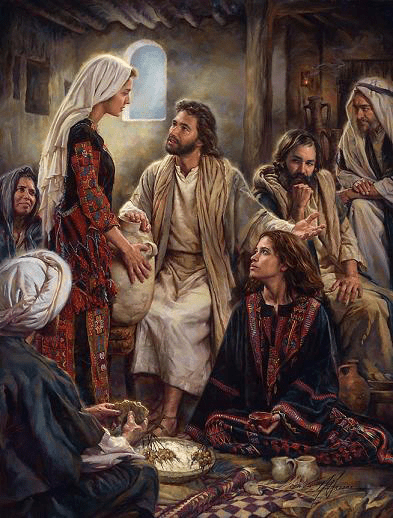
Now back to Luke: although Jesus stated that Mary’s behaviour was preferred, he doesn’t condemn Martha. Remember, in today’s Gospel Martha had been fussing over providing Jesus and his disciples a meal. I am sure they all thoroughly enjoyed it!
So, how disposed are we to put Jesus first? I confess that for me, most days, it is a struggle. I tried to think of a way to explain what I mean. I came up with a scenario that may help us to focus on our own dispositions towards the Lord.
Imagine if you will, God sends a clear message in a dream to our website editor. In that dream, Web-guy is told that Jesus will be visiting St Francis Church in Tairua next Saturday. God outlines the timetable for the visit: Jesus will arrive at 10am, participate in a meet-and-greet with any assembled folk, have a tour of the facilities, share a meal with those attending, and conduct a teaching session in the afternoon.
The Web-ster is convinced that he has heard everything clearly, been shown umpteen confirming signs, and so sends out a message on the email network and on the website to tell us all what will be happening.
What would you be thinking as you receive this message? Would you be taking the Martha or Mary approach? Be honest!
I did this. Off the top of my head, I would be wondering if the church lawns had been mown, was there any unsightly piles of Op Shop drop-offs, were there going to be kids skateboarding in the carpark, do we have enough matching dinner plates, will Jesus think our church is up to scratch, will we cancel Op Shop for that day, will we wear our masks, what will I wear, what will Jesus teach us, how will I hide my doubts?
We are about to host Jesus, and to start with all I could think about was what needed to be done. How would we measure up?
Hospitality like this is more about the host than the guest!
On reflection, I’m pretty sure that Jesus wouldn’t mind if the lawns needed mowing, or that we were eating off mismatched crockery, or that the skateboarding kids were in the carpark. Yet I obviously see those things as pretty big deal. It convicts me again of Strahan’s reflection a fortnight ago when he referred to the Kingdom without the King (see here). Maybe I don’t get it, that without the King, the Kingdom is a façade; or in my case should that be: if I concentrate on the Kingdom, I turn the King into a façade!
Talking with Keri about the prep for my talk today she mentioned having read a teaching by Pastor Joseph Prince on today’s reading and found it for me. In it, Pastor Prince poses the question: “What would you do if Jesus was coming to your house?” Would you sit him down and start serving him, or would you sit down and start drawing from him? Would you let him serve you and fill you up?
Haven’t we been taught to be gracious hosts? In Acts (Acts 20:35) it says it is better to give than receive, a concept that we have adopted to look after those in need and, like Abraham, to be generous hosts. But we aren’t talking about ordinary guests we are talking about the Lord; our Lord!
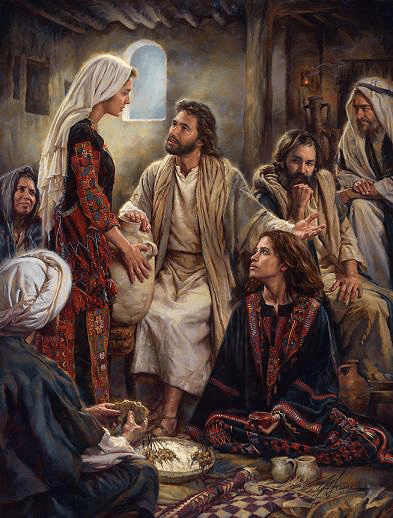
Pastor Prince writes about what the sisters saw in Jesus.
When Martha sees Jesus she sees his weariness. He has been on the road, doing good, healing the sick and tending to people’s needs. Martha sees Him as tired and someone she needs to care for.
Mary on the other hand looks past the weariness and sees his divinity. She sees Jesus as someone she needs to draw from. In doing so she has acknowledged his holiness. This is the Messiah, the Saviour that came to serve, not to be served! And Jesus commends her for her actions.
So how can we become more like Mary? How do we change our dispositions?
A key is understanding the relationship God seeks to have with us.
When I first read today’s Psalm it sounded like a list of benchmarks for those deemed worthy to be in God’s presence. My first reaction was if I could do or be all this, I might be good enough. But with the help of the Holy Spirit I flipped it around. I do believe God wants me in his company. In the presence of God these things will flow. The law would have us doing the mahi. Grace would have us in communion! But seek first the kingdom of God and his righteousness, and all these things will be added to you. (Matthew 6:33) Jesus and the Cross cleared the way!
According to Pastor Prince, we use our ears and hearts to draw from Jesus. We use our hands and feet to serve him. But our sense and appreciation of our divine God is more precious to him than all the service we can render to him. And the mystery is that the more we draw from him, the better we become at giving and serving!
And the better hosts we will be!
So my prayer today is simply, “My Lord, if it pleases you, stop here with us for a while.”






 stfrancischurchtairuanz