AI Reflects on Faith

by Barry Pollard

(Based on Mark 4:35-41; I Sam 17:1-50; Ps 9:9-20)

There are many useful tools that we can access to keep us abreast of the world in almost every way, even to the point of being able to run our business remotely, if we choose.
Last weekend we were in Wellington, the nation’s capital, famous around the globe for the fact that it has the highest average wind speed of any city anywhere (according to Air New Zealand). In preparing for the trip Keri researched how one travels on public transport in the Windy City. If you don’t know, they use a prepaid ‘Snapper’ card that you use by tapping on when you board your transport and tapping off on leaving. The trip cost is deducted each time. A great system that the city has great faith in!
We learned that when you travel at weekends and off-peak, the fares are ridiculously low. We travelled from the city centre to Otaki, a small town once driven-through as part of SH1, a distance of 73 kilometres away, on a train and bus for less than $16 return. We too developed faith in their transport system!

As great as their transport system is, there was a downside. If you don’t have a decent knowledge of a system you are at a disadvantage. On our last day of travelling across and around the city we noticed an older woman simply flashing her Super Gold Card at the conductor, receiving a ticket, paying no money and travelling free. The next ride, I tried mine and it worked! I could have been travelling the whole time with the most ridiculous low fare, zero!

These experiences, along with things I had been reading and browsing, have had quite an impact on my reflection this morning.
Being a relatively diligent bloke I started work on this reflection on the 14th of May, knowing that we were likely travelling out of and around the country in June. I started by reading and reflecting on the Scriptures set down in the Lectionary, choosing the three readings for today and starting to ponder what the Spirit was saying to me. The issue of faith stood out immediately. In the Samuel reading I highlighted part of verse 45: “but I come to you in the name of the Lord of Heaven’s Armies”. Which explained pretty much how David the shepherd boy was able to even consider taking on the giant warrior Goliath. He had faith that God would be with him; that he was acting with God’s authority. And, too, in today’s Psalm, verse 10 drew my attention: “Those who know your name trust in you, for you, O Lord, do not abandon those who search for you.” And of course the Gospel reading today is focussed totally on faith.

We have all heard preachers explain how they go about the process of coming up with a reflection, and most admit to its not being an easy task. When I first came to the role, I remember explaining that I learned so much more from the Scriptures I had to work with, because my knowledge and understanding was generally limited and I was always under stress. I had to go deeper and deeper, using the analogy of the onion that we keep peeling away, to make coherent sense out of the Word and how it could apply to our lives here in Tairua today.

But I thought this time I’d try a different and modern approach. Being an enthusiastic member of the newly reformatted Tairua Business Association, I have been paying a bit more attention to business stuff. One thing that caught my fancy was a promotion by the local Council of seminars on getting to grips with AI – artificial intelligence – in business. The focus of the offered seminar was a look at an AI tool that is available for all: ChatGPT.
Artificial intelligence at this stage of development is probably still in its infancy, yet it already provides many new and useful tools. At the same time, the spectre of technology taking over the world and relegating us humans to servant status is impacting workforces around the world.

So against this backdrop, I bravely opened ChatGPT on my computer and typed in “Write a sermon on Mark 4:35-41″. The results were instantly remarkable. So, sit back and hear what artificial intelligence was able to come up with [produced here word for word – Editor]:

“Finding Faith in the Storm”

Dear congregation
Today, let us delve into the powerful passage from the Gospel of Mark, Chapter 4, verses 35 to 41. This narrative recounts the moment when Jesus and his disciples embarked on a boat, and a great storm arose while they were at sea. As the winds howled and the waves crashed against the vessel, the disciples were filled with fear and panic. But in the midst of the chaos, Jesus was there, calmly sleeping in the stern of the boat.
This story is not just a historical anecdote; it holds profound significance for us today. It speaks to the storms of life that we all encounter—those moments of trial, uncertainty, and fear that threaten to overwhelm us. Just as the disciples faced a literal storm at sea, we face metaphorical storms in our lives: illness, loss, financial troubles, relationship challenges, and so much more.
In the face of these storms, it’s easy to feel like the disciples did—terrified and helpless. We may wonder, where is God in the midst of our struggles? Why does He seem silent while we suffer? But the beauty of this passage lies in what happens next.
The disciples, in their desperation, woke Jesus and cried out, “Teacher, don’t you care that we’re going to drown?” Their words echo the cries of our own hearts when we feel abandoned by God in the midst of our storms. But Jesus, in His infinite love and mercy, responded by rebuking the winds and the waves, saying, “Silence! Be still!” And immediately, the storm ceased, and there was a great calm.
Through this miraculous act, Jesus not only demonstrated His power over the forces of nature but also revealed a profound truth: He is with us in the storms of life. Even when it seems like He is asleep or indifferent to our struggles, He is there, ready to calm the raging seas of our hearts.
But the story doesn’t end there. After calming the storm, Jesus turned to His disciples and asked, “Why are you so afraid? Do you still have no faith?” These questions cut to the heart of the matter. In the face of adversity, do we trust in God’s goodness and sovereignty, or do we allow fear to overpower our faith?
Brothers and sisters, let us learn from the disciples’ experience. Let us not allow fear to dictate our response to life’s storms. Instead, let us anchor our faith in the unwavering truth that Jesus is with us always, guiding us through the darkest of times.
As we navigate the tempests of life, may we find comfort and strength in the knowledge that we serve a God who can calm the storm with just a word. May we cultivate a faith that is resilient in the face of adversity, knowing that nothing is impossible for our Lord.

Let us pray.
Heavenly Father, in the midst of life’s storms, help us to trust in Your unfailing love and power. Give us the faith to believe that You are with us always, guiding us through the darkest of times. Calm the storms in our hearts, and grant us the courage to face whatever challenges come our way. In Jesus’ name, Amen.

May the peace of God, which surpasses all understanding, guard your hearts and minds in Christ Jesus. Amen.
God bless you all.

There you have it! What did you think?

To be honest, I was impressed, especially when it spat out the prayer and blessing at the end. I would not be offended if you asked me to use AI to write all my reflections in future, whenever you see my name on the roster. It was certainly faster – about 1.75 seconds versus my usual two to three weeks! And its grammar is better than mine! And if Betty Moss was still with us, she would have approved of its brevity! (“No longer than seven minutes, Barry! That’s the perfect length for a sermon.”)

But just like the Wellington transport system, AI has a downside! As clever as it is, AI can’t supply the human touch. It can’t reveal its weaknesses, or speak from personal experience. It lacks ‘soul’. We can’t trust it will provide what we need. If anything, it has added doubt to the ‘reality’ that we perceive.

We still need humans to fill in some of these gaps, and it’s my turn today . . .
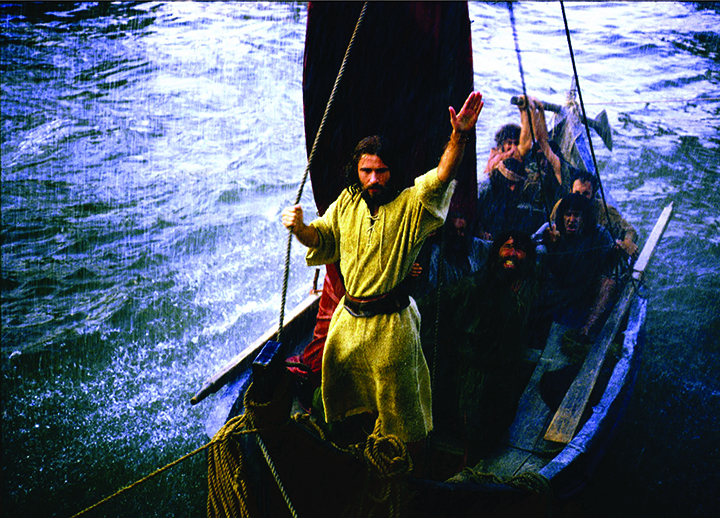
I started out saying that today’s readings were all about faith. The Gospel account highlighted two things to me. The first: if I was in that boat I know I would have been terrified too, and wondering how Jesus could be asleep in such turmoil. My faith would certainly have been tested. And second: the amazing things the disciples had witnessed and been part of in their time with Jesus suddenly were forgotten in a testing situation. How often is this true for us?
What shape is my faith really in?
The disciples were just like me! Frightened and doubting! Yet they were able to overcome these weaknesses with the right tools, and the power of the Holy Spirit.

The two verses I acknowledged earlier in the Samuel and Psalm readings offer some direction. “But I come to you in the name of the Lord of Heaven’s Armies,” is an anchor point for us. If that could be etched in the front of our consciousness it would temper much of what we think, say and do. Before you dismiss it because it sounds like a military salutation, “the Lord of Heaven’s Armies” could be translated, “the Lord of powers” or “the Lord who is the strongest of all”, the Lord God Almighty. However you interpret it, it says that God is with us and is fighting for us, and look what effect it had on David, the young shepherd boy!

Another anchor point is surely the verse from Psalm 9, “Those who know your name trust in you, for you, O Lord, do not abandon those who search for you.” This is another positional claim. If we are active in seeking and maintaining a relationship with God, we can rely on him in all ways. To trust is to have faith.

You may have noticed, many of my past reflections have contained an ‘addendum’, something usually added in the early hours of the morning of delivery. I am most receptive to the prompting of the Holy Spirit at that time, and he reveals for inclusion little extras that we need to hear. This time he prompted the inclusion of a commentary from yesterday morning’s devotions.

It’s about patience, but also relates to us all in the boat with Jesus:
Patience is one of the fruits of the Spirit. Patience comes right after peace. Why? Because when we have peace in our hearts, practically nothing can cause us to feel impatient. But these qualities are the fruit of the Spirit, not the effort of the flesh. We can’t psych ourselves up and say, ‘I am now going to be patient.’ If it’s the genuine fruit of the Spirit, we’ll have genuine inner peace, and circumstances that used to irritate us won’t bother us as much (or even at all) because we’ve started to depend completely on God. 
Patience is a type of faith. It says, ‘I trust God. I believe he’s bigger than this problem. I believe his hand is in these irritations and can use them for good in my life.’ Frustration says, ‘Why did this happen?’ Faith says, ‘God, what do you want me to learn here?’
Abraham was 100 years old when his second son, Isaac, was born. That’s a long time to be patient. The toughest kind of waiting happens when we’re in a rush and God isn’t. It’s hard to be patient when we’re waiting for an answer, but being patient is both the evidence of our faith and a test of our faith. It’s at times like that when God whispers, ‘Be still, and know that I am God’ (Psalm 46:10). In other words, ‘I’m in charge, I have a better plan, I’m working things out for your good!’

So, as I conclude, I would like us to consider, what is it that we really have faith in? How strong is that faith? What do we need to do to be rock-solid?

Let us pray as ChatGPT suggests [and notice that it even rhymes – Editor]:

Divine Creator,
In the quiet of our hearts, we come to you in humble prayer,
Seeking strength and guidance, enveloped in Your care.
Grant us, O Lord, a steadfast faith that never wavers,
A faith that holds firm through life’s storms and favours.
In moments of doubt, be our unwavering light,
Illuminate our paths with Your wisdom and insight.
When challenges loom and trials seem too great to bear,
Instil in us the courage to trust and to dare.
Help us, dear God, to see beyond what eyes can perceive,
To believe in Your promises and never to leave.
May our faith be a beacon, shining bright and true,
Reflecting Your love in all that we say and do.
In times of joy, let our gratitude abound,
Acknowledging Your blessings that endlessly surround.
And in times of sorrow, may our faith be our solace,
A balm for our souls, bringing peace in every place.
Lord, deepen our faith each day, without hesitation,
So we may walk with You in constant dedication.
For with You, O God, all things are possible and clear,
Grant us the grace to trust, to hope, and to persevere.
In Your holy name we pray.

Amen

Pastoral Parables

by Auriol Farquhar

(Based on Mark 4: 26–34)

Today’s reading is from Chapter 4 in Mark. In this chapter Jesus tells a number of parables and stills a storm. Before the parable of the gardener and the mustard seed, Jesus has told the stories of a farmer scattering seed and one about hiding one’s light under a bushel. While he often explains the parables to his disciples, he does not comment on the meaning of the ones in today’s reading; he explains it to them later.
So this is my interpretation of these passages, with a little help from Debie Thomas and Michael K Marsh.

In the first parable Jesus speaks of a gardener scattering seed on the ground and then going off to sleep. He enjoys his rest and does little to ensure that the seeds will grow. This is something of a puzzle to good gardeners, who work hard at ensuring that they will get a decent crop. Even my husband, not too concerned about the aesthetic appearance of his garden, fertilises the ground with compost, plants his plants in rows, weeds conscientiously, waters in the dry season and does his best to protect his garden from pests and birds.
But this gardener sleeps. He trusts the seeds; he trusts the sun, the shade, the clouds, the rain. He plants, and he harvests when the time is ripe.

Of course, Jesus is not really talking about gardening or farming. He is using these images to talk about your life or mine. His parable is a metaphor for the way God works in our lives.
The gardener never suffers from the illusion that he’s in charge; he’s operating in the realm of mystery. In this story of God’s Kingdom it is not our striving, our piety, our doctrinal purity or our impressive prayers that cause us to grow and thrive in God’s garden – it is grace alone, often acting in mysterious ways that we do not understand. Once the seed of the word of God is sown, only time will show how a person’s faith will grow and develop. And growth takes time. A lot happens under the ground, hidden within the soil of our lives. There’s a lot of waiting and then one day, something sprouts and voila – there is growth.
I think of my own faith journey. As a child I attended Sunday school, church and Pathfinders. I learned about the Bible in primary and secondary school and considered myself to be a Christian. As time passed, I still had faith but, although I tried to manifest that faith in my life, I stopped going to Church, except at Christmas, and was not really part of a faith community.

About ten or twelve years ago Joan asked me to help with the Christmas Community Celebration in Tairua and, after a couple of years of making my contribution, with the choir and the dramatic presentation, I felt that I needed more involvement with the life of the Church. I had a strong urge to come to church on Sundays. I cannot explain why I felt this – I just had a desire, I wanted to be part of a faith community again. God was bringing my garden to fruition.

Seeds grow when the conditions are right. God grows love in us and that love can shelter and comfort many others. God’s Kingdom is not only the ‘end-time’ or the afterlife, it is the here and now – anywhere where the power of God is evident, he is establishing it through us.

The reality is that there is a spirit moving within us. Each of us has been seeded and something is growing there. Sometimes we don’t see it, believe it or trust it – but it’s there. Sometimes we wait years, hoping, looking and wondering when, and then one day we see the first green blade rise up. Other times we wake up one day and are surprised by what has changed within us. How and when did it happen? It is not dependent on us but we participate in it.

In the second parable, a sower sows mustard seed in the ground. In first century Palestine, this was a noxious weed. It is a plant that quickly takes over the land, dropping seeds everywhere and encroaching on other plants. It would be like a modern day gardener planting oxalis or wild ginger – nuisances that a gardener tries to get rid of, not plant deliberately.
What is Jesus saying when he describes the heart of God’s Kingdom as this insignificant tiny seed that is invasive and that most gardeners would like to get rid of? Is he saying that God’s Kingdom grows and flourishes whatever efforts can be made to ‘root’ it out – that nothing can stop it flourishing?

The last image in these parables is that of the birds nesting and finding shade in the branches of the mustard plant. We all love to see birds in the garden, but what gardener wants birds taking up residence – eating seeds and fruit and dropping guano everywhere? We take steps to keep the birds away. But this doesn’t happen in God’s garden. There are no scarecrows to scare off unwelcome guests in God’s garden. No scarecrows or rattling CD discs there. That is because the Kingdom of God is about welcoming everyone; it is inclusive of all – even those that some would think were unworthy. Its main purpose is hospitality, not productivity. By trying to get rid of the nuisances in the garden, because we believe the produce is the most important thing – are we rejecting the needs, hunger and hopes of those around us because we are focused on controlling the garden? Can we surrender ourselves to losing that control and letting the garden, or God, take care of itself?

When I started to prepare for this reflection and read these verses from Mark, I was puzzled. I read some other reflections on them – which seemed to say that these parables were about trusting God to grow his kingdom. And the harvest – his Church – would grow and develop. But, I asked myself – does that mean God does all the work, and we do nothing? Do we have a role to play in the growth of the garden and the burgeoning mustard seed plant?

I think that we must have a role. Consider what seeds have been scattered for us in our own lives. Who are the people who have loved and encouraged us, offered wisdom and guidance, especially on our faith journey? Who are the ones who have given us hope, stood by us, helped us find ourselves? Who has inspired and mentored us, who has helped us to use our talents and skills? Perhaps we can identify people we have known. I’d begin with my Mum and Dad, who gave me unconditional love; then Mr Woodley, the curate who took our Pathfinder class; Miss Jenkins, my Religious Instruction teacher, who was such a gentle Quaker soul; my drama tutor on my teacher training course, Hilary Ball, who enabled me to grow in confidence and realise that I was just as worthy as others. And then, in recent years, St Francis friends Chris, Bruce, Joan and Sharon who have inspired me and made me think more deeply – and so many people in between.

I am sure that we can all identify people we have known that have played important roles in our growth. But always it is God, working in mysterious ways, enabling his garden to grow.

And what can we actually do to help our own harvest, and perhaps scatter seeds in the lives of others?
We can forgive those who hurt us, reconcile and ask others for forgiveness. We can put others’ interests before our own. We can encourage, love and reach out in compassion. We can support others when they are in the depths of emotional crisis, such as grief, despair or loneliness. We can speak out for justice and stand up for people when they are treated unfairly. We can love our neighbour as ourselves!

So, I believe that we should trust in God and have faith that his Kingdom is growing, slowly and mysteriously – with weeds that we can neither control nor contain. But we should also be open for his guidance, in whatever form it comes, on what we should plant and how we should harvest the results of his labour.

Thy will be done, Lord.

The Lord of the Sabbath

by Sharon Marr

(Based on Mark 2:23-3:6)

The gospel reading today could suggest laws and rules that to our ears sound petty and unreasonable, so before we proceed I thought I would remind you of some laws in the world that are still enforceable  today!
In England the 1854  Metropolitan Police Act states anyone knocking on doors and scarpering for fun could land themselves with £500 fine. Wow!  Hands up those who, along with me, have been guilty of this heinous crime in their childhood.
Meanwhile, in California: Nobody is allowed to ride a bicycle in a swimming pool and … it is also illegal to set a mouse trap without a hunting license. Enough said!

Today we are recognizing Te Pouhere Sunday. “Pou” is a post and “here” means to tie. The imagery is that of an anchor. A place where we could anchor our “waka”, “va’a”, or boat. Te Pouhere is a Sunday put aside to celebrate the Anglican Church constitution – the “post” of the Anglican Church in Aotearoa New Zealand and Polynesia, in which there is provision for three equal partners. Today we celebrate our identity of working alongside each other, praying with and for each other, and listening to one another.

The three equal partners are Tikanga Māori, Tikanga Pakeha and Tikanga Pasifika.  Tikanga means ‘the right way of doing things in one’s own culture’. So Pakeha have their own right way of getting things done through the Pakeha culture, and so also do Māori and Pasifika through theirs.

Our Tikanga church is to be celebrated, and constantly worked upon, so that there truly is equal partnership.

‘Their own right way of getting things done’ leads us onto this week’s reading in which Mark describes a two-part confrontation between Jesus and the Pharisees.  In part one, Jesus and his disciples are walking through a grain field on the Sabbath.  When they get hungry, the disciples pluck a few heads of grain to munch on. Jesus doesn’t stop them, and the Pharisees pounce, asking Jesus why he’s allowing his followers to break the Sabbath.  Jesus answers, “The Sabbath was made for humankind, and not humankind for the Sabbath; so the Son of Man is lord even of the Sabbath.”
In part two, Jesus enters the synagogue and meets a man with a withered hand.  Knowing that he’s being watched, Jesus asks the Pharisees whether it’s lawful to “do good or to do harm on the Sabbath, to save life or to kill.”  But the Pharisees refuse to answer.  Angered and grieved by their hardness of heart, Jesus heals the man.  The story ends, predictably, with the Pharisees leaving the synagogue to plot against Jesus’s life.

Traditional interpretations of this incident pit a rigid, legalistic Judaism against Jesus.  But that reading (in addition to being harmful and inaccurate), lets us off the hook way too easily.

The Pharisees in this story are not a stand-in for Judaism.  They are a stand-in for all convictions, values, traditions,  commitments, doctrines, absolutes, preferences, and essentialisms — no matter how cherished, noble, or well-intentioned — that stand between us … and compassion.  In other words, the question this story asks is not, “What was wrong with first century Judaism?” but rather, “What have we — here and now — become hardened too, at our peril?”
What mortal, broken thing have we deified … instead of love?  Who or what have we stopped seeing because our eyes have been blinded by our own best intentions? 

What are we clinging to that is not God?

We do an injustice to the Pharisees if we write them off as bad people.  They were good people — good people trying to preserve and protect those things — laws, rituals, traditions, habits — that mediated faith for them.  Don’t we do exactly the same thing when we hold fast to our favourite worship practices, our cherished spiritual disciplines, and our beloved daily rituals?  Don’t we just as readily decide what is sacred in our own lives, and then refuse to budge even when those things become obsolete and lifeless?  The Pharisees were not wrong to uphold the Sabbath.  They were absolutely right.  But rightness is not love.  Rightness is not compassion.  Rightness will never get us to Jesus, the Lord of the Sabbath.  Only compassion will do that. 

This is an unnerving story.  It’s a story about Jesus walking through the sacred fields in our lives, and plucking away what we hold dear.  It’s a story about Jesus seeing people we’re too holy to notice, and healing people we’d just as well leave sick.  It’s a story about a God who will not allow us to cling to anything less bold, daring, scary, exhilarating, or world-altering … than love.

Why would anyone bring the business of a synagogue to a grinding halt on a Sabbath morning?  Why would a man risk his own life to heal a stranger’s withered hand?

Apparently, nothing is more sacred than compassion.  The true spirit of the Sabbath — the spirit of God — is love.  Love that feeds the hungry.  Love that heals the sick.  Love that sees and attends to the invisible.  If we truly want to honour the Lord of the Sabbath, then we have to make relevant all practices, loyalties, rituals and commitments we hold dear — even the ones that feel the most ‘Christian’.  There is only one absolute, and it is love. 

Pastor Steve Garnas-Homes says this of today’s reading in a piece titled Do good or do harm?:

In all our discerning what is right or lawful or acceptable, it comes down to this: the choice to be kind or to be unkind.
The ‘right’ thing to do is always kind; cruelty is never right.
I am wary that what may feel like ‘justice’ to me is actually revenge; I renounce it …
The goal is not to be right but to be loving.
Life is complicated; kindness is not.

Dear Family, Rules and Laws are important but, as Jesus tells us, everything we do must be weighed by the greatest of all commandments: You shall love the Lord your God with all your heart and with all your soul and with all your mind. This is the greatest and first commandment. And a second is like it: You shall love your neighbour as yourself. On these two commandments hang all the Law and the Prophets.
Nothing is more sacred than compassion.

Only with this costly love embedded deep within us will our beloved three Tikanga church truly flourish.  Only with this costly love embedded deep within us will we become capable of following the way Jesus came to show and truly see that which is sacred in our lives.

In the Name of Julie

We were travelling to Tauranga for the weekend, and a new friend, Rosemary, asked if I wouldn’t mind picking up a grocery order for her from New World. Sure thing, not a biggie.
We love adventures while on a break – doing different things, exploring new areas and places – so we thought this could possibly be tagged ‘adventure’, and thus added this task to The Adventure List. Easy.

The instructions for collecting the groceries seemed clear: Ask for Julie by name, receive the package, pay $116.80, thank you very much, walk away with a smile.
Julie had been informed: the package would be collected today.
Wanting everything to go smoothly for us, Rosey provided extra information: the cost of each identical item (forty in total) was $2.92, the supermarket’s address and phone number. Double easy.

Walking boldly into the store, scanning confidently, it quickly became obvious that there was no counter for enquiries or customer service. No one making eye contact. And no Julie waiting at the entrance all day for me to drop on by at any hour and be served because she had no other tasks on her To Do List that day.
The supermarket was buzzing with the lunch time rush.
Okay. Not a great time to come. Which one is Julie?? How do I even find her, let alone speak with her?

Feeling less-than-bold now, I edged towards a kindly looking lady and her empty checkout. “Hello, I’m here to pick up some groceries for a friend. I was told that Julie had organised everything. My friend just said to come in and ask for Julie. Are you able to help me?”
Big blank eyes from kindly lady, followed by enquiring expression and tilted head. Was I rambling? Did Julie even exist? Wasn’t this supposed to be easy?

Kindly lady kindly smiled. “Julie? Yes, she is here. I will get her for you.” And off she went.  Whew.
Letting out the breath I didn’t know I was holding, I smiled. Easy. Julie does exist, and her name was the key! Easy unlocked.

Except that kindly lady was now returning down the aisle, Julie-less. “I’m sorry, Julie is on her break. But she left a note. You’re picking up an order of forty items for Rosemary, is that correct?” I nodded. Yay Julie! Thanks!
“I’ll just go and get the order.” And off she went. Again.

Returning still Julie-less, but this time with an oversized box, she slipped into her checkout. Blip went the scanner, and the total was calculated. “OK, so the total is $140. How would you to like pay for that?” Kindly lady really did have a kindly smile.
“Umm, that’s not right.”

My reply probably came out a little more forcefully than I meant it … “Oh, but I was told that the total would be $116.80. Julie said it would be one sixteen eighty, not $140.” What will I do if Kindly insists on one forty? Stand my ground? Ring Rosey, disturb her at work? Walk away …

I started rambling again. “My friend has been speaking with Julie, and Julie said it would be $116.80.” Did I not just say that? Definitely rambling.
“She’s budgeted for that price, so I’m not sure I should take them if it’s the higher price. I might have to ring her up and ask her what she wants to do.” This is SO not an adventure. Well, not a good one.

Kindly reread the note that Julie had attached to one of the items. “Oh, I think it’s because your friend ordered a different brand, and we ran out of that, so Julie has given her another brand, and it’s more expensive. But if Julie said that was the price, then that will be the price.”
She turned the note over. “Oh! Julie has written on here to charge you the lower price. I’m sorry that I didn’t see that at first.”

My turn for blank eyes, enquiring expression and tilted head. What? Then, Yay Julie! Your name is King (or Queen) here! Aww, and how kind …

Transaction completed, thanks all round, we walked out of New World thinking that everything had worked out so well. Julie’s name really did make all the difference! It obviously carried authority. To use it was to get results! Rosey would be stoked too. Everyone loves a bargain, right?


Why has this adventure stuck in my mind?
Well, if we dare to look beyond the face-value of all of our experiences, and invite the Holy Spirit to teach us, we can learn so much. There’s actually a name that we as Christians have been told to use – the Name of Jesus. I wonder if we truly understand the force of wielding it?
Do we speak his Name with confidence and boldness, knowing that his authority is higher above anything we perceive or imagine? Do we expect that, in the Name of Jesus, paths will be cleared, obstacles will be shifted, power will be released, results will be good?

Food for thought. And probably more than $116.80’s worth.

Keri Pollard