by Barry Pollard
(Based on John 20:19-31; Acts 4:32-35; 1 John 1:1-2:2)
In this second Sunday of the Easter season, we have thrilled at the resurrection of Jesus and now we are examining the time before his ‘ascension’.
Pondering Good Friday, did you grasp the depth of despair that the disciples were feeling? Their Lord and teacher had been crucified, raising not even a finger in self-defence, instead sticking to the plan that he came to fulfil. This man, who had patiently spent three years or more showing them who He really was, was gone. And then, on Easter morning he wasn’t in the tomb – he had risen from the dead!
With no radio, TV, internet or social media to get the message out quickly, the news of his resurrection was by word of mouth. Not everyone heard it at once. And following his resurrection, he was slow to reveal himself to his followers. Followers that were in hiding, on the fringes, grappling with all they had seen and heard.
Last week we heard about ‘the Marys’ and how they came across the open tomb, learned from an angel that Jesus had risen from the dead, but went away “trembling and bewildered”.
You will recall the walk to Emmaus (Luke 24), where Jesus walked and talked, unrecognised, with two sad travellers who told him all about the events of his crucifixion. He withheld his identity until they were breaking bread together at their journey’s end.
And it was similar for his disciples. His closest followers, the disciples, those who had come to grasp that Jesus was more than a man, were meeting behind closed doors because of their fear of the Jewish leaders. If it had happened to Jesus, surely they were next! For these followers, their foundations had been rocked, to say the least. At stake was their belief.
In the Gospel encounter, Jesus was suddenly standing among his disciples, offering peace, restoring their joy and “breathing” the Holy Spirit into them, preparing them to go, to take the Good News out to the world.
But not everyone was there. Thomas was absent – who knows where. And, of course, when he is told that the others have met with the risen Jesus already, condemns himself, probably forever, to be known as Doubting Thomas: “I won’t believe it unless I see the nail wounds in his hands, put my fingers into them, and place my hand into the wound in his side.”
Can you imagine what would have been said in the group over the next eight days?
At the next gathering, of the whole group this time, Jesus again is suddenly in their midst, again offering peace. Then, turning to Thomas, Jesus invites him to satisfy himself that he is indeed alive!
“Put your finger here, and look at my hands. Put your hand into the wound in my side. Don’t be faithless any longer. Believe!”
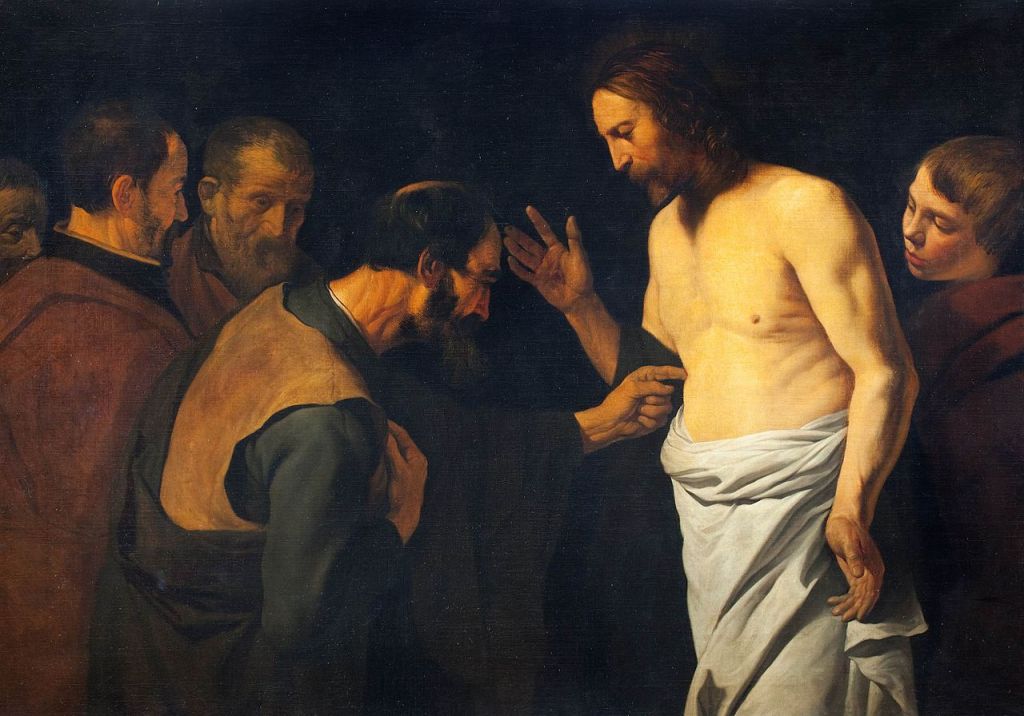
Thomas’s response is profound, indicating a monumental restoration of his belief, acknowledging Jesus as his Lord and God. And Jesus concludes by saying, “You believe because you have seen me. Blessed are those who believe without seeing me.”
As we consider ‘belief’, our theme for today, I’d like to explain how we often consider such concepts. We humans are very good at thinking in terms of degree. We find that a continuum is a good way to visualise what we are thinking about. Take ‘good and bad’, for example. We probably all locate our behaviour, attitudes, tastes, etc, on this continuum. I know as a small child, desperate to please my hard-working Mum, I tried hard to be good at times – to the point of coercing my little sister and brother to clean and tidy (dry up) the bathroom following our communal bath, put on pyjamas and march out singing, “Are we good children?” Yes, we were right up the good end of the continuum!
But you may be surprised to know I haven’t always been up that end! Truth be told, I have a rap-sheet that stretches from pre-teen to adult! For every instance of ‘indiscretion’ I had what I thought were reasonable excuses and justifications. In my mind I was simply sliding down the goodness scale a little. After all, there were a lot of people a whole lot worse than me (weren’t there?).
But is that the way Jesus expects us to be? Many concepts and states simply don’t fit on a continuum. Jesus was more about absolutes, which he referred to as truth. Continuum-thinking can fool us!
Take for instance John’s explanation (from the First John reading): “If we claim we have no sin, we are only fooling ourselves and not living in the truth. [And how often do we do that!] But if we confess our sins to God, he is faithful and just to forgive us our sins and to cleanse us from all wickedness. If we claim we have not sinned, we are calling God a liar and showing that his word has no place in our hearts.”
So, if you are not sure, yes, we are all sinners. But the great thing is, God allows for our humanness. And there is a way of getting right with God. We just need to confess our sins and seek God’s forgiveness (and forgive others as we expect God to forgive us – remember the Lord’s Prayer).
Jesus is our advocate, supporter and saviour. He has already atoned for our sins, once and for all time. But we struggle with this, don’t we.
In our liturgy, in one of our prayers of confession, we seek forgiveness for the sins we cannot even bring ourselves to acknowledge:
We need your healing, merciful God; give us true repentance.
Some sins are plain to us; some escape us; some we cannot face.
Forgive us; set us free to hear your word to us; set us free to serve you.
Some comfort may lie in the fact that, in absolute terms, if you admit your sinful nature and seek forgiveness you surely can be counted as a believer! If you didn’t believe, why would you bother?
A question I suspect you may be sitting here asking is, “Do I really believe?”
Technically, if you harbour any doubt, however small, you have fallen into disbelief. If you disbelieve, you don’t believe. Sometimes we ask ourselves, “What do I believe?” But doesn’t this just open the continuum door again and gives rise to ‘schools of thought’ and different theologies?
I assume Thomas (the Doubter) would have called himself a believer. He had spent a great deal of time listening to and living with Jesus. He would have heard the teachings first-hand and seen the miracles and signs Jesus performed in person. It must have had a huge impact on him. When Jesus said to him, “You believe because you have seen me”, I think that statement applied equally to the time Thomas had spent in the company of Jesus prior to the crucifixion. But Thomas’s belief was sorely tested by the crucifixion. His belief wavered. He did what a lot of us do, he applied conditions. “I’ll believe if I see and touch.” Because we too waver, we need to consider ways to remain steadfast and faithful.
Think about the Acts example we have heard this morning. “All the believers were united in heart and mind.”
What unified them?
The binding force can only have been Jesus. For them, their outlook on everything was changed. Now they understood about stewardship, sharing, caring for the needy, spreading the Good News.
Can we, Church family, learn anything from that?
Perhaps this recent example will stir something in us: The other day sister Sharon came into the shop to check on us, to make sure we were doing okay. And we appreciate this, of course. But this was while she was doing some shopping to keep her home running, as her hubby recovers. Her first concern was for others. In the course of the conversation, she spoke about the strength she was able to draw from the knowledge that there was a large group of pray-ers out there upholding them both at a time when they were unable to do it for themselves. The conclusion we drew from our chat was that everyone in our Church family is involved in shared ministry when they stop to pray for others in need.
Bless you, Sharon and co, for all that you do.
So there’s a simple and manageable thing that we can all do to shore up our belief, and experience that unity of heart and mind – pray for and with each other. You have all heard, the family that prays together, stays together! And you don’t need to have the special words, dripping of high church. When you pray, you just need to speak to God from your heart. Sometimes we can’t find the words to say at all, we just weep and moan. In Romans 8 verse 26 it says, “And the Holy Spirit helps us in our weakness. For example, we don’t know what God wants us to pray for. But the Holy Spirit prays for us with groanings that cannot be expressed in words.”
If God can interpret the Spirit’s groanings, he can surely interpret ours.
To develop and strengthen belief we need to know Scripture. Every prop and shield we could ask for can be found in the written Word of God. We can have faith that what we read and absorb has been tested and approved for our use. We have the accounts of eye witnesses who speak to the things we grapple with and give assurance that our belief is justified.
From the First John reading again: “We proclaim to you the one who existed from the beginning, whom we have heard and seen. We saw him with our own eyes and touched him with our own hands [even Thomas!]. He is the Word of life.”
Going on, “God is light, and there is no darkness in him at all.” And, “If we are living in the light, as God is in the light, then we have fellowship with each other.”
Our belief cements our relationships. We belong to the light. We are brothers and sisters together.
The last thing Jesus said to Thomas in the Gospel encounter was, “Blessed are those who believe without seeing me.” If you struggle with finding relevant Scripture that applies to you, then understand: this was addressed to you (and the rest of us). Jesus knew that he was soon to ascend to be with the Father. He was entrusting his ministry to the disciples and finalising the preparations before departure. He broke down their fears and with his breath he filled them with the Holy Spirit. They were ready to go out as his witnesses so that we could believe.
Apostle John wraps up the Thomas episode, stating that his Gospel was written so that we will “continue to believe that Jesus is the Messiah, the Son of God, and that by believing in him we will have life by the power of his name”.
Are you convinced?
In evangelical settings the preacher would call for an “Amen” at this point. Can I hear an Amen?
Psalm 133 speaks about harmony. Listen:
How wonderful and pleasant it is when brothers and sisters live together in harmony!
For harmony is as precious as the anointing oil that was poured over Aaron’s head, that ran down his beard, and onto the border of his robe.
Harmony is as refreshing as the dew from Mount Hermon that falls on the mountains of Zion.
And there the Lord has pronounced his blessing, even life everlasting.
We have much to be gained from being family together. Being honest with one another, encouraging one another, praying for one another, sharing with one another, caring for one another, bringing the light to one another. Belief will be solidified and lived out in the company of like-minded others. Our friends at Elim Church call it “doing life together”.
May we go from here today rejoicing in the risen Christ, solid in our belief that he is our Lord and Saviour, and shining our light in every way for one another.
 stfrancischurchtairuanz