by Pat Lee,
with acknowledgements to Jo Anne Taylor and Michael K Marsh
(Based on Matt 3:1-12; Isa 11:1-10; Rom 15:4-13)

Jo Anne starts by saying that “some folks aren’t even aware there is a season called ‘Advent.’ For them, this season leading up to Christmas is Christmas. We get that message loud and clear everywhere we go, in every store where we shop.”
And sometimes we even get to hear a real Christmas carol.
Advent to many people is putting up decorations and fairy lights, rushing around buying Christmas presents for everyone, filling the tins with goodies, writing Christmas cards or emails, and, of course, the coming of Santa Claus on Christmas Eve to fill up all the stockings of all those who’ve been good. Actually, it is fun to do some or all of those things, but without losing sight of what Christmas is actually all about. It’s not about Santa coming, as the Santa parades and all the shop decorations would have us believe.
I’ve often wondered what the real St Nicholas (where we get Santa Claus from today), a very wealthy man who gave his money to the poor, would think about how the world sees Santa Claus now. I suspect he would feel rather saddened by how it has all turned out.
What is Advent to you? My old Oxford English Dictionary says that Advent is that season before the Nativity; coming of Christ, Incarnation; second coming of Christ; or any important arrival.
Advent is a season of waiting.
What are we waiting for? In eighteen days’ time we will celebrate the birth of Jesus, which was when God sent his Son as a baby into the world to be the “light of the world”, and to bring peace to all the nations.
But that was over 2000 years ago. The Bible tells us that he will come again, but not as a baby, so that is what we are now waiting and preparing for. It doesn’t mean that we can’t celebrate Jesus’s birthday. Of course we can, and do and will. But this time of waiting is the time we need to prepare for the second coming of Christ. That is the message our readings are about today.
It strikes me as odd that today’s readings are not about Jesus’s first coming, but about his second coming. The readings which follow in the next two weeks will be about Jesus’s birth, but today … let’s look at what Isaiah had to say. Isaiah was a prophet who lived over 700 years before Jesus was born. In chapter 9 he foretells of Jesus’s birth, and then in Ch 11 he adds some more about it, until he gets to verse 6, when he suddenly starts telling us what it will be like when Jesus returns!
What a wonderful picture he paints. Won’t it be amazing to see lions lying with lambs and leopards with kids, instead of eating them for breakfast. And cows grazing with bears and lions eating straw with oxen. It would have been a shock to my father if he had ever found a bear eating grass alongside his precious pedigree Ayrshires. And a child playing over the asp’s hole and none of them being harmed. We don’t have these wild animals here in this country, but we certainly know how they live in their present day environments.
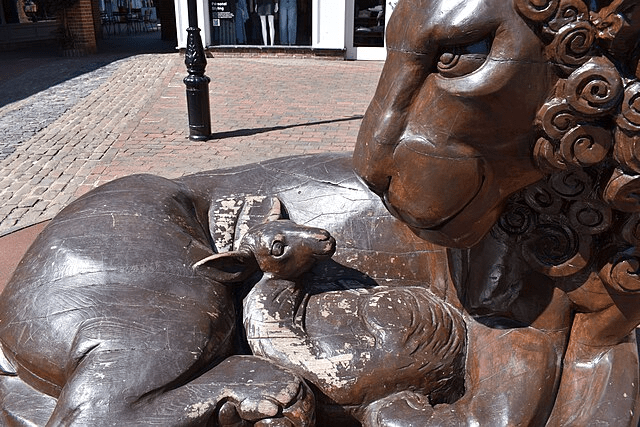
Isaiah did not see any of his prophesies fulfilled, but it is an historical fact that Jesus was born more than 2000 years ago. In Ch 65 v25 Isaiah repeats some of these verses but this time it is obvious he is talking about the new creation once Jesus has returned. The picture is of peace and serenity – something we find difficult to imagine with the world as it is today, even although we know that Jesus was born to bring peace.
It’s also a great picture of hope.
Paul, writing in Romans, was aware that Jesus had been born and, in fact, that he had already died, risen and gone back to ‘the Father’. He is using the past to show a way to behave in the present, and also the future, which includes us as Gentiles. In the quote he uses, he repeats the phrase, “The root of Jesse shall come,” linking Jesus back to King David, but adds, “the one who rises to rule the Gentiles; in him the Gentiles shall have hope.” That means us.
In the Gospel reading from Matthew, Isaiah is being quoted again. This time it is about John the Baptist who was sent to exhort everyone to “prepare the way” for Jesus’s ministry. John also knew that Jesus had been born. They were relatives. He was only about six months older than Jesus.
John is an interesting character. He dressed differently and ate interesting food, which included wild honey and locusts. There is a school of thought that suggests the locusts were the not the insect, but the edible seeds and/or the sweet pulp of the honey locust tree pods, common throughout the Middle East and Israel. I don’t know … although that sounds a lot more palatable to me.
What I do know is that he did not beat about the bush in his language, and yet people flocked to hear him, even including the Pharisees and the Sadducees. I’m sure you’re glad that I didn’t call you a “brood of vipers” this morning! John told the Pharisees and the Sadducees to “bear fruit worthy of repentance” and not presume to say to themselves that they had Abraham as their ancestor, because God was able to “raise up children to Abraham from the stones”. The axe was “lying at the root of the trees; every tree therefore that did not bear good fruit would be cut down and thrown into the fire.”
Harsh words, but are they? Or just blunt. Whatever, we need to take heed.
His message was clear: “I baptise you with water for repentance, … He will baptise you with the Holy Spirit and fire.” The Greek word used here – Matanoia – is often translated as “repent”, but a truer meaning is “to turn”. John is urging his listeners to turn from their wrongdoings. These words also apply to us as we wait and prepare for the second coming. We need to turn. We need to be ready.
The Gospels are full of Jesus’s parables telling the disciples that they needed to be ready. The parable of the ten bridesmaids is one, where five wise ones went into a banquet with the bridegroom but five foolish bridesmaids were rejected by him. I don’t want to be like those who were rejected, how about you?
So let’s look at the sorts of things we need to turn from: an unkind comment? a little white lie? A nasty thought, wasting time, just simply ignoring someone who is ‘different’ from us? Making judgements about people and what they are doing, or ignoring someone who needs help. These are just a few, but there are heaps more.
I recall an important lesson I learnt as a new mother living in Palmerston North. I was trying to get my pram up about six steps at the Post Office. Many people just walked past ignoring my struggle until out of nowhere this young, scruffy looking man with tattoos and long dreadlocks just came to my aid. I thanked him profusely. I was so grateful and the lesson I learnt: don’t judge a book by its cover. That was nearly sixty years ago.
So let’s turn away from those kinds of things in our lives. You want peace? That’s how you get it.
I’ll finish with a quote from Michael K Marsh. He says, “As difficult as it may be to see and believe Isaiah’s peaceable kingdom, it’s the promise of Advent. Advent always promises that something is coming, something new and unexpected. We don’t know when or where or how it might come. But it comes. And it comes to us as a call, an asking, an insistence that we respond. It asks our participation. That’s our hope for ourselves and for one another.”
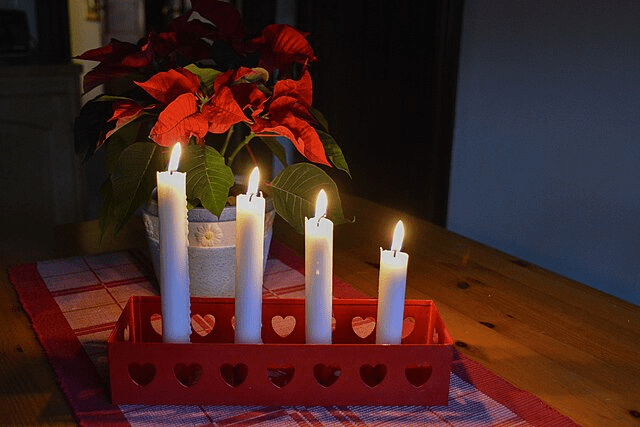
Let us pray …
Repent, for the kingdom of heaven has come near.
Imagine, for the kingdom of heaven has come near.
Be at peace with yourself, for the kingdom of heaven has come near.
Be at peace with another, for the kingdom of heaven has come near.
Be at peace with all creation, for the kingdom of heaven has come near.
Be at peace with God, for the kingdom of heaven has come near.
Peace be with you today, tomorrow, and always.
Peace be with you. Amen.
 stfrancischurchtairuanz