by Barry Pollard
(Based on Luke 12:49-56; Ps 80; Heb 11:29-12:2)
“I have come to set the world on fire!” said Jesus, and you could be forgiven for thinking that he has indeed returned to complete his work!
It seems that in recent years the world is on fire, physically and metaphorically. In the last couple of weeks I have read about wildfires in Greece, Turkey, North America, Portugal and Spain. Our weather is becoming more extreme. The world, it seems, is ravaged by wildfires these days – out of control, dangerous and often fatal.

So, is the world on fire?
In Scripture, fire analogies are often used, referring to punishment or refinement and improvement. Fire imagery is present in the Old Testament. Deuteronomy, for example, describes God’s anger as “a fire that burns to the depths of Sheol, the realm of the dead”. Some New Testament scriptures describe the “fires of hell” as a place of eternal punishment for the unrepentant. Matthew in Chapter 25 speaks of “everlasting fire prepared for the devil and his angels” and refers to “eternal punishment” for the wicked, contrasting it with eternal life for the righteous. Other verses use phrases like “unquenchable fire”. Such descriptions relate to fire used as punishment.
Imagery related to fire being used for refinement describes God’s refining process, which purifies and strengthens faith. Zechariah speaks of God refining a remnant of his people “as silver is refined”. In those days, silver was refined by fire using a process called cupellation, where silver-bearing ore was heated in a furnace with lead. The lead and other impurities oxidised and were absorbed into the porous material of the cupel (the vessel), leaving behind relatively pure silver.
Isaiah noted that God refines people “in the furnace of suffering”, highlighting that challenges and trials can serve a similar purpose to fire in purifying and strengthening believers.
You may know that ‘slash and burn’ is still a common yet crude agricultural method of fertilising the soil in some parts of the world. Farmers in many parts of the world regularly set fire to their land to produce ash which promotes plant regrowth. And we are all too familiar with our neighbours in Oz having to deal with their wildfires. In their case, a method of wildfire management is to have a controlled burn-off – setting alight the dry undergrowth during periods of settled weather to remove the fuel for future wildfires.
In both these examples of fire improving (and protecting) the landscape, the outcome following fire is lush regrowth.
So, how do we interpret Jesus’s reference to bringing fire to the world? Is he talking about punishment, or refinement and improvement?
Let’s look at a couple of the first verses again from today’s Gospel reading: “I have come to set the world on fire, and I wish it were already burning!
Do you think I have come to bring peace to the earth? No, I have come to divide people against each other!”
Jesus, the Prince of Peace, is challenging our position. Are we for him or against him? His urgency in this call is apparent. Hear his language! He wants us to choose the truth, and makes no bones about the fact that the truth will divide before it heals. His amplification of the division that is likely to occur as we decide where we stand, gives credence to the type of fire he is bringing. A wildfire, certainly, not punishing, more refining and improving. And like all wildfires, at a cost.
His coming forces a decision. We know his word reveals hearts. His call demands a response.
We can read the weather, Jesus says, but can we read the signs of the times? Can we see that now is the time to choose faithfulness, and to follow him wholeheartedly?

So, Jesus using the fire analogy to describe his work on Earth should resonate with us. Christ’s fire was about burning away our dross (our impurities). Remember why he came. Christ the Saviour came to save, restore us to God, to put things right. And while he gave warnings about how difficult the process would be, we have assurances that we will survive it.
“When you walk through the fire, you will not be burned; the flames will not set you ablaze. For I am the Lord your God, the Holy One of Israel, your Saviour.” (From Isaiah 43)
Jesus was dealing with people who had started out serving the Lord but had ended up serving themselves. Originally intent on bringing light into the world, they were now allowing darkness to rule. Outwardly ‘holy’, inwardly rotten! Jesus was pointing out that his mission was to turn that around; and it would not be easy. People would have to choose where they stood – status quo or transformation – and he couldn’t guarantee which way things would go. Division and unrest, without doubt. His way bringing restoration with God, sticking with the old way moving them even further away from him.
Now let’s see if I can link in the other readings.
The reading from Psalm 80 is a plea for restoration. The psalmist uses a vine to describe the plight of Israel, a vine that God had grafted in but which is feeling neglected and threatened. His plea is for God to return and tend to it, protecting it from harm. The vine is Israel, of course. He wants God to step in and turn its people back to him. It is a plea for justice and mercy.
The psalmist concludes that if God intercedes to save and restore Israel, the vine, then it would never abandon him again. “Revive us so we can call on your name once more!”
Their faith would be restored.
The Hebrews reading is a call to faith endurance. The author was encouraging the Hebrews to persevere, in faith, amid their trials. We heard about a variety of biblical heroes, whose stories we may know, who exhibited great faithfulness, laying God’s platform for our eventual restoration. The exploits of the Israelites under Moses and Joshua are mentioned. Rahab, the woman of ill-repute; Gideon, who (gave away Bibles?) led the Israelites to victory over the Midianites; Barak, who led the Israelites to victory over the Canaanites; Samson, the man with superhuman strength; Jephthah, who led the Israelites to victory over the Ammonites; David, King of Israel; and Samuel, a prophet and judge who managed to meld the tribes of Israel into a kingdom, are all named!
Each of these folk had periods of faithful obedience, despite their trials, that are recognised, celebrated and recommended to us as examples we should follow.
The story of Jephthah, one of the lesser known of those mentioned, is found in the Book of Judges. His story is a very tragic tale. In Chapter 11, the Israelites “again did what was evil in the sight of the Lord … they forsook the Lord and did not serve him. So the anger of the Lord was kindled against Israel, and he sold them into the hand of the Philistines and into the hand of the Ammonites”.
Jephthah was one of the ‘judges’ of Israel. He was also known as a mighty warrior who led the Israelites to victory against those Ammonites. However, he made a rash vow to sacrifice the first thing that came out of his house upon his victorious return from battle against them. The unfortunate consequence was that his precious daughter was the first to run out to greet him, leading to her eventual sacrifice …
[If there is an obvious lesson for us in this account it should be to consider thoroughly before making vows and promises, because to keep them could prove very costly indeed.]
So, the Hebrews excerpt celebrates those who endured suffering for the sake of God’s promises. They were faithful, despite adversity and tragedy.
But the pinnacle example for us, of course, is Jesus, who “because of the joy awaiting him, endured the cross”. It is his example that we look to as the ultimate encouragement to faith. It is his example that provides us with our present-day motivation and responsibility.
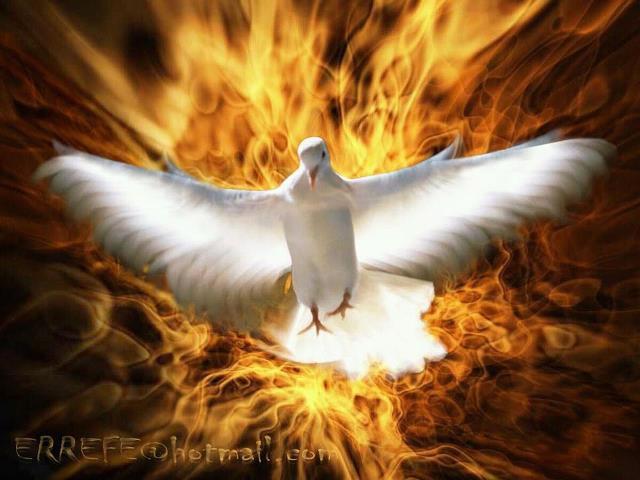
The fire that Jesus was talking about isn’t a fire he brings to hurt or harm us. It is a fire he brings to transform, restore and meld us. A fire that burns away the things that keep us from him, and others. A fire that ignites in us a passion for him, and others. A fire that we can take to the whole world …
Today’s ‘Collect’ provides us with an appropriate conclusion. Let this be our prayer today, for ourselves and each other:
Come, Holy Spirit, to all baptised in your name, that we may turn to good whatever lies ahead. Give us passion, give us fire; make us transform the world from what it is, to what you have created it to be. This we ask through Jesus Christ our Lord. Amen.
 stfrancischurchtairuanz