by Pat Lee
(Based on Luke 3:1-6)
“There’s a particular person in my life I sometimes just don’t want to be with. Sometimes I don’t like what I see in this person. Other times I am disappointed or angry with this person. Sometimes I don’t listen to this person. Sometimes we argue. A lot has happened between us. Judgements have been made, criticisms have exchanged, and wounds have been inflicted. I often don’t understand this person or our relationship. Some days I love this person, other days not so much.
Our relationship is often rough. Sometimes I feel I have descended with this person into a deep valley and make less of myself than I really am. Other times I climb a high mountain and make more of myself than I really am.
You know what I’m talking about, right? I suspect you know those feelings I described. I think we all have someone like that in our lives. But it might not be who you think it is.
In my case, the person I’m talking about is me. I’m talking about the relationship I have with myself. And I am talking about the relationship you might have with yourself.”
(Michael K Marsh)
When I read this, I felt that Marsh knew, when he wrote those words back in 2021, that I, and many others who have read them since, were feeling similar things about ourselves.
What does this have to do with John the Baptist and Advent in 2024?
Advent is the time for preparing ourselves for the coming of the Lord, isn’t it? Well, Marsh has a better way of explaining it than I have, so I’m going back to him. Not all of what he says will apply to each or any of us, but much of it might. He asks a lot of questions and gives us plenty to think about.
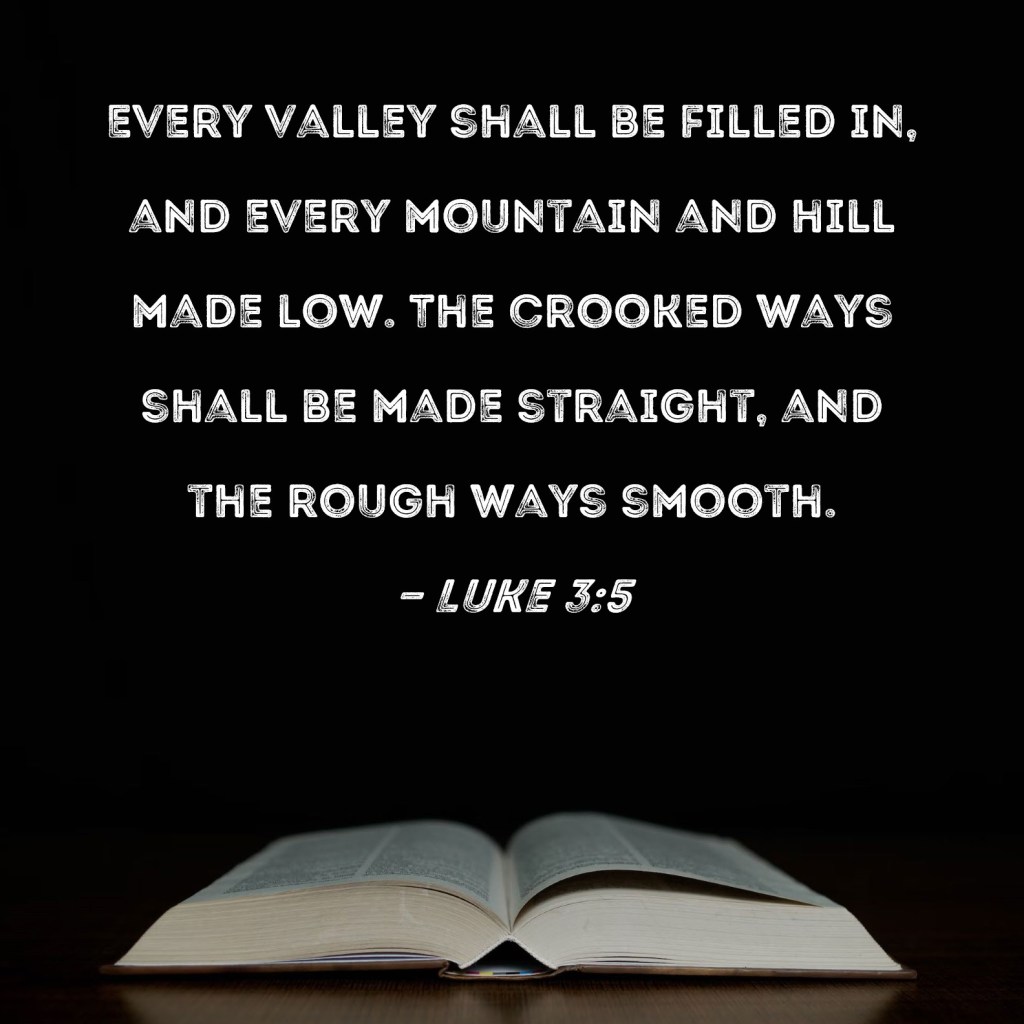
So he says, “I think that’s what John the Baptist is getting at in today’s gospel when he says, ‘Prepare the way of the Lord, make his paths straight. Every valley shall be filled, and every mountain and hill shall be made low, and the crooked shall be made straight, and the rough ways made smooth.’”
He could be talking about the relationship we have with ourselves. He’s talking about the landscape of our lives. He’s asking us to risk confronting ourselves.
What if that confrontation with ourselves is what it means to ‘prepare the way of our Lord’? And what if it’s less about whether we’re wrong, bad, or sinful and more about our healing and wholeness?
The valleys, mountains and hills, the crooked paths, and rough ways of which John speaks can be descriptive of our interior landscape. They are conditions and states of being within us. They are ways we relate to ourselves and one another. So, for the next few moments I want us to consider the landscape of our lives.
Think about the low places in your life. What gets you there and what keeps you there? Maybe it’s the judgements and criticisms you make of yourself. Maybe it’s self-doubt, second guessing, lack of confidence or self-esteem. In what ways do you diminish or put down yourself? Sometimes we live in the valley of grief and loss. Guilt, shame, embarrassment often take us to the valley. It might be regrets, disappointment, fear, failures. When have you betrayed or alienated yourself? When have you settled or given up? When have you lived less than you knew yourself truly to be?
Think about the time and ways you’ve got too big for your boots. Think about the ways in which you try to control or coerce your life, or another’s life. When have you been selfish, judgmental of others, or intellectually rigid? In what ways are you motivated by power, wealth or lack of it, success, reputation, the need for approval or to be right? When we live in excess of anything we’re on top of our mountain. When have you thought yourself better than or superior to others? When our ego is inflated and we’re full of ourselves we’re climbing a mountain.
I’m asking about those things that are out of kilter, out of sync. In what ways are your words and actions not aligned with the values you claim to hold? In what ways is your life twisted or deformed? When we are dishonest with ourselves or others, we’re on a crooked path. Is there integrity in your life, your words and actions? Every time you and I give another reason to doubt trustworthiness of our words or actions, we are living crooked. What’s the shape of your life these days? Is it shaping up the way you want it and, if not, what’s crooked?
Think about the ways your life is uneven, out of balance, or lacking harmony. What’s missing? What’s causing you to stumble and trip? What parts of your life are lacking order? What relationships need some care or repair? What beliefs, patterns, or habits are making your life bumpy? Are you sometimes more tolerant and gentle with others than yourself? Who are you roughest on and why?

Those landscapes are not just individual. They are also in churches; in New Zealand, and the world. Look at the topography of Covid, racism, immigration, economic inequality, and the political issues that divide us and you’ll see valleys, mountains and hills, crooked paths, and rough ways. In what ways are those also a part of your life’s landscape?
That landscape is a mirror that confronts us with ourselves. Not a final judgment or conclusion – it’s a diagnosis. It’s naming the places in our lives and world where it hurts. Where does it hurt today? Healing starts where it hurts. Before there can be treatment there has to be a diagnosis. And sometimes the most difficult and scariest part of healing is going to the doctor to find out what is wrong.
But I want you to know, whatever the terrain of your life and world might be today, wherever it hurts: “every valley shall be filled, every mountain and hill shall be made low, the crooked shall be made straight, and the rough ways shall be made smooth.” That’s the good news John brings from the wilderness.
It’s the hope that you and I will one day live on level ground and walk a smooth, straight path together. That’s what I want, don’t you? That’s what I want for you, or church … our nation, the world, and myself. Hope is a call asking something of us – a repentance, a change.
Imagine what your life would look like if you lived on level ground and walked a smooth straight path. That’s what John is offering each one of us. To “see the salvation of God” begins with looking at the landscape of our lives.
What do you see when you look at the landscape of your life today?”
Let us pray: Testing God, refine us with the fire of your love and justice. Make whatever is crooked or broken within us into a straight path that leads to you. May we be as your fertile valleys and plains, producing a harvest of grace within the wilderness of our world. Amen.
 stfrancischurchtairuanz