by Rev Megan Means
(Based on John 18:33-37)
The Anglican lectionary guides our theme today towards the climactic end to the church year, proposing we concentrate on Christ the King and The Reign of Christ. This is a time for us to reflect on the meaning of Christ’s reign over the church, over the world, and over our lives. What kind of ‘king’ was and is Jesus? What did and does his rule look and feel like? What does it mean to live under his kingship today?
The lectionary has given us a rather odd Gospel reading. Do we read about Jesus in his kingly glory, transfigured and dazzling on a mountaintop? Did we hear about him rise from the waters of baptism with the heavens thundering? Do we hear about one of his more spectacular miracles? No, Jesus is not described in any majestic outfit. Instead, the Gospel of John offers us a picture of Jesus at his physical and emotional worst: arrested, hungry, abandoned, sleep-deprived and standing before Pontius Pilate for questioning. If we were going to write Jesus into a kingly scene, most of us would not have chosen this reading, would we? So, where did this title of ‘king’ come from?

I think that it came from Jesus thinking that he was the King of the Jews or, at the least, a ‘King’ in a kingdom ‘not of this world’. Was Pilate’s approach just a political charge, as anyone who claimed to be a king was seen to be a threat that had to be dealt with?
Did we pick up that Pilate does not ask Jesus whether he was claiming to be a divine man, or whether he thought he was the ‘Son of Man’, or whether he was opposed to the Jewish leadership, or whether he disagreed with the teachings of the Pharisees or Sadducees, or anything else. He is only recorded here as asking Jesus, “Are you the King of the Jews?”
Did Jesus considered himself to be the Jewish messiah, a king? Possibly, yes. But back in this story’s context, Jesus may have meant something very different and more specific than what we may read and link into it today. There were various views of what a messiah would be like among Jews of Jesus’s day. The messiah was expected to be a political ruler over Israel. He was to be a great priest who ruled God’s people through God’s law. And he was to be a cosmic judge of the earth who would destroy God’s enemies in an act of judgment. The common thread here is that the future messiah would be a figure of grandeur and might, who would come with the authority and with the power of God.
But this Jesus was just the opposite. An itinerant Jewish preacher from rural Galilee who challenged the law and religious sects. He lived out teachings of love, mercy, forgiveness and serving one another and who died for these efforts. I think that Jesus was only really considered the messiah by his followers after his death, as that is when the term ‘Christ’ became the most common designation for him.
According to our earliest Gospels and their sources, Jesus did not publicly proclaim that this was his self-understanding. He does not preach about himself as the future messiah or king – in Mark, Matthew, Luke, Q, M, or the L sources. He only seems to tell his disciples, in private. They know who he thinks he is and they know who he thinks they are. Namely, Jesus is the future king and they will be serving under him. Jesus is recorded in Matthew and Luke (Matt. 19:28; Luke 22:28-30) as telling his twelve disciples that in the future kingdom of God, they would themselves be seated on twelve thrones ruling the twelve tribes of Israel.
So, Jesus did think that he would be a future king and messiah of the coming kingdom of God in some way. Did his followers ever called him king and messiah? Nathanael declared, “Rabbi you are the Son of God, you are king of Israel.” (John 1:49) And after the feeding of the five thousand, Jesus, knowing that they intended to come and make him ‘king’ by force, Jesus withdrew again to a mountain by himself (John 6:15). In John 12:13, the crowd took palm branches and went out to meet Jesus, shouting, “Hosanna!” “Blessed is he who comes in the name of the Lord!” “Blessed is the king of Israel!”
So, this must have also been what those in the public arena heard and thought as well, and why Pilate used this as a political charge against him. Any talk of another king, in any sense, in the Roman empire was enough to order ultimate punishment. Could this be why Jesus really died?
In his time, was Jesus an apocalyptic-ist (?)? One who believed that God would soon intervene in the course of history, overthrow the forces of evil, and establish a good, and very real, political kingdom here on earth. Therefore, his listeners had to turn to God immediately and repent in preparation for this imminent end.
But when Jesus ended up being arrested and crucified, did this completely and utterly destroy the disciples’ vision of what was to happen in the near physical future? Had they thought that they were going to be physically seated on twelve thrones ruling the twelve tribes of Israel, with Jesus as the King?
When Jesus was raised from the dead, and returned, it was the disciples who were the witnesses, so, did this make them change, adapt and shift how they understood who Jesus was and how the future kingdom may arrive? Is this why the term ‘messiah’ gained strength after Jesus’s resurrection?
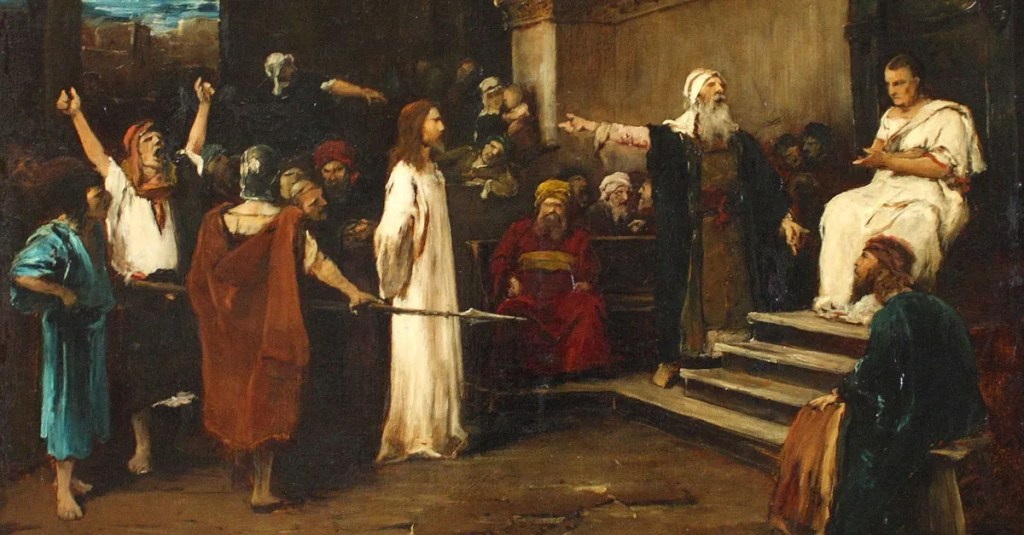
Back at the Pilate scene, Jesus went on to say that “Everyone who belongs to the truth listens to my voice”. He implied to Pilate that he, Pilate, was looking at the truth. “I am the truth.” To unpack this, I would say that Jesus understood his power as different because he believed he was truth and was established in truth. What does it mean, in our post-truth era, then, to worship the King of Truth? What does it mean to ‘belong to the Truth’ in a culture that increasingly denies Truth’s validity? Perhaps most importantly, how can we bear witness to a complex truth, a truth like the incarnation story of birth, life, death and resurrection, in a world that prefers Instagram, Facebook, and Tweets, etc, or internet games and action hero movies?
One of the most urgent tasks facing the Church on this Christ-the-King Sunday is forging a robust and gracious, urgent and respectful, relationship to the Truth. If Jesus came to testify to the Truth, if he is the Truth, if he is the King of Truth, then what does our loyalty to Truth look like, here and now? I’m painfully aware of the Church’s long and miserable tradition of using ‘the truth’ to consolidate and abuse its own power. Religious institutions have excelled at using ‘truth’ to colonize, enslave, reject, abuse, and dehumanize those we conveniently call “Others”.
And, who displayed more truth this week: the Treaty Principles Bill before parliament or the hīkoi mō te Tiriti? [A heated local constitutional issue – Ed]
Jesus calls us to belong to the Truth that he embodied in his life, death, and resurrection. His Truth was not self-centred in any way. It did not serve to bolster his own power and authority. His Truth was not and is not an instrument, a weapon, or a slogan. The Truth is Jesus.
Today we acknowledge the Reign of Christ the King. Can we stand for the Truth as Jesus did? Can we belong to the Truth as he did? Can we tell and keep telling the joy-filled, pain-filled and powerfully undeniable stories that we know to be the truth about Jesus? Next week, we will enter into Advent, a season of waiting, longing, and listening. A time for waiting for the Truth to reveal itself, in the first cries of a vulnerable baby that grew to redefined kingship. The Truth lives and we belong to the Truth. The Truth is Jesus.

 stfrancischurchtairuanz