by Joan Fanshawe
(Based on Mark 10:46-52)
Two weeks ago, the Gospel reading from Mark gave us the story of a rich man who came to Jesus asking, “What must I do to inherit eternal life?”
Today, in contrast, we have heard the story of the blind beggar’s encounter with Jesus: a man named Bartimaeus, whose sight was restored.
The rich man came asking what he could do to earn salvation. Jesus gave him what turned out to be an impossible task: give up his wealth for the benefit of the poor, then come and follow him, Jesus. Bartimaeus, on the other hand, sits at the side of the road and simply calls out to Jesus asking for mercy.
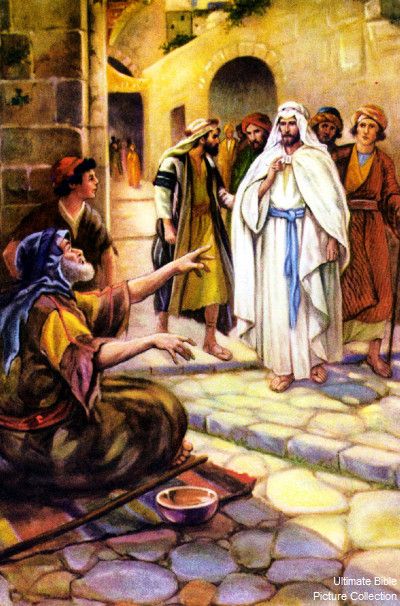
Although the crowd tries to silence him, Jesus hears him and asks what he wants. “Rabbi, I want to see,” is his reply and this request is immediately granted. “Go,” says Jesus, “your faith has made you whole.”
The rich man is told to give everything up and then follow, but he goes away. Bartimaeus, in a sense, is given everything when his vision is restored and told to go on his way, but he follows.
There are several ways of looking at this account from Mark’s Gospel.
We could just say that Jesus took pity on a blind man begging by the city gate and healed his blindness, and wasn’t that a wonderful miracle?
We could pick up on the fact that Bartimaeus became a follower and think that was great too. But perhaps not really surprising in the circumstances.
We are nearing the end of the church liturgical year now and our continuing stories of Jesus’s life and ministry will take a pause while we celebrate Advent and Christmas. But in the last few weeks we have become aware that the Mark is telling about Jesus and his disciples and followers ‘on the road’ or ‘the way’, teaching and healing and making their way to Jerusalem. In other words, walking towards what we know will be the end of Jesus’s earthly life.
Quite often the stories we’ve heard along this journey have also been saying that the disciples were not getting the message, or really seeing and understanding what Jesus has been trying to tell them about himself.
A vital link piece in today’s story is the blind beggar shouting out, “Jesus, son of David, have mercy on me.”
“Son of David” is a recognition of the fulfilment of the ancient prophesy of the promised Messiah being of King David’s line. With Jesus thus identified in this account, we might not be surprised that Mark gives the blind man a name, when very few people in the Gospel stories are named.
Names were important in the ancient world; they weren’t just labels; they conveyed meaning, and an odd name would capture the readers’ or listeners’ attention, and add to the meaning of a story.
So, what does the name Bartimaeus signify?
Mark’s listeners would have noticed that Bartimaeus was not a familiar name. It begins with the Aramaic ‘Bar’, signifying ‘son of’, but attached to a Greek name Timaeus. So, Bar-timaeus … ‘son of Timaeus’.
Some scholars attribute the name’s meaning to an Aramaic word meaning ‘honour’, giving the blind man a worthwhile background. However, others see the name Timaeus and the situation of the beggar as being linked to a word meaning a ‘son of poverty and shame’, reduced as he was to sitting with his cloak spread to receive coins from passers-by.
Rev Dr Eric Funston, an Episcopal priest in Ohio, has another suggestion, thinking about this story in the context of Mark first sharing it to his largely Gentile audience in Rome, who would have had little knowledge of the Aramaic language. They would have known some Greek though, and many would have been familiar with Greek literature.
Timaeus is indeed a Greek name – rare but well known. Because there was a Timaeus of Locri, and also Timaeus the historian, who lived in Athens around two and a half centuries before Christ. His histories were later declared unreliable and a wilful distortion of the truth by some. The historian Polybius condemned him as “an old ragwoman”, nothing more than a collector of old wives tales (which we might call mis-information or dis-information these days). If this historian is the Timaeus of whom the roadside beggar is a “son” or follower, Mark may have been telling his readers, and telling us, of the blindness that can come from untruth, distortions of fact, or someone else’s ‘alternative truth’, blinding ourselves to the truth of Jesus’s teaching about truth. Capital T truth, the Truth that will set you free.
However, Dr Funston concludes that it’s Timaeus of Locri, a famous character in Plato’s philosophical Dialogues, who is very likely the candidate for Mark’s reference. That Bartimaeus, “son of Timaeus,” should be blind in Mark’s Gospel is noteworthy because in the Dialogues, Timaeus sings the praises of our sense of sight. The blessing and benefit of sight and, thus, observation enables our understanding of the nature of the created universe, God’s place and our place as individuals and community in the ongoing story.
If Mark’s blind beggar Bartimaeus is recognisable to his listeners from this ancient connection it does seem to me that the blindness is more about being unable to see the possibilities of a new way of being.
How could this passage speak to us us today? Like Bartimaeus sitting outside of Jericho, we can be blind to the way we are existing and stay our comfort zone .
We can be blind to the needs of the world we live in.
We can be blinded by self-preservation and self-sufficiency; blinded by the influence of others’ opinions.
We can see the blindness of political and religious differences in the extreme violence of wars currently raging and the lie that violence is a solution to our disagreements.
And this can lead to our being blinded by anxiety and hopelessness.
Maybe we are all the rich man seeking salvation; we are all blind Bartimaeus sitting with our cloaks and begging bowls by the side of the road.

Jesus is coming by. What shall we do?
Will we like the rich man hold on to whatever blinds us and turn back into the darkness? Or will we be like Bartimaeus and seize the opportunity with eyes wide open?
I’m intrigued that Mark, writing what most understand to be the first account of Jesus’s life and sharing this teaching with an early Christ-centred community, gives us this account of Bartimaeus.
And that so many details in the story can still connect with us more than two thousand years later.
I keep thinking of the verse that mentions Bartimaeus casting off his cloak at Jesus’s invitation to come to him. That cloak represents his whole way of life, his livelihood, his persona, as he spreads it daily to mark his place by the roadside, to bear his begging bowl where people could leave coins or other offerings. The cloak would keep him protected at night and people would know him and recognise him wrapped in it. Even for a beggar, it was a still big move to leave all that and go to Jesus – then, with his vision restored, follow the way of Truth and Love.
For us, there is blindness in our own lives, behaviours we want to cling on to. It can be hard to face but in our deepest hearts we know that they separate us from God and need to be cast off like Bartimaeus’s cloak, so that we too can lead a full life as followers on the Way.

Jesus is coming by. What shall we choose?
Jesus, Son of David, have mercy on us.
~~~
Open the eyes of my heart
to see your grace in every moment,
to see with hope and gratitude,
with trust and humility.
Teach me to look with my mind as open
as my eyes; teach me in every gaze
to look and see as things really are,
not as I already think they are,
not as fear (mine or anyone’s) tells me to see,
but to see with grace as you see.
Let me see with the eyes of love.
Teacher, let me see anew.
Amen
“My teacher, let me see again.”
— Mark 10.51
[Prayer poem by Steve Garnaas-Holmes]
 stfrancischurchtairuanz