by Sharon Marr,
adapted from earlier work by Chris Ison
(Based on Job 38:1-7, 34-41 and Mark 10:35-45)
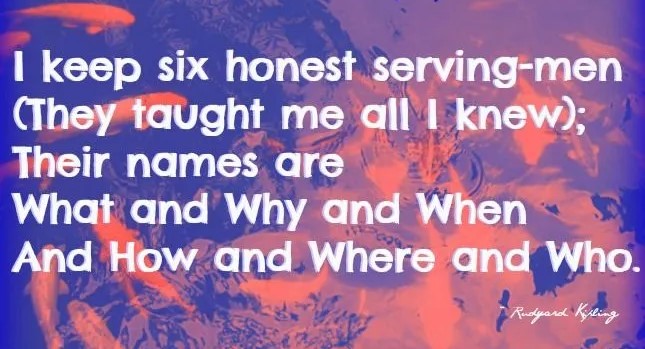
It’s funny how things from childhood stick in your mind. This short rhyme I recall was in the front piece of a ‘Children’s Book of Knowledge’ that I had a youngster. I believe it was attributed to Rudyard Kipling. It very much reflects an attitude to the acquisition of knowledge that I suspect most teachers would strongly approve of and which lies at the heart of our modern culture. For us, ‘scientific enquiry’ is the way we are taught to make sense of the world.
And like all societies and cultures, past and present, we need to make sense of the world in which we live. There is nothing more disturbing than trying to cope with the irrational or chaotic or inconceivable.
Living in an age in which human progress, based on rationality and scientific enquiry, seems to be collapsing around us … should give us some pause for thought as to whether we are actually asking the right questions. It should also provoke an increasing humility about the limits of human knowledge. We now know infinitely more facts about the world than at any time in history, and yet seemingly we cannot live in peace with one another … or look after our world.
This need to make sense of the world, and to cope with reality as it presents itself in the ordinary circumstances of daily existence lies at the heart of the ‘wisdom’ literature in the Old Testament. Job is arguably the most profound book in the Old Testament’s wisdom genre because it tackles uncompromisingly the most difficult and perplexing aspects of human life – the relationship between God, evil and the suffering of the innocent – and in doing so turns the rest of ‘wisdom’ teaching on its head.
Why, why, why?
A little aside – Many years ago, or perhaps just the other day, when I was a child of about seven and my brother was three, he went through a stage of … Why? Come inside, Marty, it’s time for your bath, called Mum. Why? Because it’s nearly tea time. Why? Because dinner’s ready to go on the table. Why? Because that’s where we all eat. Why?
By this time Marty was directed smartly by an exhausted mum to the bathroom. This stage of ‘why’ was not fleeting; it doggedly went on for many months until one day … No, I’ll wait till the end of the reflection to tell you what happened next.

Why do bad things happen to good people? It would be so much easier to cope if only we knew why!
In the previous chapter of Job, Job’s friends, who came to comfort him in his suffering, thought they had the answer. God has created an orderly universe and the job of the wise is to uncover its secrets and live in accord with them. Those who do will be blessed – those who do not, the foolish, will suffer grievous consequences. Health, wealth, honour, longevity – these will be the rewards for following the teachings of the wise. If Job was suffering, then it was obvious he had sinned in some way, and he needed to work out how. But Job – upright and righteous, as even God recognised – is adamant that he has not sinned, and this is the basis for the increasingly angry confrontations that take place between Job and his friends. He insists on his integrity and eventually, after lengthy confrontations, Job ceases to pay attention to his friends, his anger is focused on God. This climaxes in his final speech in which he demands an answer from God:
“If only someone would listen to me! Look, I will sign my name to my defence.
Let the Almighty answer me. Let my accuser write out the charges against me.
I would face the accusation proudly. I would wear it like a crown.
For I would tell him exactly what I have done. I would come before him like a prince.“
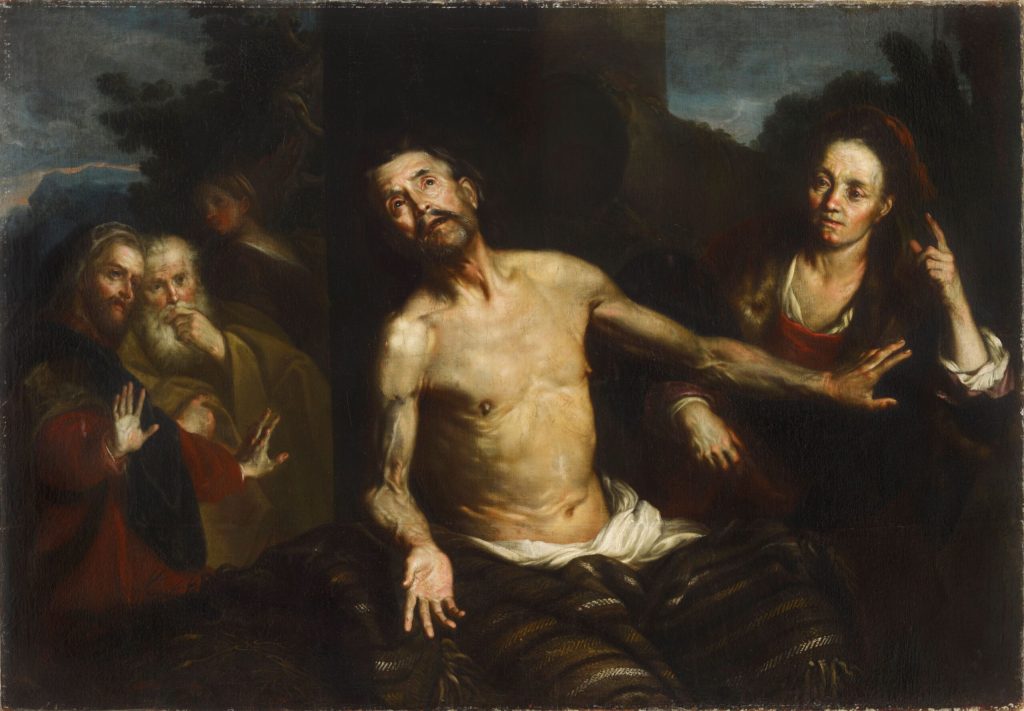
God’s answer to Job comes from “out of the whirlwind”!
And if Job was expecting an answer to his complaints, this is not it! God displays his majestic power, just as Job hoped, and he is crushed by it.
“Who is this that questions my wisdom with such ignorant words? Brace yourself like a man, because I have some questions for you, and you must answer them. Where were you when I laid the foundations of the earth? Tell me, if you know so much. Who determined its dimensions and stretched out the surveying line? What supports its foundations, and who laid its cornerstone
as the morning stars sang together and all the angels shouted for joy?“
In the reading following, Job is satisfied and his friends are humiliated, but our focus this week is on God’s response. How can this be an answer?
Well it isn’t; certainly not in our terms.
But in a deeper and more profound sense, it is! Job had been demanding an answer to an unanswerable question. As did the disciples in our Gospel reading. God in his awesome power shows Job that he knows nothing of the mysterious nature and workings of the universe, and that no-one, not even someone declared blameless and upright by God, has the right to march into God’s presence and claim any rights. God’s power is not to be constrained by some ‘heavenly Human Rights Act’. God’s action in the world, and his love, are unconstrained and grace filled.
The more we try and probe into this the more we meet mystery. We can explain moral evil as a consequence of free-will. If free-will is to be meaningful then humankind must be as free to do evil as to do good. But what about natural evil, disease, earthquakes, tsunami? Well these days, for example, we know that earthquakes are the result of the movement of tectonic plates – and tectonic plates will do what tectonic plates have to do.
So why doesn’t God stop them?
At one level we could say that it would be a funny sort of world where God kept intervening to modify the laws of physics, or biology or chemistry – chaotic in fact. And in view of my earlier comments, I wonder how we would find living in a world in which nothing behaved with any predictability. But this is too much of a pat answer. We have to accept, as Job did, that we are confronted with a larger mystery than we can understand.
At a fundamental level we have to accept that human rationality, human knowing, does not constitute wisdom in its deepest sense because we do not, and cannot, see the wider and deeper picture. [Refer to The Weaver poem – Ed]
This, of course, is taking us further forward into a New Testament understanding of God’s redemptive activity and, as we see in the Gospel reading, the disciples have just the same problem in coming to terms with the mystery of God’s activity in the world. James and John have signed up for the messianic mission, and once the Romans have been expelled and God’s rule restored over Israel, then what could be better than being second in charge – seems obvious!
Their problem is disbelief. God’s redemption of the world will not take place in some cataclysmic battle with the Romans, but in a cruel, violent execution on a wooden cross outside the walls of Jerusalem. Something that neither the religious insight of the Jews nor the wisdom of the gentiles could come to terms with.
Job’s friends were the leading promoters of the theological wisdom of their day. They knew what Job’s problem was, yet were humiliated by finding God rejected them. Job didn’t know what the problem was, but he wanted an answer, only to find that the answer was beyond his understanding and lay deep in the mystery of Creation.
He accepted this with reverent humility.
As Job discovers, God has made foolish the wisdom of the world.
Like Job, we want answers, and we live in a world in which, like Job’s friends, we believe we have the intellectual equipment to define the answers. But we must not fall into the trap of believing that the truth of the Gospel is dependent on our sophisticated philosophical arguments or eloquent speech-making, as did some in the early church. No. The Gospel rests on supremely unconvincing, unreasonable, unconstrained and grace-filled folly, Christ crucified! By no human standards would anyone suspect the crucified Jesus was the power and wisdom of God.
For us today, that message needs to be taken to heart. Faith derives not from wisdom – but wisdom comes through faith. This is beautifully expressed in this short extract from the prayer of St Anselm, that I would like to conclude with:
I do not endeavour, O Lord, to penetrate your majesty, for in no wise do I compare my understanding with that; but I long to understand in some degree your truth, which my heart believes and loves. For I do not seek to understand that I may believe, but I believe in order to understand.
For this also I believe – that unless I believe, I should not understand. Amen
Oh, I’ll finish my story of my brother’s why. Well, in response to yet another ‘why’ from Marty, mum turned around and said, ”Just cause!” And silence reigned.
The Supreme Loving Being always has the last say!
 stfrancischurchtairuanz