by Sharon Marr
(Based on Mark 9:30-37)
I love the unselfconsciousness of children in worship. I love their curiosity, their intensity, their sure sense of welcome and belonging. When they’re delighted, we can see their joy, clear and simple. When they’re bored, hungry, sad, or irritable, they let us know that, too. I love the fact that this family of God has welcomed children as they arrived on roller skates, in tutus or onesies, stood beaming with their work, tumbled down the aisle, done flips on the altar rail, or bounced Tigger fashion for communion with a huge smile.

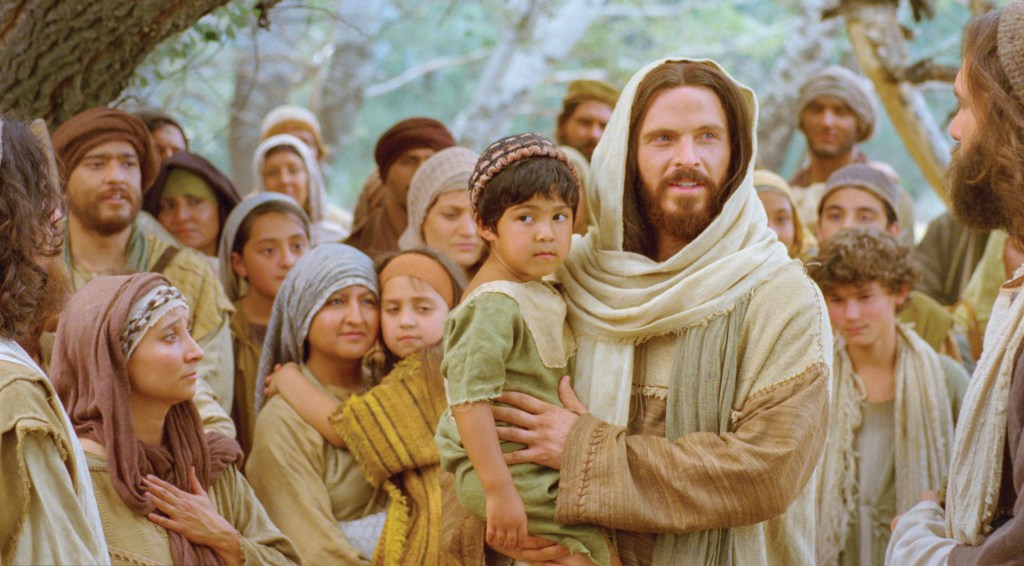
Jesus, in this week’s Gospel reading, takes a little child into his arms, turns to his disciples, and says, “Whoever welcomes one such child in my name welcomes me, and whoever welcomes me, welcomes not me but the one who sent me.”
On the face of it, this tender gesture is so small and so simple, we could easily miss … that this is very radical. But consider this: Jesus doesn’t say, “Welcome the child because it’s a kind or loving or generous thing to do.” He says: “Do you want to see what God looks like? Do you want to find God’s stand-in, hidden here among you? Are you curious about the truest nature of divine greatness? Then welcome the child. Welcome the child, and you welcome God.”
The context for this remarkable claim is an argument that breaks out among the disciples when Jesus explains — for the second time — that he will suffer, die, and rise again after three days. The disciples don’t comprehend, but they’re too afraid to ask questions. And I take note here, Jesus doesn’t show the least bit of concern that they didn’t comprehend; it wasn’t a test, he doesn’t say I’ve told you this before. Instead, Jesus asks what their quarrel is about as it was obviously important to them. They refuse to answer. They’re too embarrassed to say they were arguing about who among them is the greatest. But he already knows why they’re bickering, so he brings a child into their midst, gathers the child into his arms, and upends his disciples’ notions of greatness and power: “Whoever wants to be first must be last of all and servant of all.”
I could be tempted to sentimentalize Jesus’s gesture. I’ve heard well-meaning people suggest, for example, that Jesus likens children to God because children are so innocent. Perhaps … But the children I know are also spirited, generous, selfish, naughty, obedient, curious, bored, quiet, loud, challenging, funny, surprising, creative, destructive, solemn … and exhausting. I think Jesus knew as much when he described children as trustworthy representations of God.
So what can we really learn about God by welcoming children? How can children open us up to deeper, more authentic communion with the divine? What might children teach us about greatness?
Here are four possibilities:
Firstly, children show us that our imaginations are pathways to God. When our Lissy was expecting her second child we were wondering just what sex the child would be and we were guessing amongst ourselves. After a pause we asked Isabel, four at the time, what she thought the baby would be and she gave it some serious thought and then responded “an Acrobat”! Imagination. Isa wasn’t limited to just the sex of the coming child – she was looking ahead to its future! As it turns out she’s on the ball as our Emily is always swinging on bars or tumbling down the hallway.
Jesus invites the disciples to imagine a world where death doesn’t have the final word. Where inexpressible suffering gives way to irrepressible joy. Where resurrection is not merely a possibility, but a promise.
But the disciples can’t make the leap. They’re bound by preconceived notions of who and what the Messiah must be, and they lack the imagination to envision a world as revolutionary as the one Jesus holds out to them. Doctrine, dogma and theology, in other words, hold their spiritual senses captive. Welcome the child, Jesus says in response. Open your imaginations. Return to the capacity for wonder, newness and strangeness you knew as a child.
I taught Bible in Schools for many years and I have seen lots and lots of very imaginative, enthusiastic children. The wonderful joy for me was, after one Bible story, a child said wistfully to me, “I want to meet Him”. Imagination. She, at five years, could sense the love she would meet.
Secondly, children teach us to risk hard questions on our way to God. As I mentioned earlier, kids aren’t afraid to ask awkward, challenging, and even impossible questions. They’re naturally curious, they’re not embarrassed by their ignorance. If they don’t understand something, they ask, and they persist in asking. As parents we have all lived through that seemingly endless ”but why?” period. In contrast, the disciples are too afraid to ask hard questions. In telling them candidly about the suffering that lies in his future, Jesus offers his disciples the possibility of a deeper, more vulnerable-making intimacy with him. But they resist the invitation, they just want to remain safely in the status quo.
Thirdly, children teach us to trust God’s abundance. Young children generally expect that there’s enough to go around. Enough time, enough hugs, enough attention, enough love. It doesn’t occur to them to fear scarcity unless they’re conditioned to do so; left to themselves, they assume there is always plenty.
The disciples in this week’s story, don’t trust Jesus’s generosity, sufficiency and abundance. They quarrel for … first place, first dibs, first prize. In response, Jesus points them to the non-striving, un-ambitious, open-hearted trust of a young child.
And, fourthly, children teach us what divine power looks like. This, I think, is the most radical lesson of the four. A young child is the very picture of vulnerability. In some cultures, children are socially invisible. In others, they’re legally unprotected. In all cultures, children are at the mercy of those who are older, bigger and stronger than they are.
And yet this — this shocking portrait of powerlessness — is the portrait Jesus offers of God. In the divine economy, power and prestige accrue as we consent to be little, to be vulnerable, to be invisible, to be low. We gain greatness not by muscling others out of our way, but by serving them, empathizing with them, and sacrificing ourselves for their well-being. Whatever human hierarchies and rankings we cling to, Jesus upends them all as he holds a tiny child in his arms. Do we want to see God? Do we really want to see God?
Then look to the child with no food, look to the child who has been molested. Look to the child who is fleeing from war. Look to the least of these, and see the face of God.

In this season of ‘caring for Creation’, children can teach us much. We need imagination to envision God’s kingdom here on earth. We need to ask ourselves hard questions. Do our actions and lifestyles reflect a real commitment to the well-being of everyone and everything? Are we secure in God’s abundance that we can determinedly consider the needs of all? And, finally, can we humbly serve and protect our Earth, and all who live with us on her, reminding ourselves we are stewards not owners?
One of the most amazing truths about Christianity is that God became a helpless human infant. Jesus underscores that stunning truth with another: all children represent God’s heart, God’s likeness, God’s power. To welcome a child is to welcome the divine. To cultivate childlikeness is to cultivate godliness. To choose vulnerability, is to be great in the Kingdom of God.
Drawing on work by Debie Thomas and Steve Garnaas Holmes
 stfrancischurchtairuanz