by Megan Means
(Based on John 6:56-69)
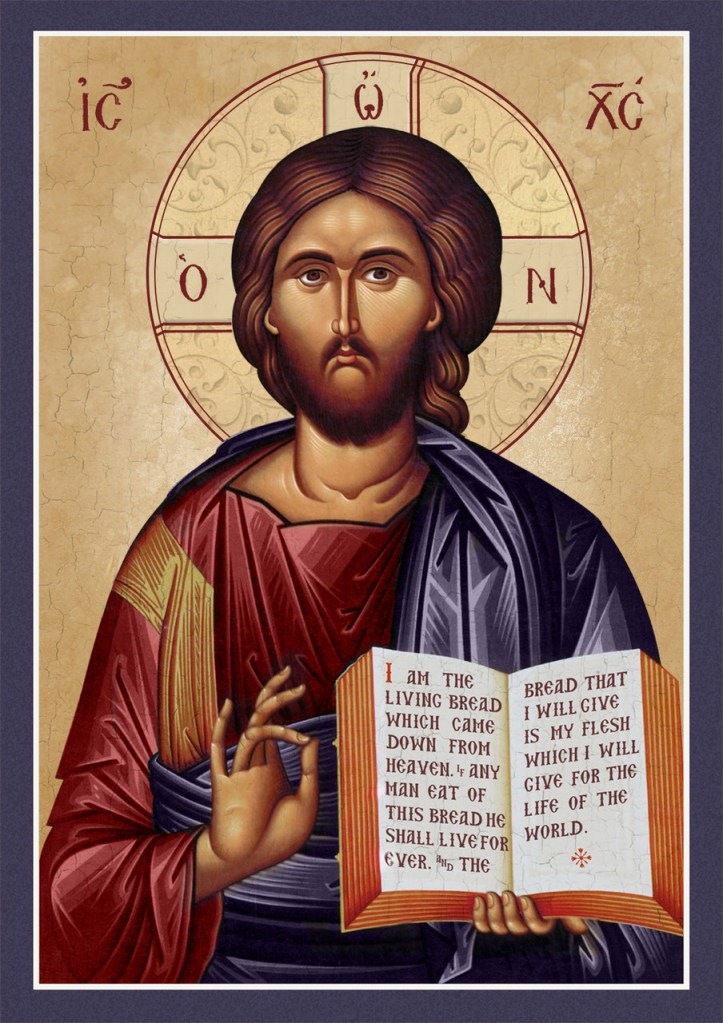
Today is another Sunday looking at Jesus’s proclaiming to be the Bread of Life. Last week we heard of Jesus revealing that he is the “living bread”: a revelation that causes more misunderstanding than joy, and generates lots of moaning and arguing. I propose today that we move into gnawing and munching and stumbling in this conclusion.
Is gnawing and munching is the best way to approach and eat this statement today? This kind of eating tries to get as much as possible out of the meal. It’s a time when politeness may go out the window as we tear the meal apart, eat with our fingers, suck up all the flavour and goodness and then lick the plate.
How will we each choose to engage with and digest Jesus as the Bread of Life today?
The larger group of disciples had now been put in a position where they had to make a choice. They complained, they were offended, they disengaged. They found this particular teaching too problematic and too difficult. They had been fed, taught, healed and loved by Jesus; but it was not enough to enable them to engage with this statement that he is the ‘Bread of Life’.
It seems logical to assume that the larger group of disciples comprised those who believed, those who wanted to believe, those who used to believe, and those who were trying to believe.
I know that sometimes it’s disheartening when I lose the support of friends that I thought I had alongside me in a common cause. But, then again, it has been I myself that has withdrawn my support in some cases … as I no longer agreed with the focus or desired outcome, or the politics, or the people who were being excluded.
This is similar to what I have heard has happened in many larger parishes after Covid. Disciples have not returned. They are just not coming any more. For some reason these disciples have made a choice that Jesus is no longer the priority, as the Bread of Life in their lives, at the moment. Of course, anyone is free to withdraw and change their choice at any time, as God’s love is a freeing love.
John writes that Jesus is not fazed, and reveals that Jesus knew this may happen. Jesus is not concerned about numbers but more about revealing his role, which is about proclaiming and serving the kingdom of God and standing firm. Therefore, Jesus asked the twelve disciples directly, “Do you, also, want to go away?” There’s something very vulnerable and poignant in this question, to disciples who are now waiting, watching, wondering and maybe worrying.
I would like to think that Jesus asks the question compassionately and with understanding, although – would he have in the synagogue setting?
What emphasis? “Do you, also, want to go away?” or “Do you also want to go away?”
Maybe this question makes us feel uncomfortable; and/or maybe it makes us feel comfortable? The truth here may be the realisation that we are a mixture of disciples. Disciples who believe, who want to believe, who used to believe, who are trying to believe … and that’s ok in my understanding because for me, it is more about engaging with the lifeline. The Lifeline.

Peter engaged and responded to Jesus with a searching question of his own. He answers from the perspective of his own belief, his courage, and his faith. In today’s terms he is probably clarifying his developing theology, which is always a work in progress – like all preacher’s cope with – and here Peter is considering, What are the alternatives? He sees Jesus’s teachings as sometimes quite involved, hard to understand in fisherman terms, but he sees that they do have life in them. And if Jesus is truly who he says he is, why would I choose death, when life is right there in Jesus’s words, in his body, and in the strange way he is talking about being the bread of life, that he is asking us to eat? Peter’s conclusion proclaims that Jesus is Life itself, and to whom else would he go?
I wonder if Peter’s thinking represents all or maybe just some of the twelve disciples?
Jesus said, “Those who eat my flesh and drink my blood abide in me, and I in them. Just as the living Father sent me and I live because of the Father, so whoever eats me will live because of me.” This statement gives much cause for gnawing and munching and stumbling about.
Over the last four weeks, throughout this chapter of John, Jesus has repeated the phrase that he is Bread of Life, the living bread. He keeps on coming back to it, circling around with familiar questions and observations and always returning to it as his central statement. Jesus is proclaiming that, as the Bread of Life, he is an essential on the dinner plate for spiritual sustenance and growth, just as bread is for physical nourishment.
To fill up the plate more – last week a preacher at Te Atatū shared this helpful analogy: “When one is practising or learning a piece of music, one has to really focus and pay total attention to every note and the progression of notes, the tempo, the volume, the phrasing. It is all-encompassing and timeless. One has to munch and gnaw on the music with attention. And when it comes together, after wrestling and repetition, it is extremely fulfilling and joyful. Life-giving, in fact. But then – and this is the eternal part – I understand it could be better. Better with more time, more engagement, more communion with the piano and the score and the playing.”
One could use following a cooking recipe for a meal, too, as an example.
I think these examples might be similar to what Scripture is teaching us about the depth of the statement that Jesus is the Bread of Life. Teaching us as members of this faith community, as a group of worshippers, who may be nibbling or munching food with our fingers or gnawing on the bones or licking the plate clean.
What is life-giving and life-fulfilling is actually to be engaged with the Lifeline. Jesus is the Bread of Life.

 stfrancischurchtairuanz