by Sharon Marr
(Based on John 6:24-35, and the just released report of the Royal Commission of Inquiry into Abuse in Care)
Every three years, the lectionary invites us — or forces us! — to spend five long weeks in John’s Gospel, contemplating Jesus’s self-description as “the bread of life,” or “the bread which comes down from heaven”. It’s a daunting business, to stay with one metaphor for so long. After all, bread is bread, right? What earthly thing could be more basic and simple? Actually, in our house that’s not quite true, because as far as our family is concerned nothing compares with Grandad Albie’s homemade bread. In fact we can usually count on the neighbourhood whanau joining us for lunch during the holidays.

However, as far as its spiritual implications go, we know that Jesus fed the multitudes with bread, we believe he’s mysteriously present at the communion table, and we generally agree that Christians should donate to food banks or volunteer in soup kitchens. What else is there to understand?
Nothing.
Because understanding is not the issue.
Growing up, I was taught that being a Christian meant understanding and believing the right things. To accept Jesus was to affirm a set of doctrines about who Jesus is and what he accomplished through his death and resurrection. To enter into orthodox faith was to agree that certain theological thoughts about God, Jesus, the Holy Spirit, the human condition, the Bible, and the Church, were true.
But for me, many years ago now, I found that I was being so overwhelmed by words and doctrines that the Jesus I had come to love as a child was disappearing down the road and I was mourning that I wasn’t there beside him holding his hand any longer.
The blessing for me came in the shape of a lovely woman visiting from Vanuatu who looked into my heart, without any words, then said – go back to the faith of your childhood.
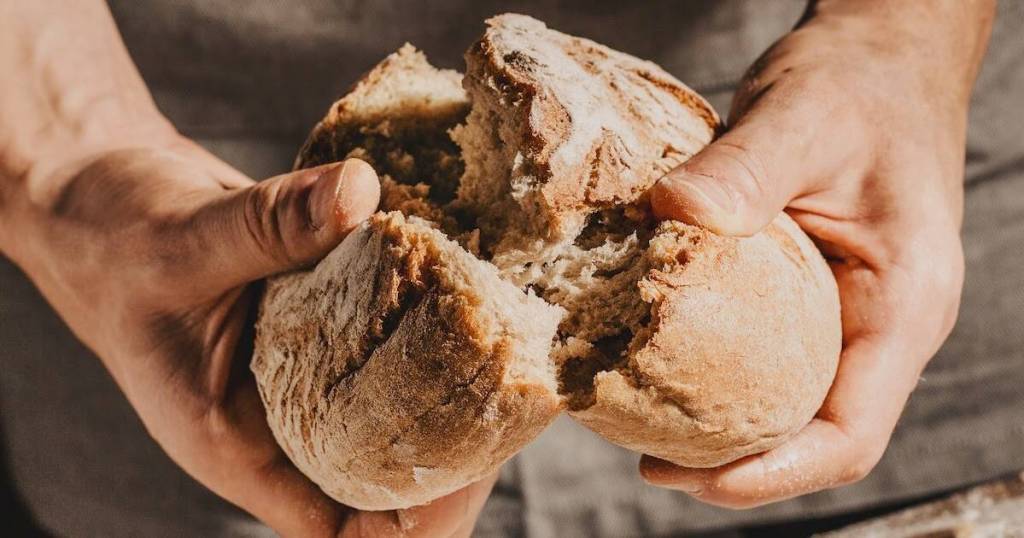
We need to listen to Jesus, who tells us very carefully and continuously in the readings we’re lingering over at this time to Believe in me, Learn from me, or even Follow me. We notice he doesn’t bother with Understand me. He says something far more intimate and provocative when he calls himself our bread. He says, I am the bread of life; come to me and never be hungry or thirsty again.
What’s really at stake in this strange invitation is whether or not to move past religion … and into relationship. Past thought … and into communion. Past self-sufficiency and … into radical, whole-life dependence on a God we can taste, but never control. Jesus invites the crowds to recognize the hungers beneath their hungers. Of course they’re hungry for literal bread; they’re poor, food is scarce, and they need to feed themselves and their families. There’s nothing wrong or ‘unspiritual’ about their physical hunger — remember, Jesus tends to their bodily needs first, without reservation or pre-conditions. But he doesn’t stop there. Instead, he asks the crowds to probe the deeper soul hungers that drive them restlessly into his presence — hungers that only the “bread of heaven” can satisfy.
What are those underlying hungers? Answering for myself, here’s my list: a hunger for meaning and purpose. A longing for connection, communion, and love. A desire to know and to be known, deeply and authentically. A hunger for joy, and for engagement with the world in all its complexity, mystery and beauty. And an ongoing need for healing, wholeness and fullness of life.
That’s my list right now. What’s yours?
And so importantly at this time, what hunger would our Abuse Survivors (highlighted in the Royal Commission of Inquiry into Abuse in Care) want satisfied? A hunger to be heard? A hunger for justice, a hunger to be believed, a hunger for wrongs to be put right, a hunger for apology and words of regret, a hunger for wholeness and healing … mostly, I sense, a deep cry from these abused hearts of a hunger to see change: no more, no more, no more!

Of course, it’s one thing to name our hungers, but quite another to trust that Jesus will satisfy them; especially if you were one of over 200,000 men, women and children who believed they were in a place that would love, help, cure, educate and nurture them only to find that – whilst the love of Jesus may have been preached – the bread they received in the name of God was in fact as worthless as dust, a rod for their back. Their experience instead brought a sense of worthlessness, brokenness and, in some cases, death.
We as a country are in a time of mourning, or should be, for our failure to provide a safe, caring and nurturing environment for all those who have a right to expect and to receive such care. It is a nationwide shame. At least fifty children have been killed since Oranga Tamariki was created – and half of them had a record with the agency before they died. According to UNICEF, New Zealand has one of the worst rates of child abuse in the developed world. The level of abuse is the fifth-highest in the OECD, with an average of one child being killed every five weeks and 150,000 cases reported every year by Oranga Tamariki. On average 50,000 women and children are referred to Women’s Refuge each year, and staff answer 71 crisis calls each day. And, as more than 67 per cent of family violence goes unreported, the figures do not show the full severity of the situation. What can we do?
We can listen. We can be active in our listening and be prepared to seek help when someone is in danger. We may not be able to help ourselves but we can bring it to the attention of someone who can. The worst thing we can do is … nothing!
There are many different kinds of abuse and many helplines are available. (There is a large list at the back of the church.) If you think someone is in immediate danger of being harmed or may harm themselves, call the Police.
We can support financially some of the (helpline and support) groups. We can pray for them all. Dear Family, it is right for us to mourn, to grieve with those who have lost so much. And it is well and truly time for change. Jesus came to change. Will we be changed? We know that the words Jesus brings are the bread of life. But we must remember they are words we live by, not words we use to make others live the way we feel they should. The bread of life Jesus brings fulfils all hunger, and so fed by the one who God sent, our belief overflows as love and becomes the Word in action – His will, His actions, not ours. May we absorb this bread. Then share it.
May its nourishment flood us through and through until we are changed and, like Jesus, become life-saving bread for the whole world.

 stfrancischurchtairuanz