by Megan Means
(Based on Ps 51:1-12)
Psalm 51 was written after King David’s transgressions in the taking of Bathsheba and sending her husband and his soldiers to die in frontline of the battle.
So, how many notable mistakes might we have made this week and even this morning?! Anyone make a really big mistake and want to confess?
We are in the best place to do this.

I had a gut wrenching incident at the beginning of Lent. It took me low and I had to work through it. It happened on a Thursday, so I had to carry it until Monday! My principle was ok, in my opinion, but not so much the opportunity I took to deliver it. I took my time with careful consideration about why I was attempting to do this, as it was an opportunity to be heard and it was for the persons concerned to understand that things are not the way they talk about them. Also I was really aware of who I was doing this for, which was not myself.
I felt as if I was a plant that had been cut down.
My apologies followed and it all worked out, with some slight improvements. However I gave myself quite a reflective jolt that I had not anticipated; but that can happen in the life of emails!
I guess I was spitting out to myself “Create in me a clean heart, O God, and put a new and right spirit within me”, just like David. Psalm 51 is an individual lament in which there is a single psalmist voice speaking about a man who is crying out to God for deliverance from what he felt was a life-threatening situation.
The Psalmist records David’s confession of his sin and his pleas to God to have mercy, to ‘blot me out, to wash and cleanse me’ from “my transgressions”, “iniquity”, and “sin”. David had made a big mistake against God and against humanity. Against his family, friends, staff, and community.
The root meaning of transgression is ‘to go against, to rebel’, iniquity means ‘to bend, to twist’, and sin means ‘to miss a mark’. They are all words that really acknowledge the gravity of a situation and are well suited for us all to contemplate in this Lenten season.
And while we are on mistakes, there’s a big theological misinterpretation in this psalm. This is one of the most misinterpreted verses in the Old Testament, in my and many scholars’ opinion. David is in the depths of remorse, absolutely gutted, and he is personally declaring that his ‘missing the mark’ feels as though it is all part and parcel of his conception and birth, since he did something so wrong!
Many interpreters have understood and used these words to reflect the concept of ‘original sin’, a depraved nature that is intrinsic to every human being, which was passed down to us by the first human pair. Of course, you will have your own theological understanding and may very well hold to the ‘original sin’ doctrine (formed by Augustine of Hippo in the third century). However, a more plausible interpretation, is that within the psalm it is expressing with these words the all-encompassing quality and quantity of the guilt that accompanied David’s sense of wrongdoing.
Yet the psalm, rather than dwelling on transgression, guilt and wrongdoings, turns its focus towards a God who delights in truth, who bestows wisdom and seeks the creation of a clean heart, with a right spirit placed within. Out of the depths of total remorse, David longs to be forgiven in some way and to hear joy and gladness and be able to rejoice and be renewed.

Consequently he requests a few things of God to assist in his renewal:
David longs for inward purity with a clean heart, with pure thoughts, pure emotions, and pure motives. He wants to gain a deeper strength of character. David has felt some of his weaknesses and vulnerability and wants to be strengthened so that he might be established in the ways of righteousness. He desires to be blessed and he knows that this type joy and happiness can only be experienced from being in fellowship with God. He wants to be restored knowing the joy of God’s salvation and he finally desires to be sustained in his walk with God, with a strong desire to do things the right way.
With these requests, then, he commits himself to a life of service and, eventually, he gains an interest in the people around him. David becomes willing to move beyond his own problems towards thinking of others. Sometimes our wrongs paralyse and consume us. We don’t want to think of others, we just want to lick our own wounds and sink into ‘woe is me’. I know in my experience that it really took an effort to concentrate on the meetings with others, before Monday finally arrived.
David experienced that with forgiveness there was a restoration to usefulness again. David believed God and accepted that he was forgiven, and could then turn his mind to others’ needs.

Likewise, the season of Lent is about attending to what needs to be done and reflecting on past experiences. Some mistakes may have been committed against God, against humanity, against our family, friends and community. Lent is a time to be honest with ourselves, access what changes need to happen in our own lives, try to make our world a better place and to stretch and grow spiritually. Lent is meant to be a time out of time; a piece of life dedicated to rethinking. It’s time to ask where we were last year at this time and where we are now. Or, most of all, where we want to be? And what do we need to do to get there? Lent calls us to take the space and time we need to make the changes in life that we need. It’s about plotting our own renewal into a more placid, a more regular, a less hectic self. It’s about sinking into the kind of personal reflection that brings us to confront the self for which we seek. Lent is not a spiritual competition, a kind of ‘no pain, no gain’ exercise of the soul. Lent is the time to renew the best in us. It is a summons to live anew and be refreshed.
The process that David followed in Ps 51 aligns well with a Lenten season and it is also the liturgical process we follow every communion service. David sinned big, repented big, and the Bible remembers him (in 1 Samuel 13 and Acts 13) as “a man after God’s own heart”.
Our mistakes may not be as public as David’s, but we all fall short of living well, in the steadfast love and mercy of God.
David of ancient Israel petitioned for the creation of a pure heart, and the renewal of a right spirit within himself. If these words were fitting for him then, then they are just as fitting for us in this twenty-first century.
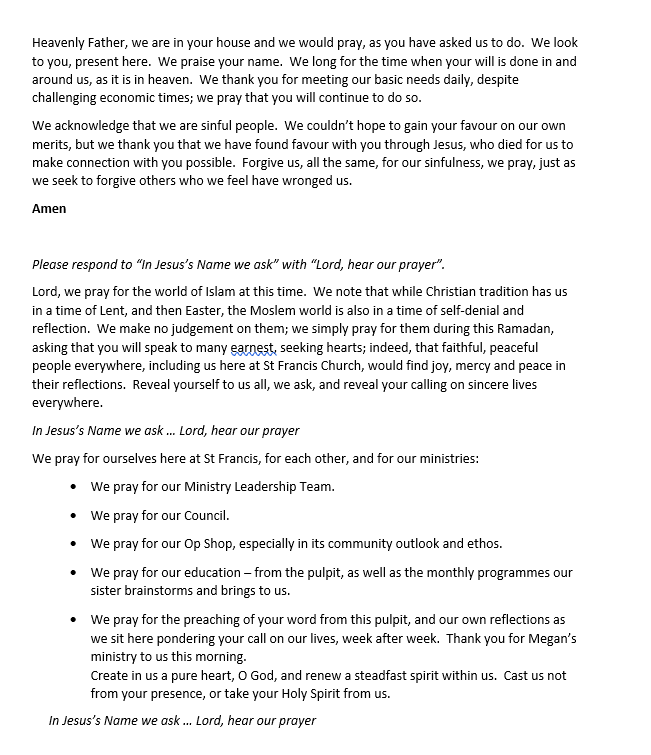
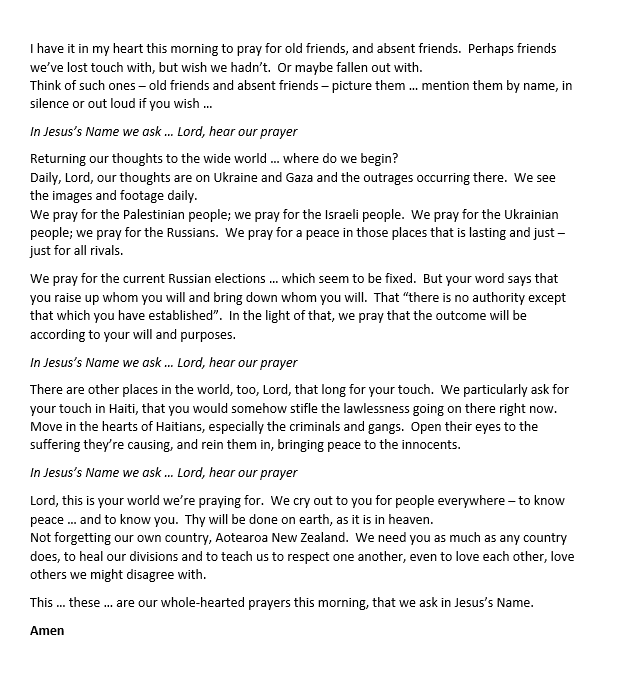
[Editor: Megan has asked that the intercessory prayer from the Lenten service at which she delivered this reflection accompany this post. The script of that prayer follows …]
 stfrancischurchtairuanz