by Pat Lee
(Based on John 2:13-22; 1Corinthians1:18-25)
John, in this Gospel, records the event we’ve just heard after the wedding at Cana, where Jesus turned the water into wine, and just before Passover. But Matthew, Mark and Luke record the same event as happening closer to the crucifixion, apparently the final public act of Jesus in these three Gospels, and the ‘last straw’ for the authorities in making the decision to kill Jesus.
However, the final decision to kill Jesus in John’s gospel comes after the raising of Lazarus from death, so there seems to be a difference of opinion about the timing of these events. We are not told which is right … but they do confirm that the clearing of the temple happened, and when is not important in this reflection.
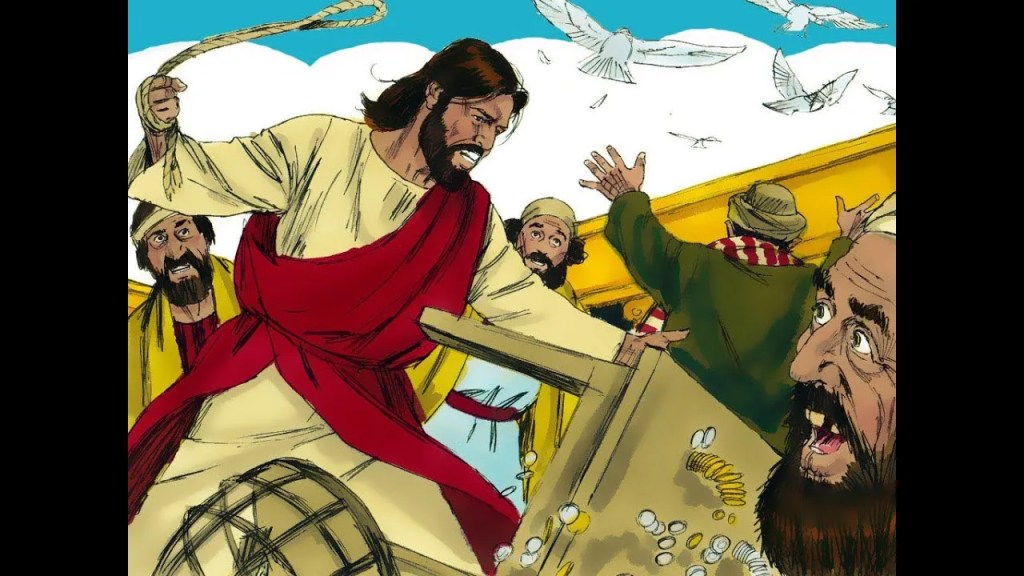
I make no apology for using an extract from a reflection (written by a Michael K. Marsh), because I think he sees more in this event than most of us have thought about before.
The author writes, “What do you think of the table-turning, animal-driving, whip-carrying Jesus? What do you imagine set him off that day? And what do we do with this story?
There was a time when I heard this story as being mostly about anger. Jesus got angry. I get angry. So it’s ok to get angry if you’re angry about the right thing. Maybe, but I think there is more to this story than that. I wonder if what we see Jesus doing might not be an expression of his deepest compassion for life, for the temple, for you and for me.
There was a time when I thought Jesus was upset about the animals and the money changers being in the temple. Maybe, but again I think there is more to this story than that. I don’t think Jesus was surprised by the animals and the money changers. He grew up as a faithful Jew going to the temple. He didn’t show up this day and say, ‘Wow! There are animals and money changers in here. I didn’t know that. This is wrong.’
The animals and the money changers had always been there. ‘Business as usual’ meant changing Roman coins to temple coins, purchasing an animal, and offering a sacrifice. I think the ‘business as usual’ is the issue. The animals and the money changers are not the problem. They are the symptom that something else is going on.
“I think that Jesus went to the temple that day for one purpose and one intention: to throw out and overturn business-as-usual.
There are times when we need the tables of our lives overturned and the animals thrown out. It’s just so easy to fall into the trap of business as usual.
“Haven’t there been times in your life that business as usual was leaving you spiritually bankrupt, or you were just keeping on keeping on but nothing was changing? Business as usual can happen in friendships, marriages, parenting, work, or church.
There are many reasons and ways in which we fall into business as usual. There’s one thing, however, that I keep coming back to. Forgetfulness. Business as usual is born of forgetfulness.
It happens every time we forget the original beauty of creation, when we forget the God-given dignity of humanity, ours and others, when we forget that we have been created in the image and likeness of God, when we forget that after creation ‘God saw everything that he had made was very good,’ when we forget the grace and possibilities bestowed upon us at our baptisms, when we forget that ‘the Word became flesh and lived among us’, and when we forget that we have all received grace upon grace.
“When we forget that we are the temple of God, the very residence of God, life can easily become a series of transactions. Relationships and intimacy are lost. Priorities get rearranged. Making a living replaces living a life, and the life we have becomes a marketplace rather than a place for meeting the holy in ourselves and one another.
“That’s what Jesus is overturning and driving out of the temple. Here’s why I say that. When the authorities ask for a sign from Jesus for what he is doing he says, ‘Destroy this temple, and in three days I will raise it up.’” [End of Marsh’s excerpt.]
The authorities don’t understand. They are thinking of a stone and mortar temple, but Jesus is talking about a flesh and blood temple, the temple of human life, his life. ‘In three days’ makes us think of what happened ‘on the third day’, the resurrection, a new life, a new beginning, a rebirth.
We have the benefit of knowing from God’s word that this story is prophetic, and came true, but the disciples didn’t know that at the time this event was happening.
The authorities, who were considered to be the wise ones of the time, were confused by Jesus’s words. The reading in 1 Cor 1:18 says, “For it is written: I will destroy the wisdom of the wise; the intelligence of the intelligent I will frustrate.” And that is exactly what Jesus did when the authorities asked him for a sign.
The disciples didn’t understand either, at first. It wasn’t until after the resurrection that they remembered what he had told them would happen, when he had said the words, “Destroy this temple, and in three days I will raise it up.” Then they believed the Scripture, and the words that Jesus had spoken.
Do you believe the words that Jesus spoke?
Last week we looked at the story of the transfiguration. God spoke from the cloud saying, “This is my Son, the Beloved. Listen to him.”
We need to believe the Scriptures ourselves, and listen to what Jesus is saying to us.
 stfrancischurchtairuanz