by Barry Pollard
(Based on Mark 1:1-8; Isa 40:1-11; 2 Pet 3:8-15)
On this second Sunday of Advent, with its focus on peace, I am going to be looking at the man, John the Baptist, who, I imagine, had far from a peaceful existence.
I admit from the outset that I have struggled to find “takeaways” from today’s readings, those hints to action that we like to ponder following a time of grappling with Scripture. In fact, today’s reflection may just be a whole pile of questions: let’s see.
John the Baptist, sometimes referred to as John the Baptiser, was a preacher active in the area of the Jordan River in the early first century AD. He is also known as Saint John the Forerunner in Eastern Orthodoxy, John the Immerser in some Baptist Christian traditions, Saint John by certain Catholic churches, and even gets a mention in Islamic literature (according to Wikipedia). And, if you are a follower of The Chosen, he is called Crazy John by the disciples!

John and Jesus were relatives. John’s mother Elizabeth is recorded as being a cousin of Jesus’s mother Mary. I imagine that family ties were such in those days that they likely grew up together. I imagine that they would have been quite familiar with each other. And, I wonder if they each had inklings about their own or each other’s destinies.
In several ways John was similar to Jesus. Both had miraculous births. As we journey through Advent our focus is the arrival of the Christ-child, and we are pretty familiar with that miraculous story. But John the Baptist too had a miraculous birth. Luke 1:11-17 tells of the revelation of the angel Gabriel to Zechariah, John’s father. Zechariah and his wife Elizabeth were advanced in years and were childless:
While Zechariah was in the sanctuary, an angel of the Lord appeared to him. Zechariah was shaken and overwhelmed with fear when he saw him. But the angel said, “Don’t be afraid, Zechariah! God has heard your prayer. Your wife, Elizabeth, will give you a son, and you are to name him John. You will have great joy and gladness, and many will rejoice at his birth, for he will be great in the eyes of the Lord. He will be filled with the Holy Spirit, even before his birth. And he will turn many Israelites to the Lord their God. He will be a man with the spirit and power of Elijah. He will prepare the people for the coming of the Lord. He will turn the hearts of the fathers to their children, and he will cause those who are rebellious to accept the wisdom of the godly.
So, Gabriel foretold the birth and life of John the Baptist. And John did grow up to do all that Gabriel said he would.
John was also similar to Jesus in that they both taught others. In a sense, John taught the introduction to the Advent story and Jesus completed it.
John however was different. He chose to hang out in the wilderness, wearing crude clothes made from camel hair, and eating local wilderness fare – locusts and honey are recorded as favourites. His central message to those seeking and following him was the repentance of sin by baptism in water. So a natural place for John to be found was the banks of the Jordan River.
John the Baptist was humble, he was diligent, and he wanted to prepare people for the coming of the Messiah. He taught people what it meant to be a good person, and helped people start their personal journeys to becoming better people. Part of the journey included baptism with water for repentance. But most importantly, he preached of Jesus!
His work was not aimed at having people join the Church of John the Baptist. His work was preparing people to follow Jesus. Not only did John do good things and encourage others to do better too, but he recognised that whatever goodness he put into the world through his actions would absolutely pale in comparison to the good Jesus would do.
Our Old Testament reading today is one of Isaiah’s amazing prophecies, announcing that the Messiah would be heralded by the voice of someone shouting:
“Clear the way through the wilderness for the Lord! Make a straight highway through the wasteland for our God! Fill in the valleys, and level the mountains and hills. Straighten the curves, and smooth out the rough places. Then the glory of the Lord will be revealed, and all people will see it together.”
And lo! As Mark reiterates in his Gospel, referring to the imminent arrival of the Messiah, “Look, I am sending my messenger ahead of you, and he will prepare your way. He is a voice shouting in the wilderness, ‘Prepare the way for the Lord’s coming! Clear the road for him!’”
I’ll read that bit again: “Look, I am sending my messenger ahead of you, and he will prepare your way. He is a voice shouting in the wilderness, ‘Prepare the way for the Lord’s coming! Clear the road for him!’”
I read this as God the Father announcing that He was sending the messenger ahead of Jesus to prepare the way. So the voice shouting in the wilderness is John, who is calling out, “Prepare the way for the Lord’s coming! Clear the road for him!”
Who is he calling out to?
I don’t know about you but when I am reading Scripture and Israel is mentioned – often negatively: sinful, unseeing, unhearing, and so on – I substitute “Barry”. You might be surprised how many times the sin being attributed to Israel matches mine! Or maybe you won’t.
If Israel is being exhorted by John to prepare the way for the Messiah then we should take note. But what could constitute preparations for the Messiah?
The fact that John was offering water baptism to show that those being immersed were repenting, being washed clean of their sin and turning to God, is a good starter. Remember we have heard many times that Jesus was concerned with our hearts. A change and softening of hearts leads to eyes being opened and ears unblocked. So being publicly and ceremonially washed clean is a great indication that the ‘dip-ee’ is preparing for transformation, ready for that change of heart.
Isaiah said, “Make a straight highway through the wasteland for our God! Fill in the valleys, and level the mountains and hills. Straighten the curves, and smooth out the rough places.” Can you think of the places in your life that need straightening, filling in and levelling? What about the rough places? I certainly can! See, these instructions are still for us.
John the Baptist attracted a large and loyal following. He was initially mistaken as Messiah by many in the crowds he attracted. Several of the disciples of Jesus were initially followers of John. So you can see that he was having a huge impact on those who listened to and followed him, all the while trying to point ahead to the coming Messiah!
To fully appreciate John’s impact, it is worthwhile delving into the account in Matthew’s Gospel (Chapter 11) when John was imprisoned. Hearing all the things Jesus was doing from afar, John sent his disciples to ask Jesus, “Are you the Messiah we’ve been expecting, or should we keep looking for someone else?” Jesus told John’s disciples to ‘report what they had heard and seen; the blind seeing, the lame walking, those with leprosy cured, the deaf hearing, the dead raised to life, and the Good News preached to the poor.’
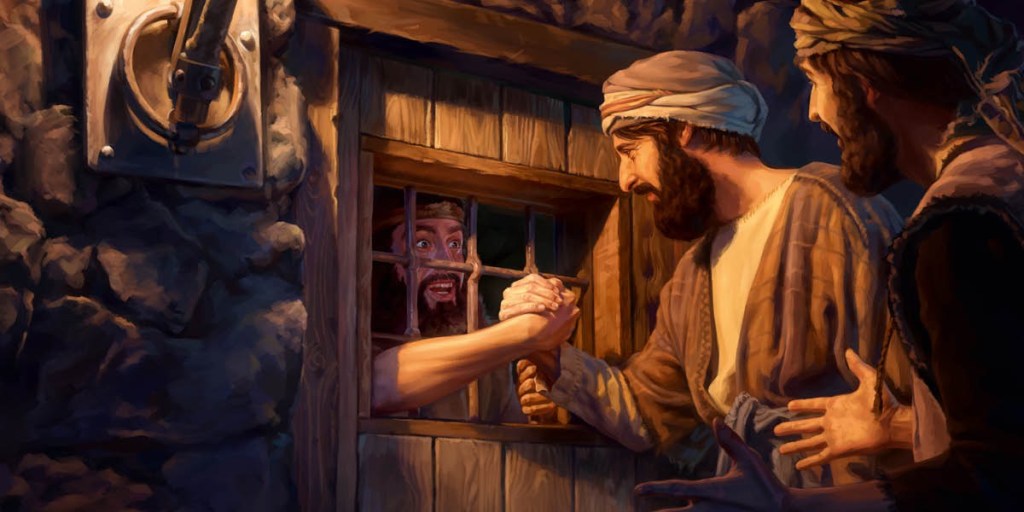
As John’s disciples were leaving, Jesus began telling the crowds about John. “What kind of man did you go into the wilderness to see? Was he a weak reed, swayed by every breath of wind? Or were you expecting to see a man dressed in expensive clothes? No, people with expensive clothes live in palaces. Were you looking for a prophet? Yes, and he is more than a prophet. John is the man to whom the Scriptures refer when they say, ‘Look, I am sending my messenger ahead of you, and he will prepare your way before you.’
“Of all who have ever lived, none is greater than John the Baptist!”
That is some impact!
When I read today’s alternative Collect:
God, for whom we wait and watch, you sent John the Baptist to prepare for the coming of your Son: give us courage to speak the truth even to the point of suffering. This we ask through Christ our Saviour. Amen.
I note that its author has focused on John’s truth telling, the cause of his imprisonment and eventual demise, as a key element that we can take away from today’s reading. This prayer, which we would have all “amened” I’m sure, should lead us to straightening, filling in and levelling our lives, and sharing that experience with others.
Speaking truth is often the hardest thing to do!
How then are we going to prepare the way for the Lord’s coming this year?
The Prayer of Confession in Advent is a great place to start our rethinking:
O God, you search us out and know us,
and all that we are is open to you.
We confess that we have sinned:
[This is our admission that we are disposed to transformation.
Are you disposed?]
When we long for your coming to change the world,
and yet are unwilling to change even our own hearts:
When we reduce our preparation for your coming
to reckless expense and trivialities …
[These are examples of our shortcomings.]
Are we going to continue to be stubborn and worldly? Or is there a better way for us?
In the New Testament reading, Apostle Peter was reflecting on things that are to come. He was perhaps cognisant of the words of Mark’s account of John the Baptist’s work. He stated that the Lord is patiently waiting for us all to have the change of heart He seeks. Whether it is a day or a thousand years, He is waiting. Peter tells us that the world we know is going to noisily end and judgment will be passed on it. His exhortation is that while we wait, because we don’t know when this will occur, we should lead peaceful and righteous lives. Another prompt to examine how we are living, I think!
And, if you think about it, God is pretty generous! Think about how much time we have been given to come to our senses and turn to him. Think about how many opportunities we have been given to repent of our old ways. Think about how many piercing examples we have been given to model our lives on.

So the season of Advent isn’t just four Sundays focusing on candles (the candles of hope, peace, joy and love). Collectively it pulls us up and has us rethink how we live, how we interact with each other, and how much better things can, and should, be.
Let’s use our time wisely this season. Let’s prepare our hearts for the full acceptance of what Jesus came to bring.
Let’s accept that baptism of the Holy Spirit that fills our mind with a genuine understanding of truth, takes possession of our abilities, and imparts gifts that qualify us for service in the body of Christ. Amen?
 stfrancischurchtairuanz